

Last week, two markets looked at Robinhood and responded positively, although they were focused on different parts of the same developing ecosystem. Traditional equity investors concentrated on Robinhood’s improving ability to monetize its customer base. Crypto investors focused on the economic activity emerging across the infrastructure supporting Robinhood Chain. A separate Wall Street Journal story, describing individual investors beginning to use AI agents to manage portfolios, added a third piece to the picture.
These developments have been discussed separately. Taken together, they point toward a broader transition in financial market structure as traditional assets, programmable settlement and autonomous software begin to converge.
Morgan Stanley upgraded Robinhood to Overweight and raised its price target from $124 to $150. The thesis centered on monetization. Robinhood now operates 13 business lines generating at least $100 million of annualized revenue, while assets per customer continue to rise. Traditional coverage emphasized retirement accounts, credit cards, banking, advisory services, prediction markets and lending, products that deepen engagement with an installed base of 28.5 million funded customers and approximately $355 billion of platform assets. The shares rose roughly 17% during the week through September 4.
At the same time, a different Robinhood story was attracting attention in digital-asset markets. Robinhood Chain generated a record $3.75 million of fees on September 1. Decentralized-exchange volume approached $1.6 billion during the day, DeFi deposits approached $750 million, and stablecoin balances were near $800 million. Assets tied to the underlying ecosystem moved sharply. Arbitrum rallied as investors focused on the economics flowing through its infrastructure stack, Uniswap rose alongside decentralized trading activity, and tokens associated with issuance and derivatives infrastructure repriced as well.
For many traditional equity investors, much of that paragraph will sound like a foreign language. Arbitrum, decentralized exchanges, DeFi, stablecoins and onchain fees are still outside the vocabulary used to analyze a brokerage stock. That is precisely why these numbers matter. Think about what happened with ChatGPT. Artificial intelligence had existed for decades, but ChatGPT brought it into daily life so quickly that we stopped thinking about AI as a separate technology and started thinking about what we could do with it. Along the way, every portfolio manager learned a language that did not exist in their vocabulary three years ago: tokens, inference, context windows, agents, MCP, OpenClaw, reasoning models. Nobody chose to learn it. The market forced it, because you could not analyze Nvidia, Microsoft or a utility without it. The same thing is now happening with the vocabulary of the digital-asset world, and a similar boundary is beginning to disappear between traditional finance and onchain finance, even though investors still analyze them as separate markets. I call this the Merge, borrowing a word crypto readers will recognize from Ethereum’s 2022 upgrade, though I mean something broader: the merger of traditional assets, programmable rails and autonomous software into one system. Robinhood is becoming an unusually clear place to watch it happen in real time.
The equity market was valuing Robinhood’s distribution and customer monetization. The crypto market was valuing portions of the financial infrastructure forming underneath that distribution. These may prove to be different expressions of the same transformation.
Understanding the Economics
The first distinction investors need to make is that Robinhood Chain’s headline fee and volume figures represent ecosystem activity rather than revenue attributable solely to Robinhood. This is why in my weekend video I highlight the crypto ecosystem for my 46-name index. Several participants provide the services necessary for the network to function and each collects a different part of the economics.
Robinhood operates the chain and controls the customer relationship. Arbitrum provides part of the underlying blockchain technology. Ethereum provides the settlement layer, while ETH serves as the gas asset. Decentralized exchanges, lending protocols, derivatives venues and other applications generate fees according to the activity occurring within each protocol. Under the Arbitrum Expansion Program, for example, 10% of net protocol revenue from participating chains flows back to the Arbitrum ecosystem, and those licensing fees were already about 35% of ArbitrumDAO’s July income, Robinhood Chain’s first month on mainnet.
This is an early illustration of how value can be distributed across an onchain financial stack. A single customer relationship can create economics for the brokerage, chain operator, infrastructure provider, trading venue, credit protocol, oracle network and settlement layer. Different equities and tokens therefore represent exposure to different portions of the same underlying activity. Robinhood has not yet disclosed enough for investors to isolate its direct chain economics, although some sell-side analysts have begun incorporating the chain into longer-term forecasts alongside perpetual futures and prediction markets.
The size of the prize is easier to describe than to measure. A brokerage today earns money from trading activity, cash balances, financing, securities lending and subscriptions, roughly $187 of annual revenue per Robinhood customer. Most of the $355 billion on the platform earns the company nothing beyond custody, because a share of stock in a brokerage account does very little between the day it is bought and the day it is sold. Tokenization changes what that share can do. If even a small fraction of those assets begins working as collateral, lending inventory or a hedging input on programmable rails, the economics attached to them would rival the largest business lines Robinhood has today. The opportunity is not a new trading fee. It is monetizing assets that have been economically idle since the brokerage industry was invented.
This is why it is a structural change rather than a product launch. Uber did not build a better car or a shorter trip. It changed the technology that matched riders with drivers and put idle cars to work, and within a few years a New York taxi medallion that had sold for more than a million dollars was worth a small fraction of that. The drivers who adjusted moved onto the platform. The owners who assumed the license was the moat did not. The medallion of the securities industry is the friction of custody and settlement, the reason a share can do only one thing at a time and every additional function requires another intermediary. Programmable rails remove that friction, and a business built on friction has to adjust whether it wants to or not.
Incumbents appear to understand this, which is why the adoption pattern looks like AI rather than a normal financial product cycle. After ChatGPT, no bank or brokerage could wait for a proven use case, because the cost of a pilot was trivial and the cost of being late might have been existential. Tokenization is producing the same behavior. BlackRock runs a tokenized fund, JPMorgan operates a blockchain unit, Nasdaq and DTCC are moving toward tokenized securities, and Morgan Stanley and Schwab are adding crypto. None of them is waiting for the CLARITY Act. Legislation will shape the rules and the pace, but the race began the moment the technology proved it could carry the assets, and no one in the industry can afford to finish it last.
The September 1 activity therefore matters less as an annualized revenue extrapolation and more as evidence that meaningful economic activity can occur on programmable rails connected to an established brokerage distribution network. The durability and composition of that activity will determine its significance.
Distribution Is the Scarce Asset
Blockchain networks can offer efficient technology, but financial networks ultimately require customers, assets, liquidity and trust. Robinhood already has all four.
Consider the traditional lifecycle of a retail equity position. An investor deposits $10,000 into a brokerage account, buys Nvidia shares and holds them in custody until the position is sold. A substantial institutional infrastructure surrounds that transaction, including exchanges, clearinghouses, custodians, securities lenders, banks and prime brokers. For the end investor, however, the position remains economically passive for most of its holding period.
Tokenization changes the functional characteristics of the asset. A tokenized security can serve as collateral, support borrowing, participate in lending, be hedged through derivatives or interact with other financial applications through common programmable infrastructure. The same $10,000 Nvidia position could support a loan, allow the proceeds to be deployed elsewhere, maintain a hedge against part of the original exposure and later be reallocated as conditions change. Assets that currently spend most of their life sitting in custody become usable financial inventory.
This blurs the analytical boundary between an equity platform and a crypto network. Robinhood controls distribution and operates the chain. Issuance platforms create new assets and markets. Decentralized exchanges provide liquidity. Credit protocols support borrowing and lending. Derivatives venues provide hedging and leverage. Oracle networks supply machine-readable pricing. Arbitrum provides blockchain infrastructure, and Ethereum supports settlement and gas. The customer sits at the top of this stack, and one pool of capital can create economic activity across every layer. For investors, the question becomes which security provides exposure to which toll point and how large each pool can become.
Machine Brains on Human Rails
The Wall Street Journal story on AI agents provides a clue about the demand side of this transition. The Journal profiled individual investors already using AI tools such as Claude and Codex to build agents that analyze portfolios, monitor markets and execute strategies. Some users run multiple agents with distinct responsibilities and let them operate throughout the day.
Mainstream analysis naturally views this as the democratization of quantitative investing. Individuals can use software to perform tasks that once required teams of analysts, programmers and traders. That alone is significant. The deeper question concerns the financial infrastructure these agents are being asked to use.
Agents are increasingly capable of operating continuously, while much of the financial architecture underneath them remains organized around human workflows. U.S. equity markets have defined trading sessions. Custody, settlement, financing and collateral management occur through separate institutions and ledgers. Sophisticated institutions can navigate those systems, although doing so requires substantial infrastructure, legal agreements and operational coordination.
The first phase of agentic investing therefore looks familiar: software researches securities, constructs portfolios and executes trades through existing brokerage rails. Robinhood is already there, with agentic trading capabilities that let AI systems interact with customer accounts within defined budgets and guardrails.
The larger opportunity emerges when agents can manage the asset itself across multiple financial functions. A tokenized security could operate simultaneously as investment exposure, collateral, a lending asset and an input into a hedge. An agent could continuously compare borrowing rates, yields, liquidity and hedging costs and decide how to deploy the same pool of capital across those functions within one programmable environment.
That matters because autonomous software has a different operating cadence from human investors. A person may rebalance monthly, borrow occasionally, move cash after a rate change or add a hedge after a large market move. Software can evaluate those decisions around the clock. As the number of financial decisions that can be automated increases, so does the value of continuously available, machine-readable infrastructure.
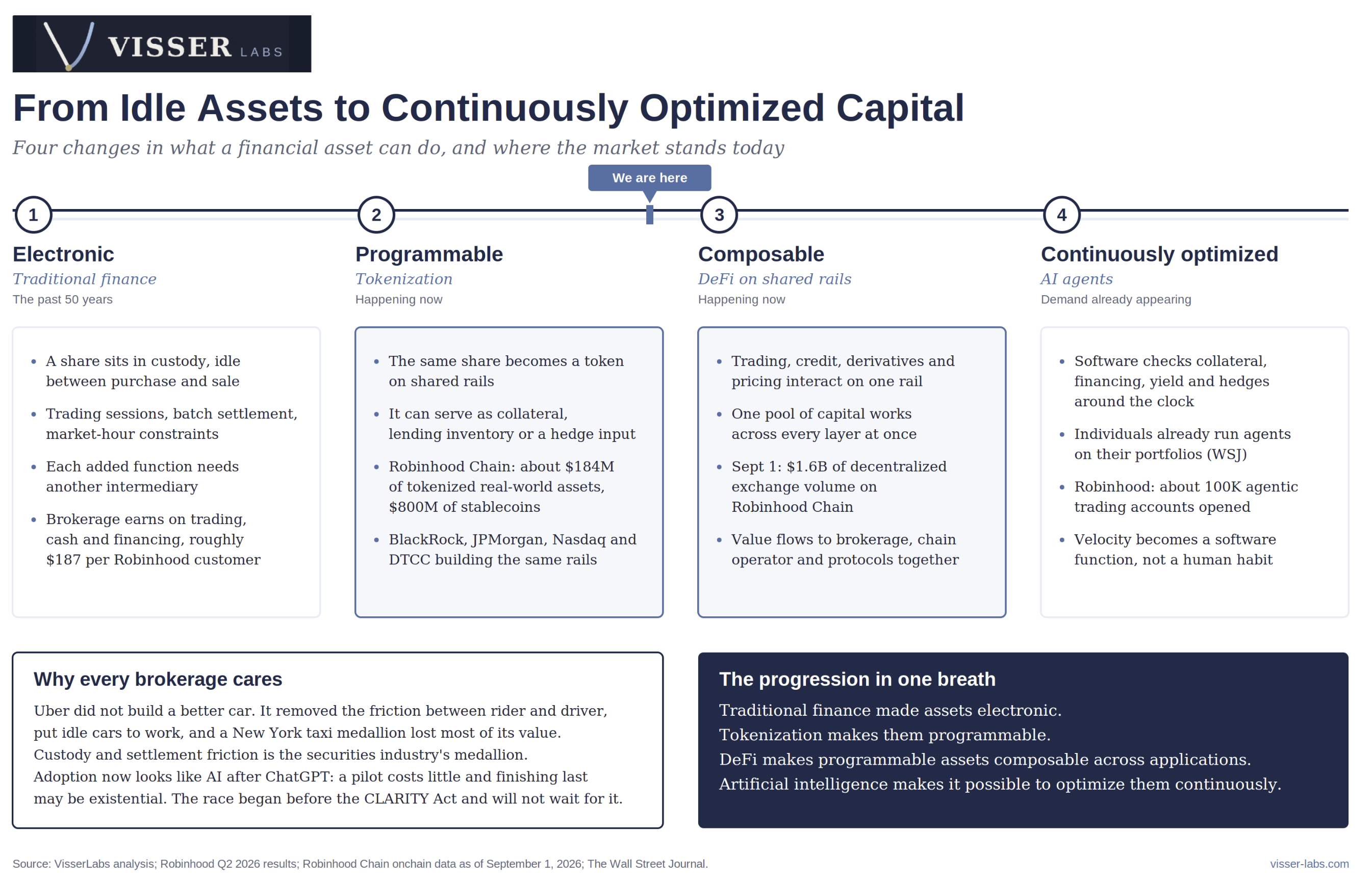
The progression is a sequence of changes in what a financial asset can do.
Traditional finance made assets electronic. Tokenization makes them programmable. DeFi makes programmable assets composable across applications. Artificial intelligence makes it possible to optimize them continuously.
Financial velocity becomes partly a software function rather than solely a human decision, and the productive use of capital rises because assets can move between investment, financing and risk management with far less friction.
The Journal story is the demand-side signal: autonomous capital allocation is already appearing at the user interface. Robinhood Chain is an early attempt to build the programmable infrastructure that could eventually sit underneath it.
The Platform Analogy
Robinhood’s opportunity has useful parallels with the platform economics that developed around the smartphone. Apple created an ecosystem around a device consumers already trusted, then opened that ecosystem to outside developers who built applications Apple could never have produced on its own.
Robinhood is pursuing a comparable model in financial services. It already has funded accounts, customer relationships, identity infrastructure and substantial assets on its platform. By placing more financial activity onto programmable rails, it can create an environment in which outside developers, liquidity providers and financial protocols build additional services around the same customer base. The application remains the distribution interface, while the assets inside the account become inputs into a broader financial ecosystem.
A technically sophisticated blockchain without customers or assets is an empty marketplace. Robinhood begins from the opposite position, and the opportunity is to increase what its existing assets can do.
What Would Confirm the Thesis
The evidence is encouraging, although the next two to four quarters will be more informative than one week of price action. Much of Robinhood Chain’s early activity is crypto-native and speculative. That activity demonstrates the capacity of the infrastructure, but sustained institutional relevance requires broader adoption across tokenized traditional assets.
Several indicators will help. Tokenized real-world asset balances on Robinhood Chain, currently around $184 million, should keep growing through periods when speculative crypto activity weakens. The share of decentralized-exchange volume tied to traditional assets, stablecoins and other non-memecoin activity should rise. Robinhood should eventually disclose enough about chain economics for investors to see how network activity translates into company-level revenue and profit.
Competitive behavior will also be informative. An announcement from another major brokerage, custodian, exchange or asset manager that it intends to build similar infrastructure, or to move meaningful assets onto existing programmable rails, would be evidence that the architecture is becoming strategically important across the industry.
The regulatory environment matters equally. The ability of U.S. investors to access tokenized securities, the treatment of custody and settlement, and the rules governing interaction between regulated brokerages and decentralized protocols will set the pace of adoption.
It is also worth naming what would weaken the case. If chain activity fades with the next crypto downturn, if most of the economics continue to accrue to the protocols rather than the brokerage, or if tokenized collateral proves harder to enforce legally than it is to move technically, the thesis would stall at the speculative stage. A useful thesis provides observable milestones, and in this case the transition from speculative volume toward sustained growth in tokenized assets, credit, settlement and institutional participation is the clearest sign that a new financial architecture is gaining traction.
A Potential ChatGPT Moment for the Merge
ChatGPT mattered because it made the implications of artificial intelligence visible to a broad audience. Decades of research preceded it, yet the product gave millions of people direct access to capabilities that had previously been abstract.
Robinhood Chain could play a similar role in the convergence of traditional assets, crypto infrastructure and autonomous software. Its significance would come from bringing several technologies into one environment where mainstream investors can watch them interact with familiar assets inside an established brokerage relationship.
The current scale of tokenized real-world assets remains modest relative to global capital markets. Decentralized trading activity is still driven by speculative crypto demand. Autonomous financial agents are early. Those facts define the current stage of development and provide the baseline from which progress can be measured.
Last week, traditional equity investors repriced Robinhood while digital-asset investors repriced the infrastructure surrounding Robinhood Chain, and mainstream financial media documented individual investors beginning to delegate parts of the investment process to AI agents. These are being analyzed as three separate stories: brokerage monetization, blockchain economics and AI-enabled investing. The opportunity lies in understanding that they are increasingly the same story.
If this progression continues, Robinhood’s largest opportunity extends well beyond becoming a more diversified brokerage. The company could help transform the brokerage account from a place where assets are held into a gateway through which capital is continuously deployed across programmable financial infrastructure.
The ChatGPT moment for the Merge will arrive when tokenization moves from a technology discussed by specialists to infrastructure that traditional investors use routinely. The early signs may already be appearing in three places at once: in brokerage accounts, in onchain activity and in the growing use of autonomous investment software. Investors who have not yet done their homework on the crypto side of that picture are, for the first time, at risk of not understanding a brokerage stock and eventually all businesses as agentic customers replace human customers.

