

Ongoing tit-for-tat strikes between the United States and Iran in the Gulf region, and the continuing more potent enforcement of the U.S. naval blockade of Iran has seen WTI and Brent oil prices creep back up above $90/barrel in recent days, while European LNG prices have gone above €70/MV, and wholesale electricity prices across the major European economies have also risen to levels not seen since early 2023. Material global refining outages from strikes in both the Gulf region and Russia are simultaneously pushing up global refining margins, increasing noticeably end-user diesel prices, and adding to upwards energy price pressures.
This gradual rise in energy prices has not to date, however, yielded any evident shift in the political position of the Trump Administration, which continues to resist entering into a formalized negotiated process intended to bring the conflict to a conclusive close.
This suggests that the current unstable “no war, no peace” equilibrium will continue in the coming weeks, if not months, with fossil fuel prices gradually climbing upwards as Iran continues striking transiting ships at an adequate frequency and the U.S. naval blockade remains in place.
Given where energy prices are already, this makes another ECB rate hike later this month a now very strong base case, and also seems likely to add input to coming monetary decisions in Frankfurt and in both the United States and Japan.
Having tried both full-scale war and on-off economic sanctions in 2026, the Trump Administration has in the naval blockade seemingly found a policy tool that will effectively over time hurt the Iranian regime’s ability to not only continue to financially and militarily support its regional proxies, reconstitute its weapons programs, but also gradually erode its ability to sustain its domestic economy and repressive apparatus.
If sustained over a long period, the naval blockade on its own may therefore go some way to achieve American policy goals vs. Iran. It is Iran’s physical inability to ship crude oil, rather than the recently announced economic sanctions (still not likely to be seriously enforced against major Chinese, Russian or UAE entities dealing with Iran), that may economically constrain Tehran’s future policy options.
Ironically, there is a major risk that the Trump Administration, having now found an effective policy tool in the blockade, will by continuing to refrain from serious negotiations with Iran fail to exploit its new leverage to get a more advantageous diplomatic resolution to the war. Even severe economic pressure alone has a very poor historical record of forcing despotic governments into making dramatic policy changes on issues of core regime survival.
The President’s personal disengagement from the conflict and the Trump Administration’s unwillingness to now, as the blockade begins to bite, seek a “negotiated offramp” risks not only driving Iran to further riskier escalation against the Gulf region, but also shut the door on making real progress on the actually stated most important U.S. policy goal for the war – namely Iran’s nuclear program.
The U.S. Navy has by enforcing the blockade and implementing a major ongoing “transponder off tanker transit operation” succeeded in not only hurting Iran’s economy, but also in securing that enough crude oil has come onto global markets to keep prices at their – still all things considered – relatively low levels.
These successful actions, however, mostly translate into addressing the problem the launching of the war against Iran created – the closure of the Strait of Hormuz – rather than making strategic progress on the original war goals themselves. As the war has also led to the ascendancy of a new Iranian leadership after the slain Supreme Leader Ali Khamenei, addressing the nuclear program will require a potentially lengthy diplomatic process that not only must lead to credible verification of Iran’s nuclear activities, but also must address the risk of the new Tehran leadership politically deciding to move towards full weaponization of Iran’s highly enriched uranium stockpile.
As regime change looks increasingly unlikely to materialize for the foreseeable future, only a broader negotiated agreement with Iran can hope to make progress on this, the main stated reason that the war was launched. The Trump Administration, however, seemingly remains focused on only getting enough oil through the Strait of Hormuz, while hoping against the historical odds that economic pressure will compel a set of dramatic Iranian concessions to get deal quickly. This is not a strategy that can hope to succeed in even the medium-term.
Increasing blockade related economic pressure on Iran and successful interceptions (allegedly by expending a very large number of Patriot interceptors) of Iranian retaliatory missiles against U.S. regional bases may over time instead force Iran towards a gradual escalation against “softer GCC targets” and other regional infrastructure.
This would likely start with still more strikes against the most U.S.-leaning GCC members hosting bases in Kuwait and Bahrain to test if the U.S. will retaliate against such strikes, and more frequent strikes against transiting ships in the Strait of Hormuz.
This is not likely to lead to a resumption of full-scale war, but prolong and hereby increase the economic costs of the standoff on the GCC economies. Just because even quite a lot of oil is “smuggled through the Strait”, normal “non-tanker transits” remain very few and activity in the broader non-oil GCC economic sectors in tourism, real estate, logistical services and much else remain subdued. Iran will hereby seek to expand the economic pain it feels itself from the U.S. blockade to the rest of the GCC, likely in the (small) hope that GCC rulers will weigh on Donald Trump to shift to a negotiated path forward.
Yet, when even the negative political effects of the war on Donald Trump’s mid-term prospects have not shifted his stance, it seems unlikely that such foreign diplomatic pressure will. The strong base therefore remains that the current standoff continues until after the mid-terms, unless unexpected fossil fuel price increases changes currently frozen political calculations on both sides.
This outlook puts the ECB in a monetary policy bind, as it essentially locks in another 25bp rate hike next week. The latest euro area inflation figures saw HICP rise to 3.3 percent in August, driven by energy costs (figure 1), and important energy prices today remain far above assumed levels in the June 2026 ECB Macroeconomic Forecast. The problem for the ECB is not oil prices, which still remain a bit below the $97/barrel assumed in June, but
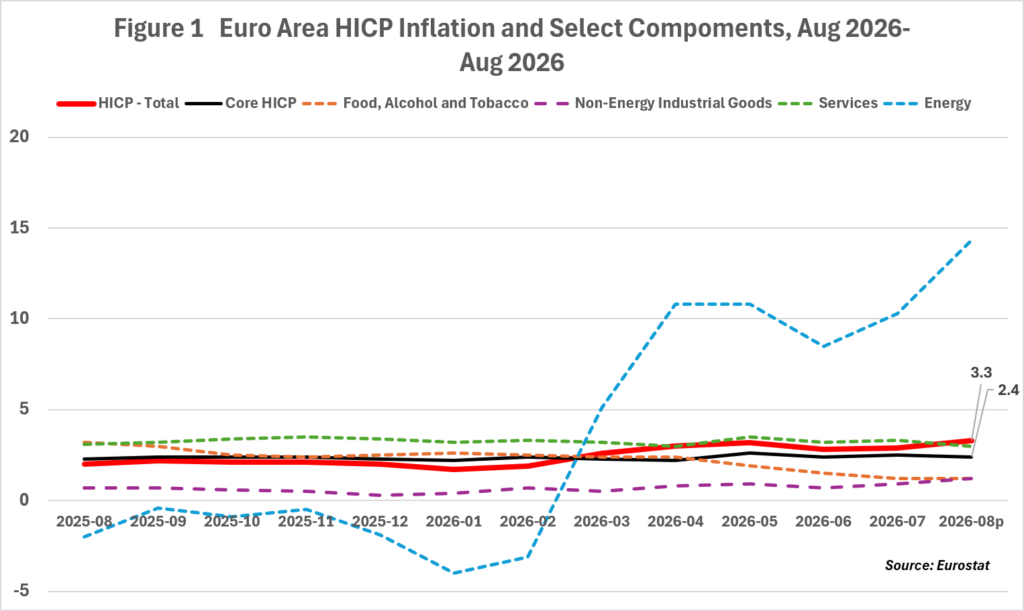
rather natural gas prices, as TFF prices are now more than 50 percent higher than the €45.6/MW then thought likely for 2026. Aggravated by increased power demand due to summer heat across Europe and declines in hydro and nuclear production, wholesale power prices across almost all euro area members by August rose to 30+% above the ECB’s 2026 assumed level of €89.3/MWh.
This is not an energy price development that resembles the shock of 2022-23, but it makes another rate hike next week almost inevitable. Moreover, while the Governing Council and President Lagarde seem certain to maintain the “data dependent outlook”, current euro area energy price levels and the base case that the standoff with Iran (as well as Ukrainian strikes on Russian refining infrastructure) continues well into Q4 now makes a third ECB hike in December a higher probability.
Failure to make progress on any negotiated settlement in Iran ahead of the last ECB meeting of the year will likely make a third hike the base case by then.
While European “weather risk” over the summer manifested itself via dramatic heat waves and higher power demand, and lower “water related” base load production in the hydro and nuclear sectors, low European gas storage levels now raises the risks that an unusually early and cold winter might see European gas prices rise further as the heating season begins. Such increases will however not likely result in “2022-23 style scarcity pricing” for natural gas in Europe, but rather price levels high enough to price out enough lower income participants in the global LNG market out and ensure adequate LNG loads reaches Europe.
In sum, while the U.S.-Iran standoff looks set to continue in a “range-bound” and managed tit-for-tat escalation cycle and risk premia hence only are likely to continue to rise gradually in the coming months, the Iran situation combined with European summer weather now forces the ECB to take further monetary policy action and hike this month and possibly also in December.
Jacob

