August Employment Report Keeps Reducing Labor Risks
- Nonfarm payrolls growth beat every expectation in the BBG survey at +162k (127k private) and saw +55k revisions over the prior two months.
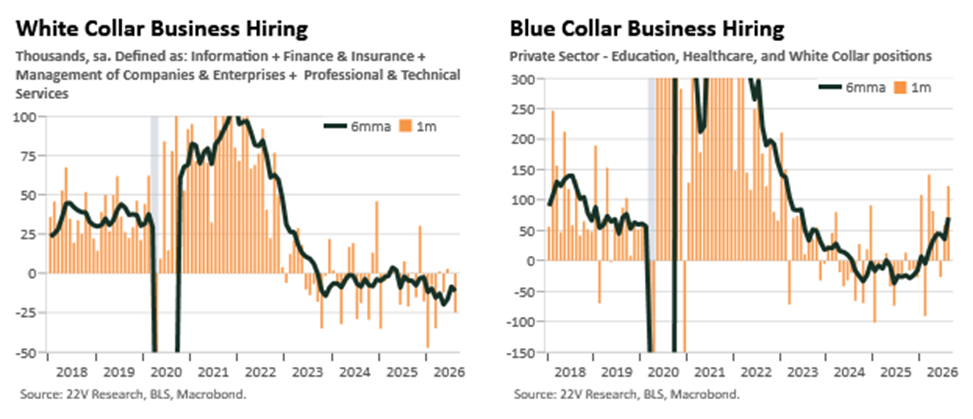
- The composition of hiring was solid as we saw last month’s dip in education rebound, health care continued to add jobs but at a slower pace than usual, and blue collar hiring is clearly rebounding along with other cyclical indicators. White collar hiring continues to muddle through moderately negative doldrums driven by weak rehiring rather than layoffs.
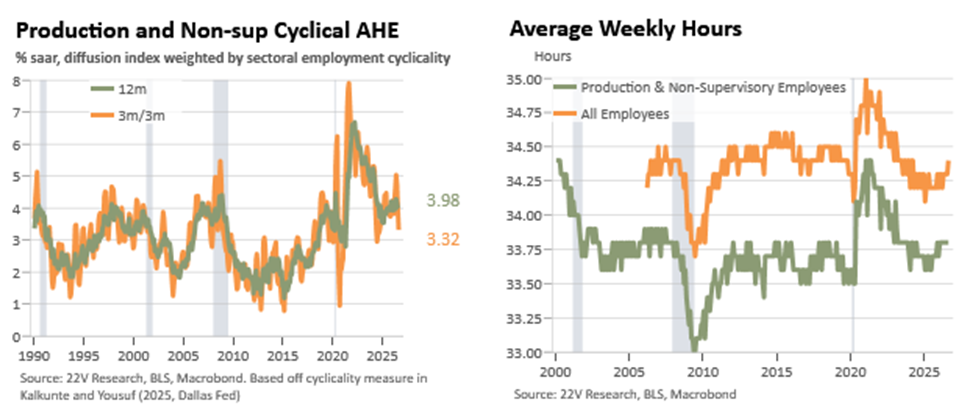
- Wage growth remains soft and the recovery we saw earlier in the year in more cyclical sectors has lost much of its relative momentum.
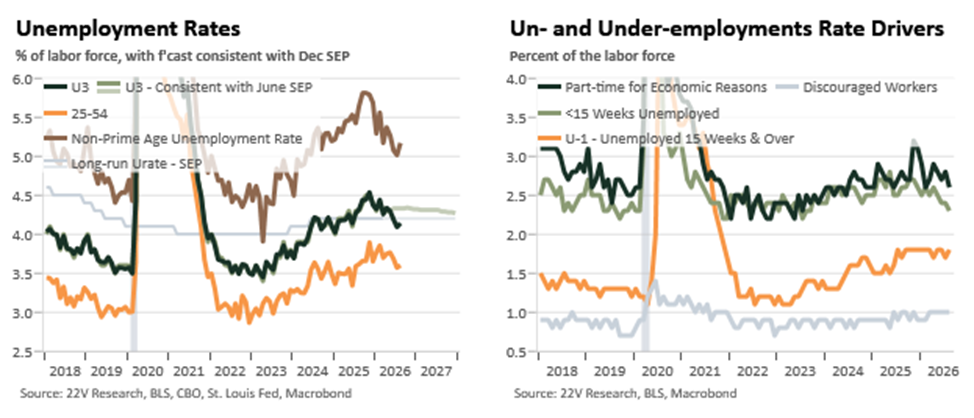
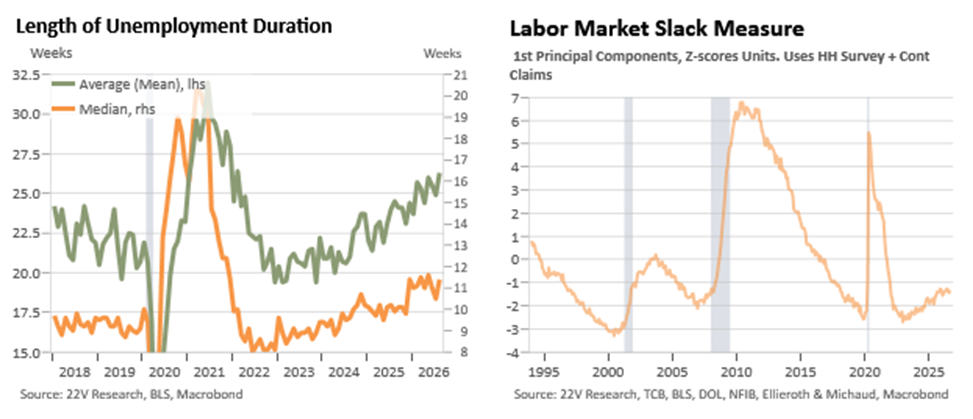
- The household survey was a bit mixed. The unemployment rate was up 5bps but the labor force participation rate moved 22bps higher taking the overall employment-to-population rate higher. These recent months’ moves have been concentrated in the noisier and less impactful non-prime age cohorts. Overall slack was about flat.
- For the Fed, this data reduces plausible arguments against hiking. It is not on its own an argument to hike but as almost all Fed officials have said recently, the inflation data is what is driving policy. Even if the labor market is not directly a source of inflationary pressures it seems fairly neutral and not clearly disinflationary, financial and credit conditions are supporting growth, the economy is still digesting myriad supply shocks, the AI boom is booming, and most cyclical indicators are showing a mid-cycle rebound. All of this on top of 5y of above target inflation.
NFP growth continues experience substantial m/m volatility. This is at least partially a result of the BLS’ new methodology implemented earlier this year, which seems to have added m/m noise to the topline and sectoral prints. Looking across recent months, hiring seems largely stable on net but with improving cyclical composition and trends in the work week.
Health care continues to add jobs although the pace has been slowing some in recent months but given the secular imperative, we should expect it to remain a modest source of payrolls growth from here. White collar hiring had seemed to be looking bit better but august was quite weak and so the best descriptions there remains messily gradually shedding jobs, likely mostly through passive attrition given the good layoff numbers. Blue collar hiring on the other hand is seeing a clear cyclical rebound, matching the cyclical signal from the PMIs and many other indicators which show the US economy exiting its post-rate hike cycle and tariffs driven doldrums.
Wage growth remains soft and the recovery we saw earlier in the year in more cyclical sectors has lost much of its relative momentum. Healthcare wage have been a big part of this story but they do not account for all of. It may be nothing more complicated than the fact that wage growth and job churn typically lag the bottoming of the labor market.
The troughing in the average workweek seems consistent with the mid-cycle recovery. Overall hours worked continues to bounce around its extrapolated 2023-24 trend rather after its 2025 downshift. As a result of meh wage growth and improving workweek, aggregate take home pay growth is running near 4.5% which seems more than sufficient with strong balance sheets to sustain household spending in the near-term.
The household survey was a bit mixed. The unemployment rate was up 5bps but the labor force participation rate moved 22bps higher. The moves here were largely concentrated in non-prime age workers. Prime-age employment to population was flat, down 3-4 tenths from its cycle high, as the overall bounced 2 tenths this month and the youth EPOP bounced a noisy 4 tenths.
At first glance, the jump in participation seems to have worsened most metrics related to rehiring ability or unemployment duration which had seemed to be stabilizing over the spring and early summer; this is a bit in contrast to the signal from continuing claims which continue to drop but the continuing claims universe is a narrower one and not directly applicable to those reentering the workforce even if rehiring and low job churn related challenges apply to both groups. The more intensive margins of slack measures by the share of workers on short-term layoff, those on permanent layoff, or working part-time for economic reasons all improved.