

Anthropic’s long-awaited IPO is weeks away and we should soon get the S-1. It was just under 3 months ago that SPCX set a record for the largest IPO in history and entered the $1T+ market cap territory. Anthropic will likely set another record for valuation and IPO capital raised.
The IPO for Anthropic is a critical step for the AI trade, and the increasing disclosure of their business model and the company’s opportunity to express leadership in AI on several fronts will be closely watched.
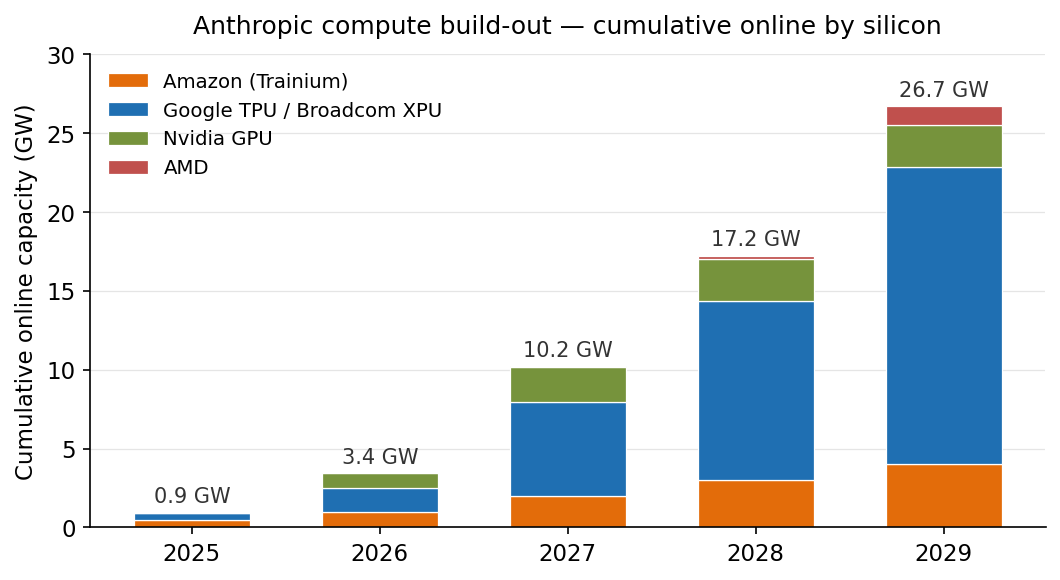
Built to scale: Anthropic has put itself in a position to scale through the end of the decade with a flurry of strategic compute deals from chips to power. Piecing together Anthropic’s compute deals, the company looks to be growing from 2GW of compute at the beginning of 2026 to over 30GW by the end of the decade. The chart below directionally shows this progression through 2029. We recognize it could be imprecise for the timing, but the underlying agreements and announcements underpin the scale Anthropic has been building. The higher range was clear from Broadcom’s conference call this week, indicating that Anthropic has become its customer, with 5GW and 10GW of demand in 2027 and 2028, respectively.
Source: 22V Research
Revenue and margin will be of particular focus and based on compute capacity contracted and taking “demand” as a given, we can see the path to significant revenue growth in 2027 and 2028 as it doubles and triples platform compute. Key variables here for margin will be average token price (directionally biased lower), % of compute monetized (should increase as frontier training demand stabilizes), utilization and throughput of compute per watt (increasing with new generations of GPU and XPU).
The incremental compute coming online will produce significantly more tokens per watt (Vera Rubin vs Blackwell and advancing XPU chips), creating a scenario where Anthropic could grow margins in an environment where volume accelerates and average token prices move lower over time.
A final note on “back-of-the-envelope” math for revenue and simple margin potential. In 2026, if we assume Anthropic averages 2GW of IT capacity, 60% utilization, and sells 50% to customers at a blended $1.75/M tokens, Anthropic would generate $45B in revenue. In future states, if we were to see the blended token price fall to $1.00/M tokens, but productivity of compute rises (Vera Rubin, new XPU chips), at 7GW of capacity with similar assumptions, Anthropic could generate north of $200B in revenue per year. Many variables impact the math and the goal is directionally to indicate the scale potential and can walk through this in more detail.
Margins can move higher based on a pursuit of cost-effective deployment strategies (including what appears to be more vertical integration down to the power). Recent deals are occurring at ~$16M/MW/year (Nscale and Lambda) for Vera Rubin, and the future XPU compute deployment could be even more cost-effective if they get closer to power in vertical integrations. The higher-power compute set against this stable cost base could more than offset token price pressures as demand continues to ramp and agentic AI demand takes off.
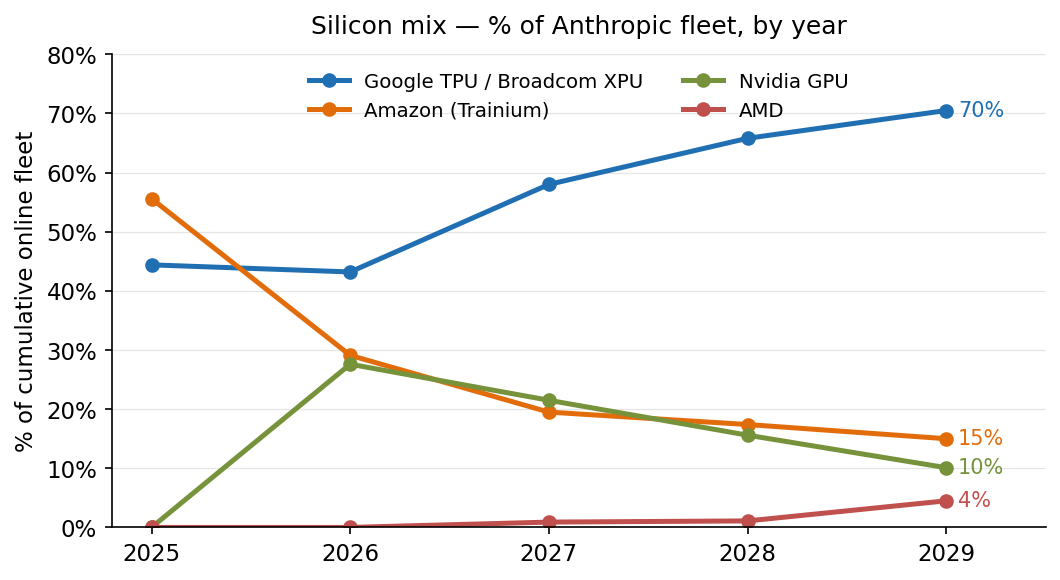
Below is our estimated view of Anthropic’s compute fleet composition over the coming years. Nvidia’s % of the fleet peaks in 2027, and XPUs from Broadcom ramp to over 70% of the mix by the end of the decade. Within this strategy appears to be more vertical integration, which could help increase margin capture by going direct to the powered shell for $2M/MW/year. Note that OpenAI is pursuing similar strategies in Georgia and with SB Energy.
Source: 22V Research
Additional S-1 Focus Points and Key Debates
Open Source: The elephant in the room is whether open-source models will break the dominance of closed source AI model companies and put a dent in the growth trajectory of closed-source AI models. The company’s response to value / token and how the AI ecosystem is evolving can give some added color to this likely long-running debate. We don’t expect the IPO to be a final answer.
Pricing models: AI companies are experimenting with many different pricing models from the basic input/output prices to success-based pricing models for AI workloads. Anthropic has announced new models with Salesforce recently. The future mix of pricing models will have an impact on how to model the revenue side of the business and understand customer mix expansion.
Regulation: Investors we speak with are concerned about the overhang of what happens if an AI model is responsible for a larger cyberattack and the government steps in to regulate or stop AI development. Anthropic will need to navigate how it is approaching safety with rapidly-advancing AI model capabilities.
Revenue metrics: Average price per 1M tokens is on the wish list of most investors to determine from what average price the current revenue base is set. A lower $/M token level arguably would be positive as the future token price pressure / volume concerns may be minimized.
Customer concentration: Investors will be closely monitoring Anthropic’s customer concentration mix as well as the breadth of customers potentially by industry and/or geography.
Margin and cost mix evolution: As noted above, the margin and cost structure is a core focus as will be the FCF profile.
Training and R&D costs progression: Model training costs and projections will be insightful. As the demand ramps up, this spend should flatten and become a smaller % of the overall cost structure over time.
Lockup and index inclusions: SPCX employed a staggered lockup, and we would expect to see something similar. This has been thoughtful and has worked reasonably well given the size of the company and volume of shares. We would assume that the Nasdaq gives Anthropic similar index treatment for early inclusion. The S&P remains a wild card, and it should not be expected that it would treat Anthropic differently. That will likely remain a catalyst 1+ years from the IPO.
New initiatives: Future product lines or business initiatives may gain some focus. Enterprise has been the primary mantra for Anthropic; however, consumer, physical, public sector, and other areas of growth will be important.
We will be closely analyzing the S-1 as it comes out and look forward to a dialogue.

