

There are a few aspects of tomorrow’s employment report that might be worth reviewing ahead of the release, because they are not that sensitive to the beat or miss. Beyond what I express here, I have no view going in. Helps with staying objective and skips the chronic embarrassment.
First, I have noticed – and not just this month – that the popular discussion of employment gains or losses has tended to overstate the importance of minor beats or misses. For example, Wednesday’s ADP release was almost exactly in line and yet was described by journalists as having missed. And I am pretty sure I know what the source of this bias is. People have an intuition to score the beat or miss relative to the size of what was expected. So, if the expectation is +50 and it prints at +25, some folks will say that the gain was half what was expected. That is definitely the wrong way to think about it. There is no reason to believe that the variance of employment growth should be proportional to the mean growth rate. It might be proportional to the level.
Average hourly earnings disinflation
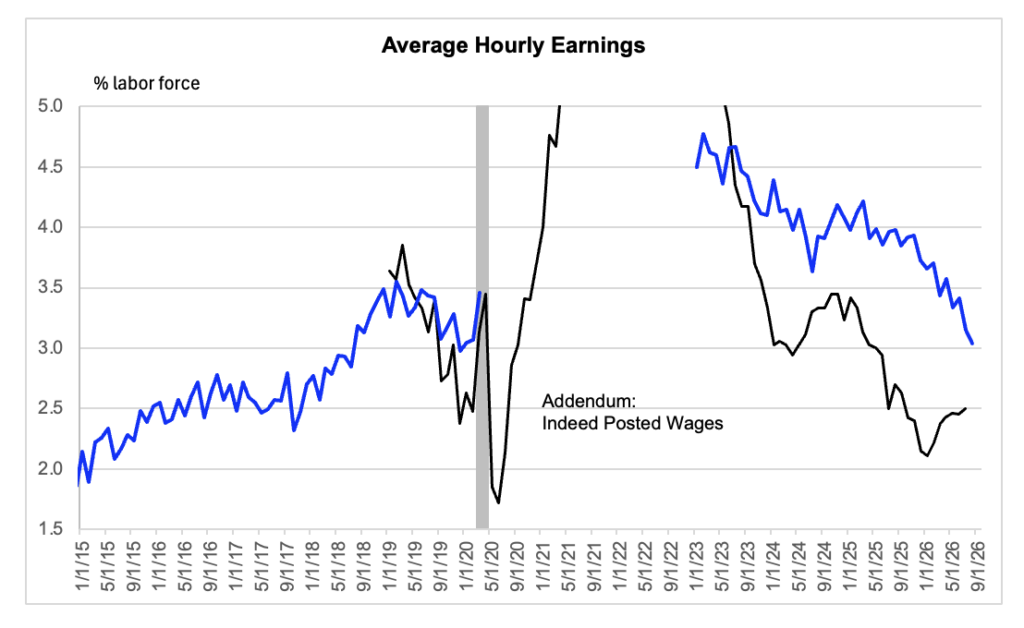
Average hourly earnings are actual to July and consensus for August. Indeed data are actual to July.
AHE are censored for Covid shock and early aftermath.
Second, I do not call the monthly data releases but it is interesting that the consensus has factored in no payback for last month’s average hourly earnings miss. Instead, the consensus has factored in the typical 0.3% gain, which would allow the 12-month wage inflation to continue decelerating. If this is roughly correct, it is striking evidence that the labor market is not tight and may even be loose, given that both productivity advance and recently firm inflation suggest that wage growth might be quickening in a neutral labor market tightness setting. Of course, a beat on wages tomorrow is possible. I would say confirmation of consensus would be dovish – in the big picture.
Has the labor market been tightening or easing recently?
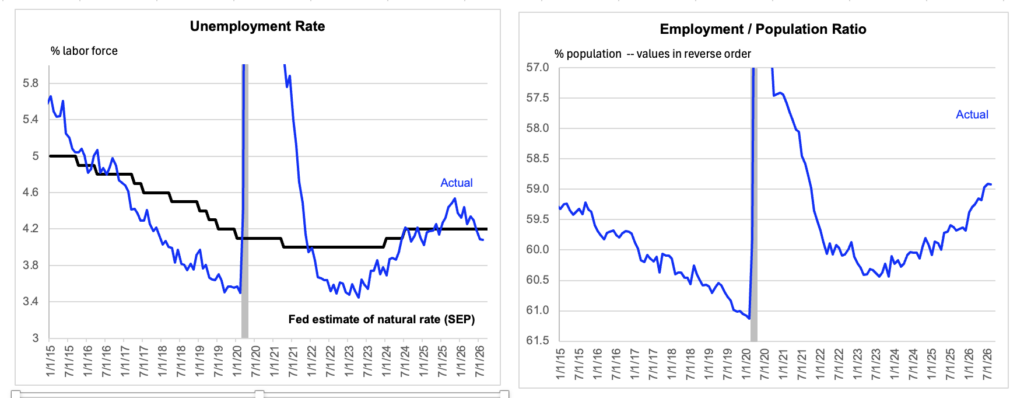
Data are actual to July and consensus for August.
Third, prepare for another debate around whether we should be looking at the unemployment rate or employment/population ratio, shown in the chart above on an inverted scale to make it comparable with the unemployment rate. My own view is that the magnitude of the decline (shown as rise) in the employment population ratio cannot be viewed as entirely structural. There is more likely than not some cyclical component to it, which would suggest that the labor market has more likely been easing than tightening recently. My take aside, people will quarrel over this tomorrow.
Fourth, until recently, I had been arguing that soft employment growth figures were not really an issue for the consumer spending outlook because the labor income proxies in the employment report were strong enough. But with last month’s data, I have been forced to reduce my best guess of trend growth in the labor income proxy from 4 ¼% to about 3 ¼%, based merely on my eyeballing of the level data, which is inherently backward looking. It will be interesting to see how these trend lines look tomorrow, once we actually get the updated data.
Bit flatter
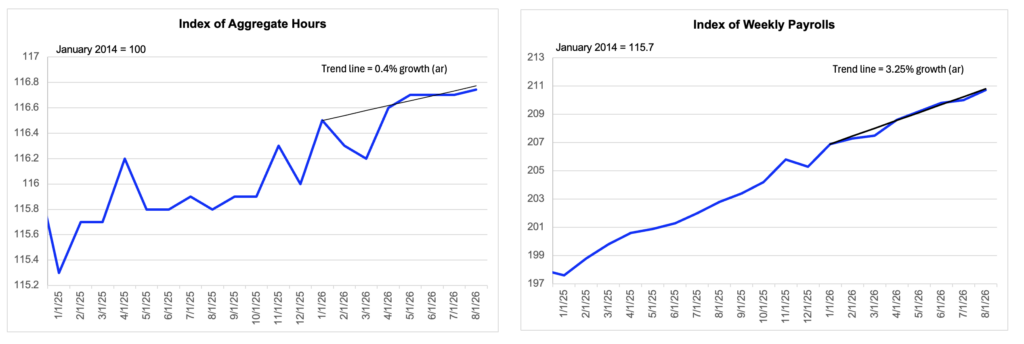
Data are actual to July and consensus for August.

