

Compute futures markets are imminently launching, and we believe they will become an important signal for investors in the AI trade and a critical hedging instrument for buyers and sellers of AI compute. We expect the compute futures market to be rapidly adopted given the trillions being invested and the significance of AI in the global economy. Since our initial note regarding price discovery in AI on June 9th (link), we have highlighted the need for and the planned launch of futures markets this year. Today, the CME announced (link) they will launch their GPU futures on October 5th.
In the next few months, we expect three separate exchanges to launch GPU futures products. These exchanges are the CME, ICE and Architect. We have spent the past couple of months developing relationships with and talking to the founders and team members behind the compute indices (Silicon Data, Ornn and Compute Desk) that will underpin these early futures products. We recently hosted a webinar with Silicon Data (link) and walked through their views on the potential use cases and size of this emerging asset class.
Below we give an overview of the players as well as frame out the potential market size and investment implications.
The following combinations of regulated futures exchanges and index providers will drive the initial development of the GPU futures market.
CME / Silicon Data: The only one with an announced date. On October 5th, the CME is launching their cash-settled GPU futures for H100s and B200s based on the Silicon Data indices. They currently have the first-mover advantage among the larger exchanges with the most established and public index builder.
Silicon Data is one of the more mature companies in the marketplace and has been a leading voice on developing AI compute price indices and LLM token price indices – both of which are actively tracked on Bloomberg and cited in the press.
ICE / Ornn: In May, ICE announced a plan to launch cash-settled compute futures based on Ornn’s Compute Price Index (OCPI). Ornn was founded by Wayne Nelms, CTO and MIT computer science graduate, and Kush Bavaria, CEO. They recently raised $33M in a seed round led by a16z, with Galaxy Ventures participating. Ornn anticipates an early fall launch, though details remain scarce on timing.
Architect AI Exchange / Compute Desk: Compute Desk came out of stealth recently and was founded by Andrawes Bahou, who was recently a compute infrastructure team member at Meta and worked in quant and accelerated computing at CSFB and ETH Zurich. His team comprises other Wall Street veterans and engineers. The company has stated they have backing from some leading AI companies and executives.
Compute Desk’s Bahou believes their index methodology stands above the other products in the market given it is built on IOSCO benchmark principles (the International Organization of Securities Commissions) and comprises both live and private bilateral settled transactions in the index. They believe their private bilateral transaction data is robust given proprietary agreements with larger hyperscale/neocloud-type companies.
Architect Financial Technologies was founded by Brett Harrison, ex-Citadel and former FTX US President. The company currently operates an offshore perpetual futures market. In May, Architect purchased a U.S. regulated futures exchange called IMX Health LLC and renamed it the American Innovation Exchange (“the AI Exchange”). This new exchange is where their GPU futures products will be listed, and we are following the company’s or founder’s X/Twitter for updates on product launch.
ICE / NATIVX: ICE is also approaching compute futures with NATIVX, a compute and power exchange platform, to create a normalized GPU-compute futures product called COIL. This product would seek to eliminate the GPU specificity that is being contemplated by the other products and tie together the productivity of compute and power into a defined contract. This appears to be a more complex product and may take longer to launch or build volume.
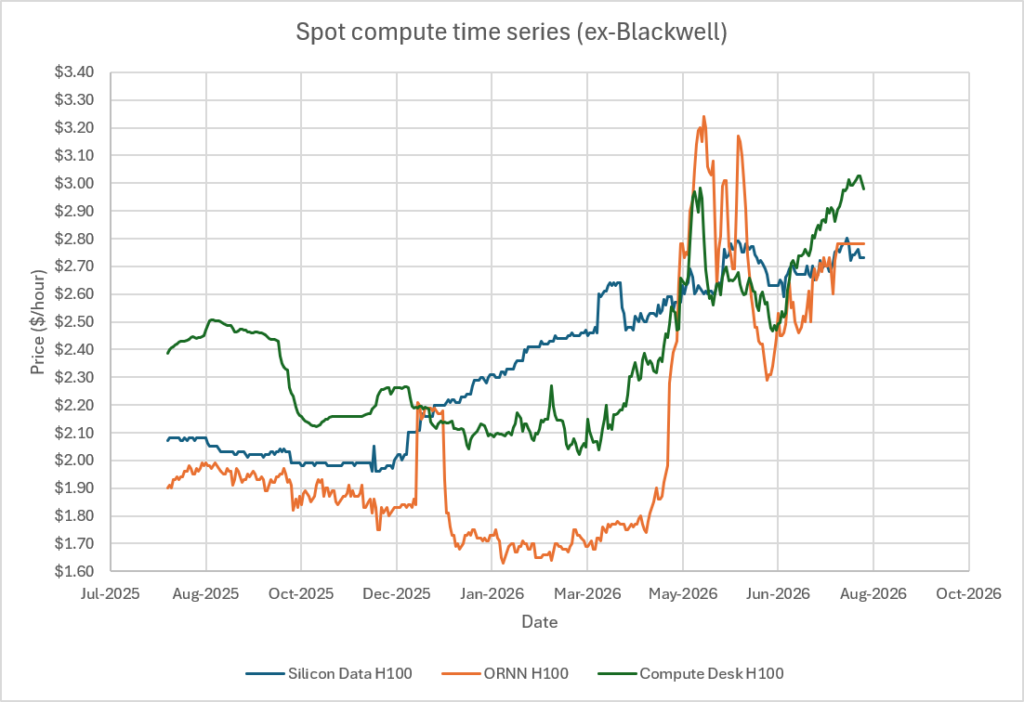
Index methodology: We believe a key driver of these markets will be the confidence in the index methodology and standards. The three index builders that exist today are all utilizing slightly different methodologies and have different underlying transaction bases and volumes. We don’t have a view on which is the most relevant; however, the common thread in other mature markets is IOSCO compliance and investor confidence. The chart below shows how these three index providers’ methodologies derive H100 spot prices. They get to the same general result via different paths.
Source: Bloomberg; 22V Research
Timing and approval considerations: While the CME leads the primary exchanges with a set launch date, we think Architect may be the first of the three to have a product trading in the market, albeit one closer to a crypto-perpetual futures model. The CME, ICE and Architect are regulated futures exchanges, otherwise known as Designated Contract Markets (DCMs) and are regulated by the CFTC. Each DCM can self-certify and set a launch date for their GPU futures product. The CME has just announced its date as October 5th, 2026. While processes can be quick, the CFTC could still comment or delay that offering if there were questions. The DCMs may also go through a voluntary approval process and seek CFTC approval. This would take longer and there are pros and cons to either process. Based on following Architect, we would not be surprised to see its product launch prior to the CME.
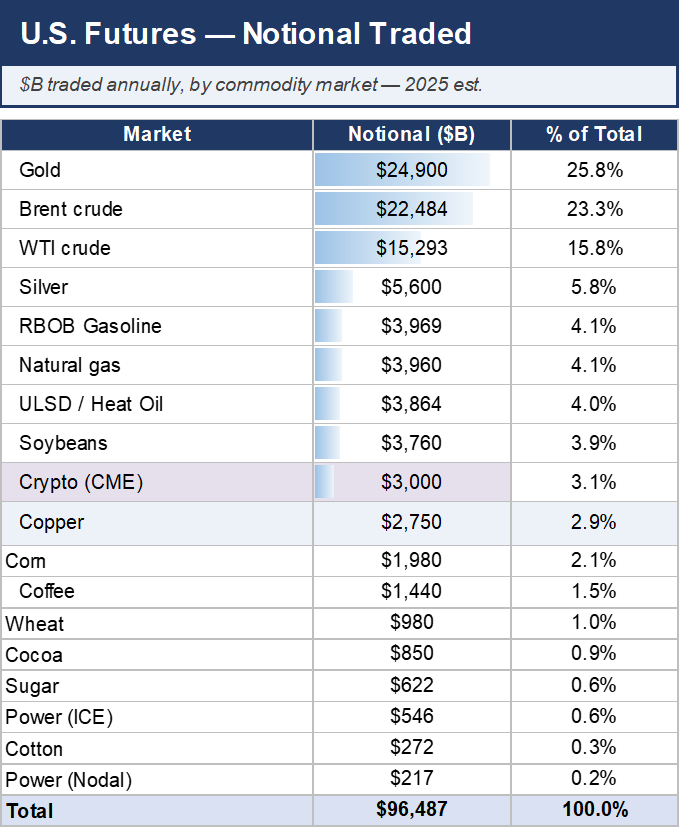
Market sizing and comparison to other futures markets: In some papers and publications, compute futures have been compared to the oil markets; however, we would draw a closer parallel to other non-storable resources like power. AI compute and its productivity are heavily linked to the power it consumes to generate output, which reinforces the power-market analogy. In dollar terms, though, the market has the potential to be far larger – closer to oil. The CME’s head of global commodities noted on its Q2 conference call that this product fits well in the commodities portfolio and allows developers to hedge data-center exposures.
The number of players on many sides of this market and the size of these institutions lead us to believe the notional trading size of the compute market could make it one of the larger futures markets in the world. Hyperscalers, banks, private equity firms and speculators are just a few examples.
Below are current futures products by size (2025 basis).
Source: 22V Research
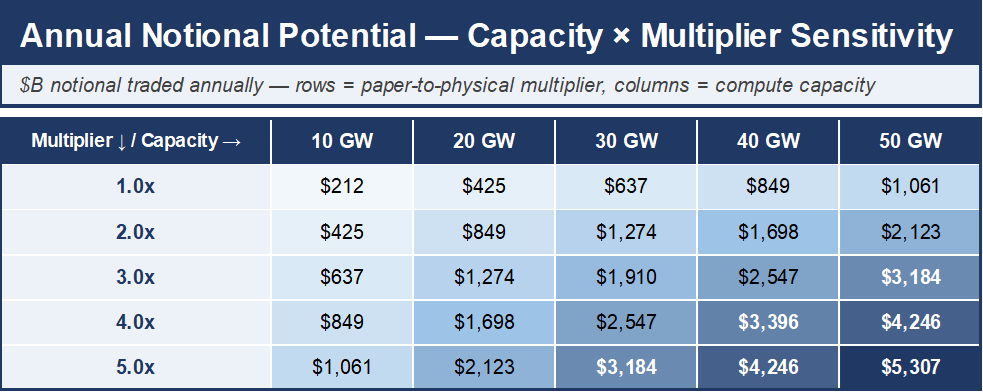
We expect the size of the compute futures to be sized as a blend AI capacity installed, price. The initial GPU classes will be Hopper (H100) and Blackwell (B200). Below is a range of notional traded sizes based on installed capacity and an average blended hourly rental rate of $3.50/hour. The size of this market coudl be substantial and one of the larger futures products in the coming years.
Source: 22V Research
Investment implications: The most important implication we are seeing evolve is an increasing effort to classify AI compute as an asset class and develop financial products, such as futures. This can lower the barriers to investment by allowing market participants to more easily access risk management products that currently do not exist. As we can tell, the logical hedge has been the CDS market which only works for certain market participants and is not scalable.
Neoclouds, data-center builders and turnkey power providers should benefit from this reduced barrier to entry, through new financing models and hedging instruments. We continue to have a positive view on trends for neoclouds and builders (CRWV, NBIS, SPCX, FRMI).
Prices and volatility: The futures prices for compute will inevitably need to be translated and followed, and their volatility and ranges will have impacts on how investors view the trajectory of spending and capex over the long term. These additional data points will be taken in concert with the current process of closely monitoring the hyperscalers, for example, for directional signals on the AI capex trade.
Drawbacks and counterpoints: We see a couple of points of contention around the initial futures market that may stir debate and limit market size and growth.
Nvidia dominance: Futures contracts are H100- and B200-specific. Eventually there will be Vera Rubin classes as well; however, many will point to the fact that this represents only a portion of AI compute. We would expect future products to include other forms of compute to the extent there is a market for trading (TPUs or other).
Asset life complexity: H100s will not be around forever, and the pool of active H100s will decline over time. We would think this is largely an issue for the size and complexity around a physically settled market and less for price. A signal on H100 price will be important and likely has multiple years of relevance.
As this evolves, we look forward to bringing more detail on these products and would welcome a dialogue on what price changes and levels will mean for the AI trade going forward.

