

The data in the Productivity and Cost report for Q2 were slightly more benign than expected, although one quarter of data cannot really change the perceived underlying trends much. Just eyeballing the data in level terms, I (continue to) put the new trend productivity growth rate at 2.1% (ar), which is roughly a doubling from the pre-Covid trend. This upturn has been fortuitous, to say the least, given that it has been coincident with a steep slowdown of population and thus labor force growth.
I still eyeball the new trend at 2.1% (ar)
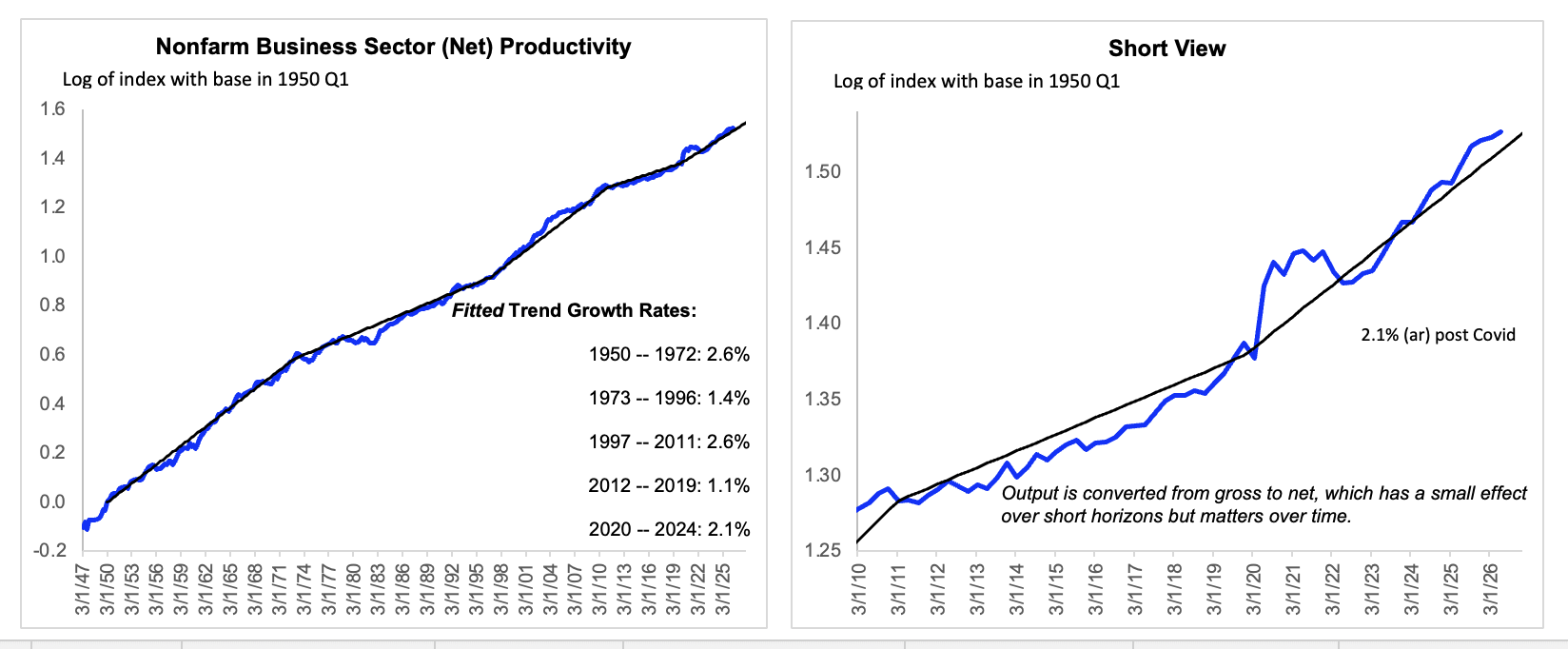
Data are actual to 2026 Q2
The combination of decent productivity growth and only moderate gains in Average Hourly Compensation (AHC) has meant that the 4-quarter change of unit labor costs (ULCs) has been oscillating around 1% in recent quarters. But directly observed ULC inflation is probably not the best way to back out trend ULC growth, because both AHC and productivity are very volatile, even when measured on a 4-quarter change basis. It is probably better to back into the underlying trend of AHC by observing core ECI growth — and then adding an appropriate constant term to reflect that ECI is a fixed weight metric and may not quite capture the trend component of strength in benefits — and then compare that with trend productivity.
Add 75 bps to Core ECI growth to get trend AHC growth
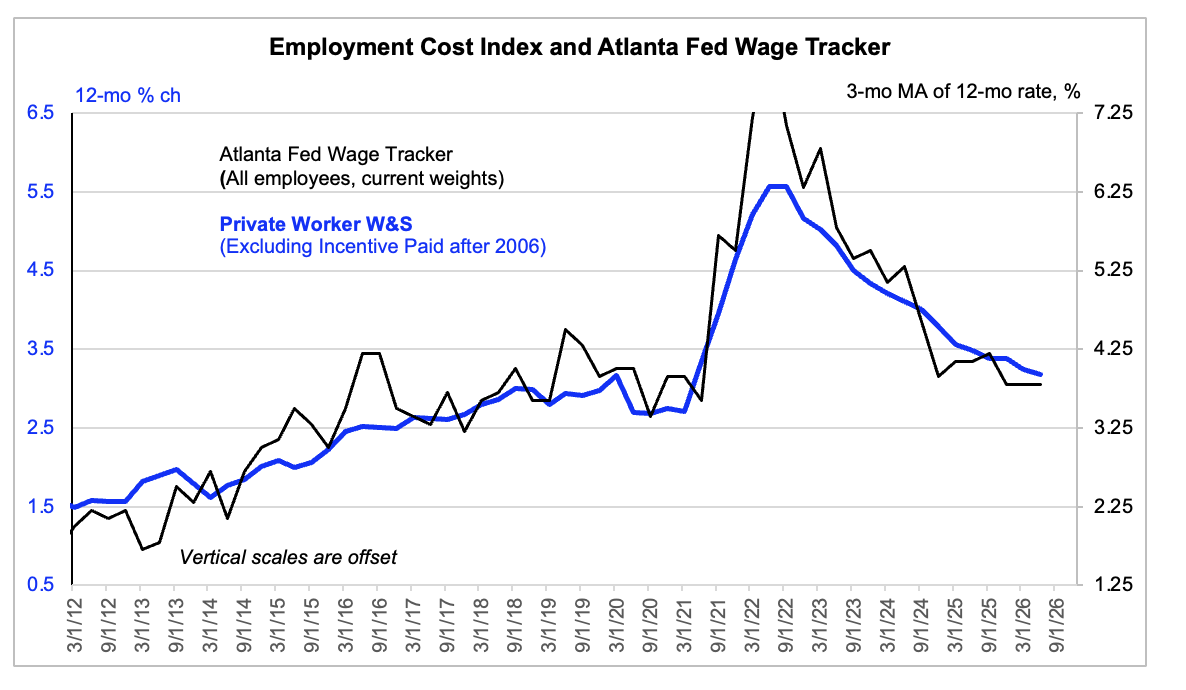
Data are monthly but reported quarterly and are actual to June.
In my view, the appropriate constant there is about 75 bps, for reasons I have been over in earlier notes. That gets me to 4% growth in underlying AHC and therefore underlying unit labor cost inflation of just below 2%. This is consistent with the widely shared view, which I accept, that there is little evidence that inflation pressures originate in the labor market. There is a story one can tell to get to inflation pressures in the labor market that would appeal to increased corporate concentration. But it is not the most obvious central case.
While it is hard to back the underlying trend of ULC out of their directly measured growth rate, the ratio of ULCs to the value added deflator in the nonfarm business sector is a highly relevant measure of the labor share. It has been utterly collapsing since the Covid shock and is now at a new record low. The main implication of this has been soaring profit margins. But another implication of this is that there is plenty of room for any wage pressures to go into a bit of margin compression, rather than into inflation. So, the Productivity and Cost data are generally consistent with a benign interpretation of the inflation outlook. I would keep an open mind that disinflation might soon resume, then. I don’t think NY Fed President John Williams, for example, is just making stuff up. The problem is that directly measured goods and services price inflation has been quite high, the moderate June PCE gain aside. And policy makers have to respond to that inflation, even though there is some legitimate dispute about its source and how persistent it might be.
Better to be K than L
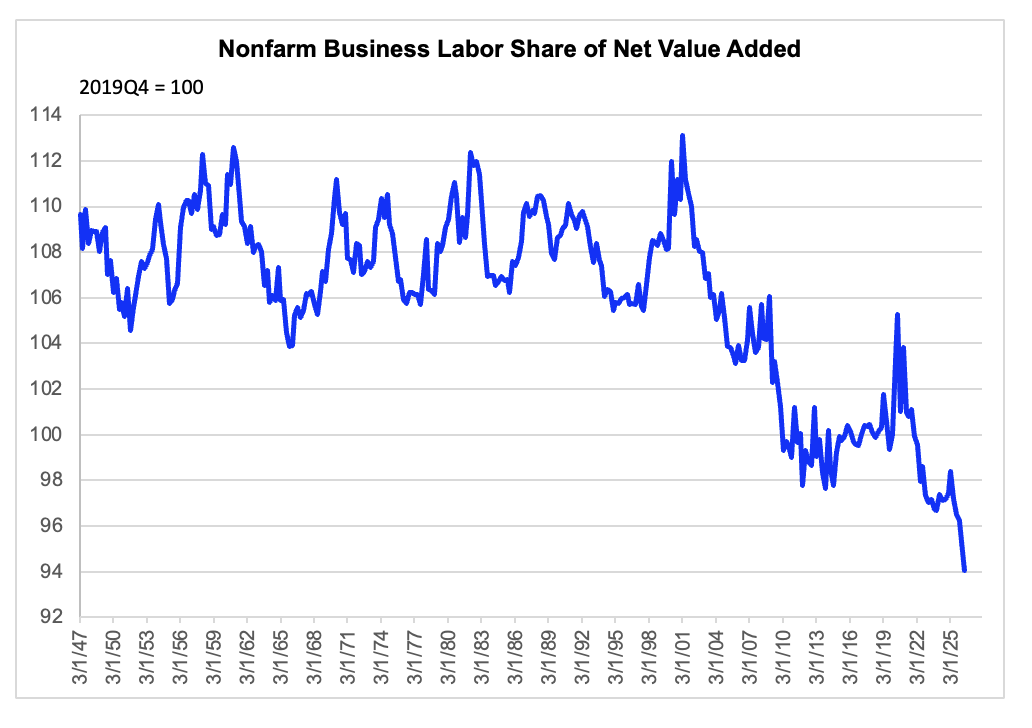
Data are actual to 2026 Q2.

