

Main point: Warsh is not the main driver of trends in fixed income that largely predate him.
In this note, I return to a theme on which I have been harping a bit since Fed Chair Kevin Warsh’s press conference on Wednesday. I intentionally repeat for emphasis, because I think there is some mischaracterization going around. But I promise to be brief, because I have in fact been over some of this.
The main point here is that markets have not really assigned a new risk associated with Kevin Warsh.
I part paths with the consensus interpretation in two regards here. First, it is tempting to infer what the capital markets think of Kevin Warsh from the change in asset prices while he was speaking on Wednesday afternoon. But that is too narrow a window. To see Warsh’s effect on things, we would need to take a longer view. And to see how the market views things in the presence of Warsh, in other words, conditional on the fact of him being Chair, we can look at the level of asset prices. This makes for less fun but possibly more accurate story telling.
Second, it might be useful to think slowly and formally when considering what is meant by a “risk premium” or more specifically “term premium” when backing out what the bond market may be thinking here. Strictly speaking, the term premium is not really about the perceived risk that something bad might happen. So, for example, the idea that inflation might be higher does not map one for one to a steeper yield curve, although there is a link running from inflation risk through portfolio balance into the term premium, as I will get to below. And I mention this because there are good reasons to believe that the yield curve should have a tendency to steepen over time here for reasons that are not largely about concerns over whether Warsh is a good or a bad guy. Fixed income as morality tale might not be best practice.
Let’s start with the first point, which I admit already to having been over. I am reminded to return to this theme by CNBC reporting suggesting that the bond market is signaling Warsh that he does not have credibility as an inflation fighter. Of course, the bond market cannot express an opinion any particular member of the FOMC, but it does implicitly take a view on what the Fed or the system more broadly might deliver, and the Fed Chair obviously enters into that. And while inflation break-evens did widen on Wednesday, the current level of break-evens is fully consistent with the idea that the Fed will hit its 2% PCE target over, say, the next 10 years on average. Keep in mind that a CPI-based breakeven of 2 ¼% would map to a PCE inflation rate of about 2%. When people say that the bond market does not trust Kevin Warsh – or more precisely the effects of Kevin Warsh – I really don’t know what they are looking at, besides two hours of repricing on Wednesday, which is not the right metric.
One possibility here is that people are inferring the recent re-steepening of the coupon yield curve as evidence that the risk premium in the bond market, i.e., the term premium, is going up. But precision is required here. The steepening of the curve since late June is probably mostly about the rates path. We can argue about whether that is good or bad, but it is separate from “risk.” And perhaps more to the point of this note, there should be a tendency for the yield curve to steepen over a longer sweep of time because of upward pressure on the term premium, as I have been emphasizing for a couple years now. But that has little do with the idea that we are at risk of something bad happening, including at the Fed. Rather, the combination of very heavy duration supply, associated with the chronically massive fiscal deficit, and the switch of the stock-bond correlation from the Ice regime of the 2010s to something that looks a bit closer to Fire does favor a rise of the term premium, even if nobody has in mind the idea that something is inclined to go wrong – either on the fiscal or monetary side. For duration supply that is no longer diversifying to be taken down, the excess return provided by it has to go up. And that is literally what is meant by the “term premium.” That concept is not normative, although people often forget the point.
Warsh did not end the Ice Regime, although I get he is unlikely to restore it
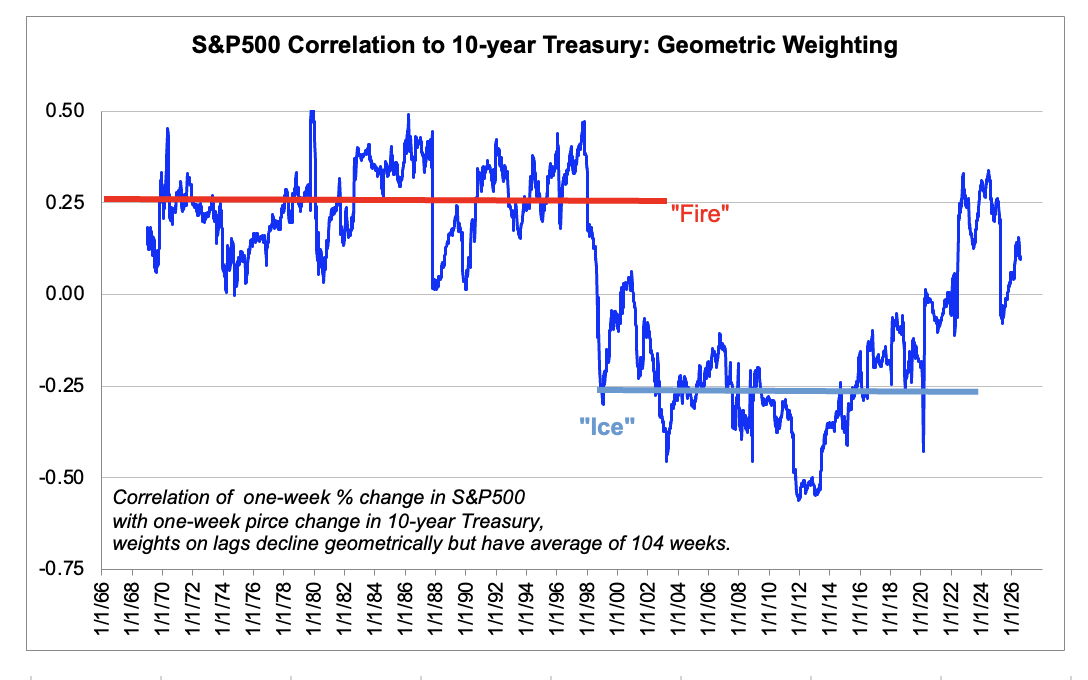
Source: Bloomberg, Federal Reserve Bank of St. Louis (FRED), FH calculations
Data are weekly and to the close Friday.
My interest in the stock-bond correlation arose from my long-standing and loud resistance to the idea that the Treasury yield curve flattened during the 2010s because of QE. No, the Treasury curve flattened because the stock- bond correlation went convincingly Ice, which in turn reflected the zero bound on rates and lowflation. And those same conditions of liquidity trap and lowflation caused QE. But people got confused – with a nudge from the Fed – and believed QE caused the flat yield curve.
I had been making the point for quite a while when I saw an interesting quant piece from DE Shaw in late winter 2019 mentioning the same thing. They put the argument with more authority than I had, but I got there first! And one fun aspect of the DE Shaw piece was that its publication pretty much marked the end of the negative correlation between stocks and bonds. Not their fault for not anticipating Covid or Biden. But it is still fun, and sort of typical of markets.
Another fun aspect of the DE Shaw piece is that it cited some work by Campbell et. al. back in 2014 looking into the theoretical foundations of this idea. These same authors have since then published updated work showing that the stock-bond correlation switched signs in 2001, going into an Ice regime, then, because the correlation between the output gap and inflation had also changed signs. In an Ice regime, low demand causes low inflation, rather than high inflation forcing the Fed to deliver low demand, as in the Fire regime. That exactly fits with my own take. I would just say that presence of an Ice regime had become far more obvious by the time we were recovering from the GFC.
But now that is past. The escape from liquidity trap and the recent experience of a burst of inflation mean – in the terms of Campbell et al. – that left tail risks no longer predominate and that the stock bond correlation should therefore move from Ice and toward Fire. And that favors a steeper curve, especially with duration supply now so heavy. We have to take down more of what is no longer reliably diversifying. So, the term premium should rise even if monetary policy is sound and risks of a fiscal accident are believed to be low.
Obviously, this mechanism, assuming I understand it correctly, operates at a much lower frequency than Kevin Warsh’s expressions of his feelings about monetary policy. And Warsh probably did give a slight nudge to a steeper curve on Wednesday, via both the expected path of rates and – secondarily – the term premium. But it is not as though we should view 2s20s at 100 bps as some sort of anomaly that requires a special factor to explain. It was at 130 bps before Warsh came into view anyway. I don’t see much evidence of Warsh in the level of things here, away from whether the market believes the Fed will have hiked by September, which is trivial.

