

Two themes stand out after the first two weeks of earnings and our research around the growing open source model debate.
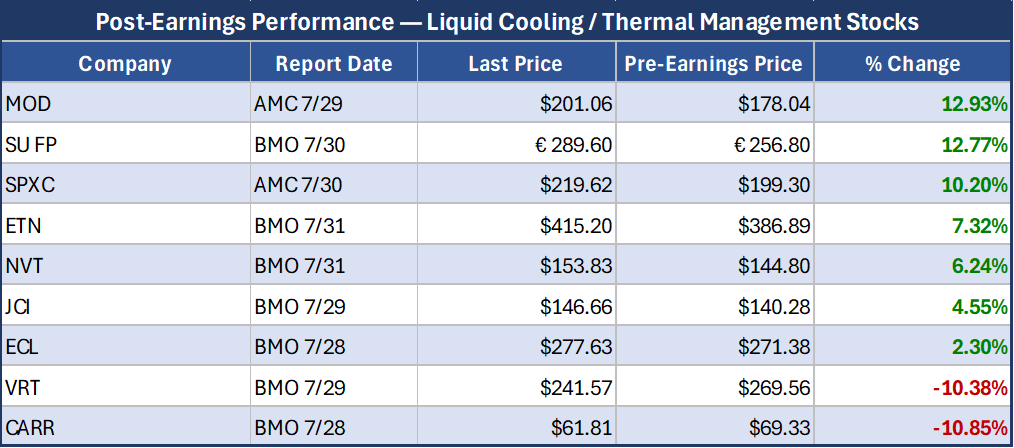
Liquid cooling remains among the most durable themes in the AI-capex complex, and Q2 earnings confirmed it. Dispersion finally emerged between companies executing and expanding margins and those that are suffering internal and external teething issues due to intense growth and increasing product complexity. The top names to emerge were ECL, ETN, and JCI this quarter. VRT, MOD and CARR faced various challenges that impacted margins and revenue timing and further evidence of resolution will be needed before multiple expansion or earnings revisions can restart.
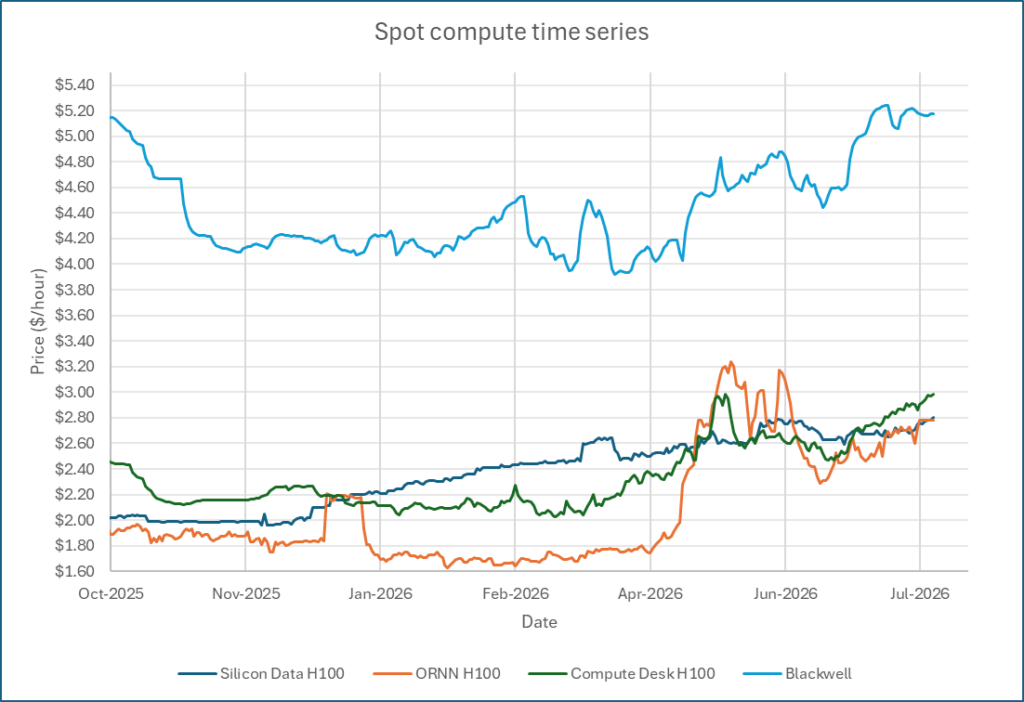
Compute scarcity: An additional theme that has emerged is the disconnect between neo-cloud / data center equities and an increasingly tight compute market. Spot pricing sits near the highs, demand is growing quickly, and open-source models are increasing the compute needed to host and provide multi-model platforms. Combined with continued downward pressure on token prices, we view this as a net positive for neo-clouds and data-center builders.
Compute tightness — scarcity persists, token prices continue lower
Compute scarcity is creating upward pressure on rental prices and an implied higher-price market for future compute contract deals. We view the increased demand for multi-model hosting platforms for open-source models as creating upside optionality and demand for neo-clouds and data-center builders (CRWV, ORCL, NBIS). META, on its earnings call, struck a less dramatic tone on the timing and scale of competing with neo-clouds; MSFT, GOOGL, AMZN, and others solidified the demand picture. In addition, last week OpenAI’s CFO flagged accelerating ARR into July — an incremental positive for ORCL (link).
Spot compute pricing has continued to trend higher and remains near the highs; these indexes are worth monitoring going forward.

Source: 22V Research; Bloomberg
Source: 22V Research; Bloomberg
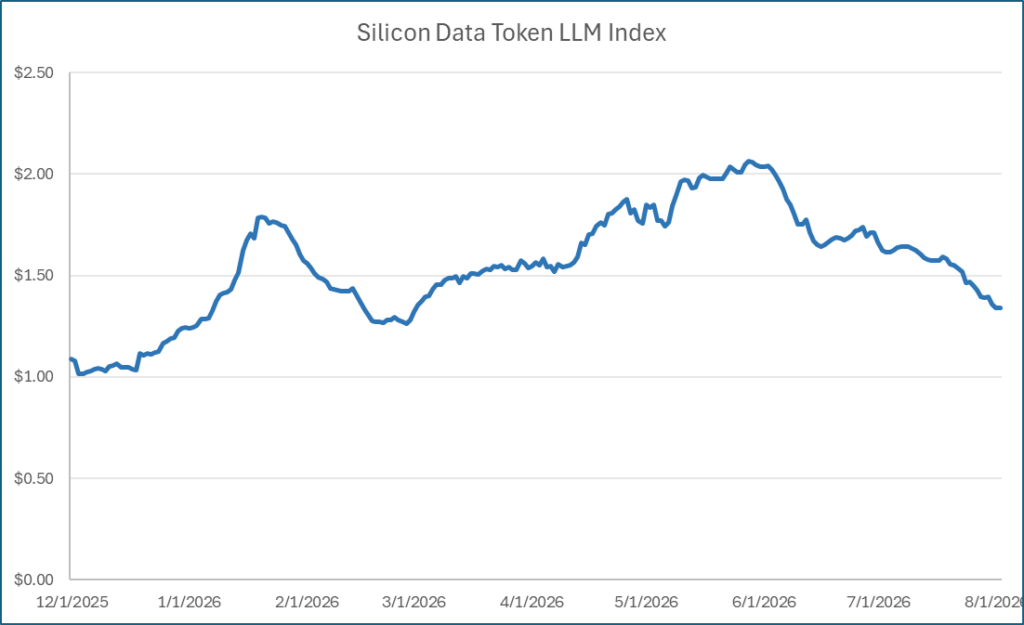
The SDLLMTK (Silicon Data LLM Token Expenditure Index) has continued lower, reflecting a falling average cost per 1M tokens and directionally validating the impact of growing open-source adoption and lower frontier-model pricing.

Source: 22V Research; Bloomberg
Source: 22V Research; Bloomberg
Liquid cooling and thermal management — expanding importance and TAM
“Every era is defined by the infrastructure it demands, and this is the age of thermal management.” — JCI CEO Joakim Weidemanis, Q2 2026 earnings call.
“At the heart of AI is water… we are now the only company with integrated solutions across that value chain.” — ECL CEO Christoph Beck, Q2 2026 earnings call.
Liquid cooling and thermal-management earnings produced a wide dispersion of outcomes during the AI selloff that tried to bottom late last week as can be seen below. What was crystal clear is that liquid cooling is growing rapidly and continues to be in the early innings of an incredible multi-year demand story. We are focused on names that are executing now — ECL and ETN stand out, with JCI added this quarter. While we continue to like MOD, it now needs to show that it is getting through the supply-chain issues and can regain its position as a complement to the liquid cooling infrastructure. We also continue to be surprised by limited commentary around its liquid cooling/CDU portfolio.
Source: 22V Research; Bloomberg
ECL: CoolIT is growing over 100% y/y this year, and ECL integrated its 3D TRASR monitoring technology into CoolIT quickly. The company continues to thematically leverage their growing technical water business with liquid cooling and semiconductor fabrication. An analyst day is on the horizon in November to increase visibility for the margin accretive Global High Tech (GHT) business.
NVT: The company announced a further expansion of its Blaine, MN manufacturing lines as its prior plan to double was insufficient given the demand. Liquid cooling is a major driver of their stated $2B of data-center revenue target in 2026. Management framed liquid cooling market penetration at roughly 10–15% and is working with Nvidia on roadmaps through 2030. Even if the AI buildout slows, they expect the compute refresh cycle and increasing market share gains to drive liquid cooling growth that outpaces the market.
ETN: Data-center revenue grew 65% y/y, and ETN raised its Boyd division revenue target to $1.8B, +63% y/y. Management cited its grid-to-chip portfolio, where Boyd is a leading cold plate and CDU manufacturer partnering across chip providers. That confirmation validates ECL’s strategy, where CoolIT is a full CDU-to-chip solution provider.
JCI: JCI expects data-center revenue to grow from high-teens to nearly one-third of company revenue by the end of the decade, driven in part by a newly launched, Nvidia-certified CDU product. This new line has hundreds of millions in planned orders and a $1B+ pipeline.
Execution, supply chain, and margin challenges: These idiosyncratic issues surfaced this quarter and create near term growing pains for VRT, MOD, and CARR.
MOD faced external supply-chain issues, with recast data-center EBITDA margins hitting 14.8% — down from near 20% — as long-lead items persist. The company cited continued long lead items and it would appear there is at least another quarter to go before there is more clarity around this pressure abating.
VRT beat margin expectations but missed revenue by over $100M on internal execution as it ramps increasingly complex modular data-center infrastructure products; the revenue ramp plus margin-sustainability concern is an overhang. It may be a stretch but the increased project and milestone revenue recognition backlog as a percentage of overall business may take time for the market to be confident in execution.
CARR pulled its full-year margin-growth guidance, though this reflects less a supply-chain issue. Overall, we view CARR’s data-center exposure as smaller and less core to the theme.
Please reach out to discuss in more detail our thoughts around the compute markets or liquid cooling themes.

