

Main point: Wednesday was fun to watch, or read about in my case. But I don’t think it captures the primary trend here. Warsh is mostly hurting himself, thankfully.
The spectacle of an impostor being called out in real time by the most efficiently priced asset class on the planet is admittedly hard to look away from. And on the day, most of the repricing there involved increases of inflation premia, rather than real rates, at least as proxied by the TIPS market. Warsh looked and sounded like a simp, and the bond market priced a bit more inflation.
But if we zoom out a bit, I think we can see that the theme of the day on Wednesday is not the primary trend here. And the idea that Warsh is already driving up risk premia seems premature. For example, I have been looking for a steeper yield curve for a couple years now, because of the huge flood of duration supply implied by the surging federal debt and the recent switch of the stock-bond correlation away from an ice regime. (This argument has little to do with inflation or even fiscal worries per se, except to the extent that this influences the stock/bond correlation.) The curve has tended to steepen over this period, although at short horizons the curve is much more dominated by the rates outlook itself. But the reason I mention this is that the yield curve does not seem to have overshot on the basis of some other consideration. And relatedly, I think it is a mistake to claim that Warsh has already caused risk premia to blow out. (There is more likely than not more yield curve steepening in front of us.)
Instead, I think something else is going on. And one aspect of this other thing that is interesting (to me) is that it is something that a lot of folks expected. Recall that when Warsh was appointed, there was a group of Fed watchers who thought the appointment was a mistake but who were not particularly worried about it undermining the inflation outlook. Either Warsh would tack to the center on his inflation views or he would lose credibility and the power on the FOMC would shift out to the broader committee. If Elvis loses his singing voice, he does not get to call the tune, as my pal mentioned.
In the event, both elements of the non-panic take seem to have played out. For example, Warsh has made a great show of talking tough on inflation, for whatever that is worth. He has also quietly dropped – or delegated to task force — some of his dumber arguments for dovish monetary policy, like the AI boom or the Trimmed Mean inflation rate. And even on Wednesday, he did suggest that he saw the case for restraint from higher interest rates. It is just that he made a fool of himself rationalizing how that would work, although in a way that ultimately concedes the case for rate hikes. He is not acting in the worst-case dovish way. This is probably in part because he is disciplined to some extent by the fear of losing his credibility on the committee.
And yet, the second aspect of the non-panic take is also playing out. That is, Warsh does seem be frittering away the authority that comes with the role, and a bit more quickly than even his harshest critics expected. I am reminded of this point, and prompted to write this note, by Paul Krugman’s most recent Substack post, whose title is inappropriate to family macro. I know Krugman wears his politics on his sleeve and is not to everybody’s taste. But think this snippet apt:
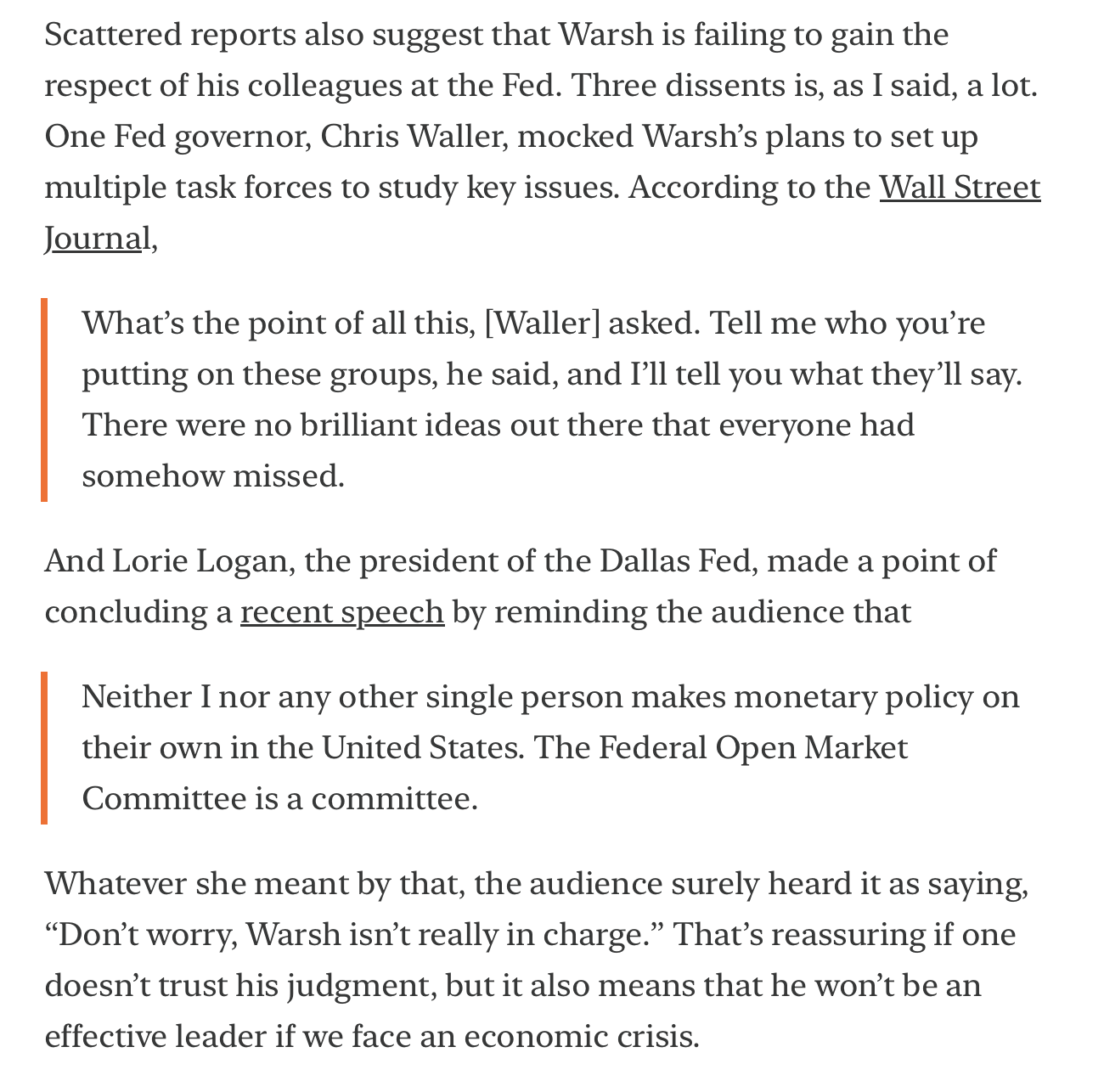
I particularly like the concluding point about the risk of not having sturdy leadership in the event of a crisis. And I concede that even with this check on the guy from the broader committee, and from the fact that he presumably has some dignity and does not want to be judged a fool, the risks around inflation over the longer haul are probably skewed to the right. But for the most part, the damage Warsh has been doing has been mostly to himself. And I would avoid mistaking my view on what markets should be doing with what they have done, the striking example of Wednesday aside.

