

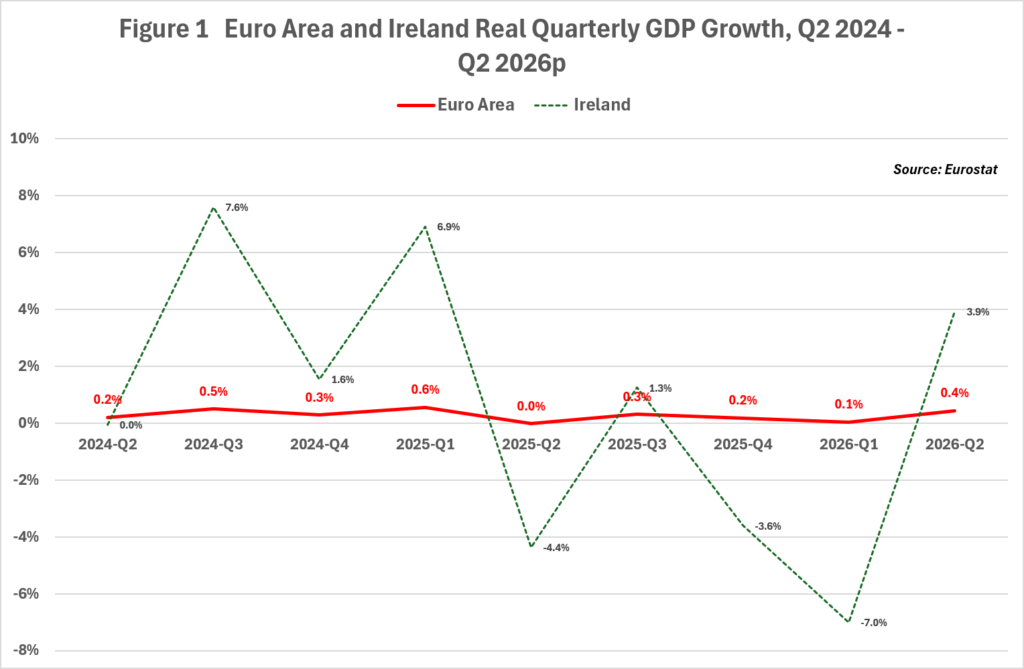
I Euro area Q2 flash GDP growth estimate showed a robust 0.4 percent rise and 0.5 percent in the EU. This represented a rebound from near stagnation in Q1, though a large part of this headline swing can be attributed to the meaninglessly volatile GDP figures for Ireland and the recorded activities of large multinational corporations located here. Quarterly Irish GDP dropped seven percent in Q1, but recorded a rebound of 3.9 percent in Q2, yielding an “adjusted euro area excl. Ireland” GDP quarterly growth number for both quarters at around 0.25-0.3 percent.
Hardly breakout levels, but resilient numbers for a major fossil fuel importer during another period of energy price volatility and consistent with an annual growth number for the euro area and EU for 2026 at around 1 percent of GDP, somewhat but not dramatically below the euro area/EU’s potential growth rate of around 1.2-1.3 precent (figure 1).
Euro area unemployment remained flat in June at near historical lows at 6.3 precent, while headline inflation picked up 0.1 to 2.9 percent in July. More importantly though core inflation (HICP excl energy, food, alcohol, tobacco and changes in indirect taxes) rose only to a modest 2.5 precent, a level assumed by the ECB in its June forecast for Q3 2026 (figure 2).
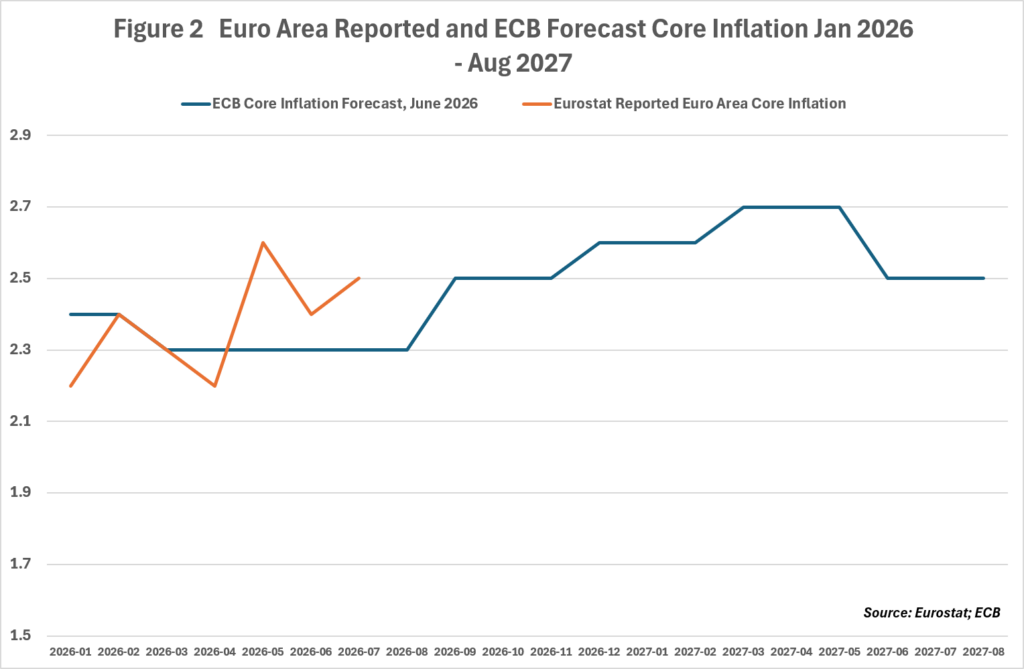
Combined with the continued decline in food inflation – declining to 1.2 percent in July – the continued range bound development of euro area core inflation will make the ECB with near certainty not contemplate more than possibly one more 25bp rate increase at their September meeting.
Determining the majority of the Governing Council, in a euro area growing at a steady but below potential level, is likely to be the developments in global energy markets by then. Given the near-term pessimistic outlook for a negotiated breakthrough and another decline in prices (see next section), it is hence prudent to maintain as the weak base case for the euro area that the ECB will raise rates to 2.5 percent at their next meeting, and then start contemplating the eventual unwinding of their two recent hikes.
II In recent days the near two-week U.S. bombing campaign against Iran has come to a more frequent temporary halt, as the Trump Administration are seemingly giving repeated space for regional negotiation initiatives to play out. It is, however, also evident that there is increasing concern among top U.S. military commanders that continued bombing of Iran has no real military or political effect on Iran and continues to expend scarce U.S. precision ammunition. From a military and strategic point of view, the recent return to a more war reliant strategy against Iran by the Trump Administration hence appears to be at a dead end.
At the same time, Iran has continued occasionally forceful ballistic missile retaliations against U.S. bases in the region and Tehran’s proxies in Yemen and Iraq have also attacked targets in Saudi Arabia, and the Houthis struck transiting ships related to Saudi Arabia in the Red Sea. The conflict is in other words geographically spreading again.
Diplomatic solutions focusing on the Strait of Hormuz have been floated by regional mediators, but have been repeatedly rejected by Iran. This suggests that the currently dominant faction in Tehran is skeptical that any negotiated agreement with the Trump Administration is worth the paper it would be written on, given the repeated inability of President Trump to stick to previously agreed terms. That this was also the case towards an ally in Saudi Arabia (Trump publicly changed the terms of a new nuclear agreement with Riyadh, making it contingent of Saudi normalization with Israel first) this week will likely not have given any in Tehran much confidence that negotiating with the Trump Administration is worth it.
This means that the conflict may remain in its current “not war, not negotiated settlement” status for quite a while, as President Trump is evidently reluctant to expand the targeting of Iran’s infrastructure, and may instead shift increasingly towards a mostly economic pressure campaign, focusing on enforcing the embargo against Iran in and around the Persian Gulf.
Such a strategy, however, can only hope to affect Iran’s decision making over a number of months as the economy gradually deteriorates, and as such is unlikely to lead to any near-term diplomatic breakthrough. At the same time, both GCC members and Iran itself are likely to use such a prolonged intermezzo in fighting to seek to reroute crude oil supplies to global markets through alternative pipelines, and in the case of Iran trying to circumvent the U.S. naval blockade.
Such ongoing attempts by both sides to get crude oil to markets may well continue to prove quite effective, and there is hence no immediate reason to assume that even several months more of “no war, no peace” need necessarily lead to dramatic further increases in global oil prices.
There may hence no economic factor in global oil markets forcing Donald Trump to make peace at any cost ahead of the U.S. mid-term elections, even if his political polling in the United States continues to gradually deteriorate.
Absent a dramatic new development in the conflict, the current relative lull in fighting between Iran and the United States may therefore linger on during the coming summer weeks, with only slowly rising oil prices as a result. This is likely to bring about one more ECB rate hike, but may not otherwise dramatically damage the global economy.
Jacob

