Q2 ECI: Emerging Signs of Stabilization
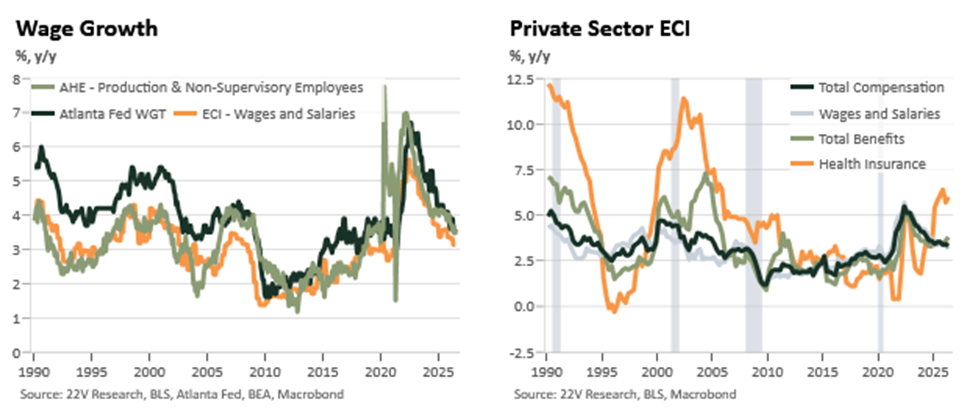
- Q2’s employment cost index slightly beat expectations at 0.9% q/q sa but overall wage growth trends seem fairly steady in the mid-3s.
- Private industry wages bounced after a few soft quarters from 0.7% to 0.9%. Over the past year, benefits growth has been modestly above wages and salaries growth reversing the pre-covid dynamic. This had been more common pre-affordable care act as healthcare cost inflation was a dominant driver of comp; it is now running at its hottest pace since 2005.
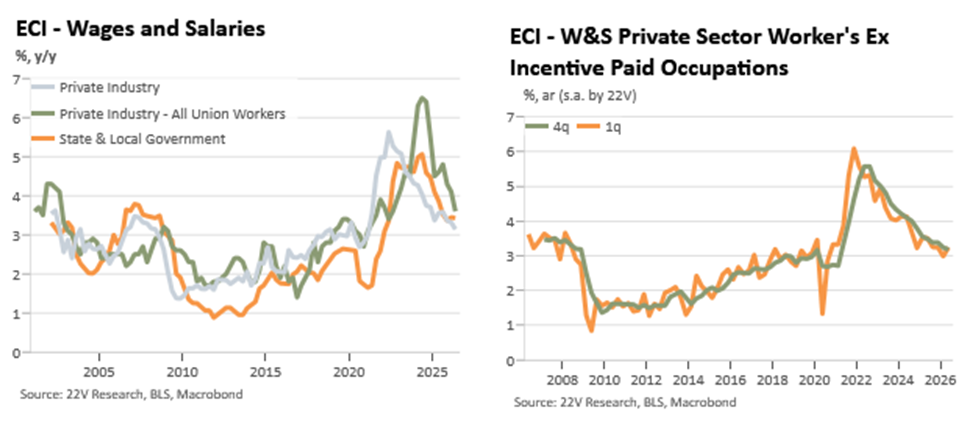
- There is still a catchup dynamic as well with union and public sector jobs seeing slightly firmer wage growth than the non-union private sector.
- Wages and salaries growth ex incentive paid occupations (core wage growth in effect and frequently cited by the Fed in that capacity) also seems to be steadying around its peak level from the last cycle.
Looking across measures, wage growth appears to be seeing a slowing in its multiyear deceleration over the past few quarters. As we’ve noted before, cyclical wage growth (at least in the monthly AHE data) seems to be firming and wage gains for job switchers have steadied. Given that labor market slack seems to have troughed late last year, a moderate lag between its stabilization and stabilizing wage growth measures seems reasonable enough.
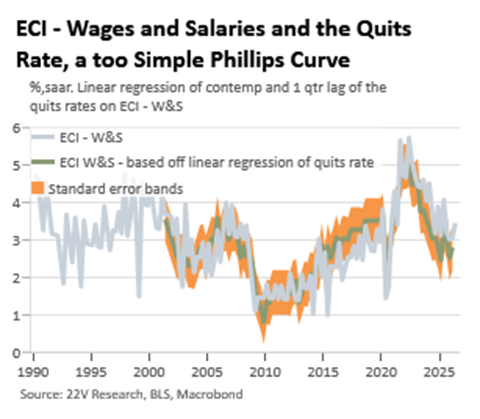
It is important to note that wage growth is running at an appreciably faster pace than just slack measures alone would suggest; higher inflation and potentially trend productivity growth may be playing a role in boosting wages relative to what slack levels alone would suggest. It is clear enough in most respects that economy has snapped to a new faster nominal growth trend post-covid. Taking that into account suggests that very low labor churn might be an appreciable drag on wage growth at the moment around a somewhat higher baseline run rate. The distinction between measures of labor market slack, such as the unemployment rate, and measures of job churn, such as the quits rate, which have normally been quite tightly linked but have sharply diverged in recent years.
While it seems reasonable enough for Fed officials to note that the labor market (whether a urate near its long-run value or wage gains that are only modestly positive in real terms) does not seem to be a source of upside inflationary pressures, strong private final domestic growth is. The implication of that statement is also more worrying than they seem to appreciate given that non-cyclical inflation is either a function of supply shocks (something we’ve seen many of recently and only in an inflationary direction) or underlying inflation shifting higher.