

The past few weeks have reminded me of 2025. For me, last year was defined by persistent fears of an AI bubble. There was hardly a month when institutional conversations did not revolve around a new concern: excessive hype, hallucinations, weak adoption, unsustainable capital spending, or the possibility that the technology would never generate returns commensurate with the investment. Many investors seemed more focused on explaining why they were not involved than on understanding how quickly the underlying capabilities were improving. It became a year-long AI therapy session.
That pattern began to change once the prior year’s returns were crystallized and the rise of the agentic world became more apparent to both the buy side and the sell side. Active managers entered the new year with cleaner P&L statements and a greater willingness to take risk, much like flowers beginning to bloom in spring. The anxiety remained, but positioning gradually shifted from watching the opportunity to participating in it.
The past three weeks have revived much of that same 2025 anxiety, although from a very different starting point. Last year, the pain came from missing the opportunity. This year, it has come from losing money while already invested. The emotional response is therefore more intense, but the underlying skepticism remains familiar. Investors are once again questioning whether the AI story is beginning to unravel, even as the recent volatility may simply represent another stage in a much larger structural transition.
The concerns have arrived in sequence. First came weakness in stock prices. Investors needed an explanation and found one in pressure on the token index. That led to renewed scrutiny of debt, return on invested capital, capital intensity, and the scale of infrastructure spending. As bubble concerns resurfaced, attention shifted toward rising competition at the model layer. Mythos was initially tested, pulled back under government pressure, and later released. Since then, we have seen major new models from OpenAI, xAI, Meta, and, most recently, Moonshot AI with Kimi K3, all approaching the capability level of Claude Fable 5.
The latest releases have revived fears that Anthropic’s lead is disappearing or that greater model efficiency will reduce the need for infrastructure. The reaction to Kimi K3 has been particularly revealing. As an open-weight Chinese model delivering high performance through a different architectural approach, its success has been interpreted by many investors as evidence that the AI investment case is weakening.
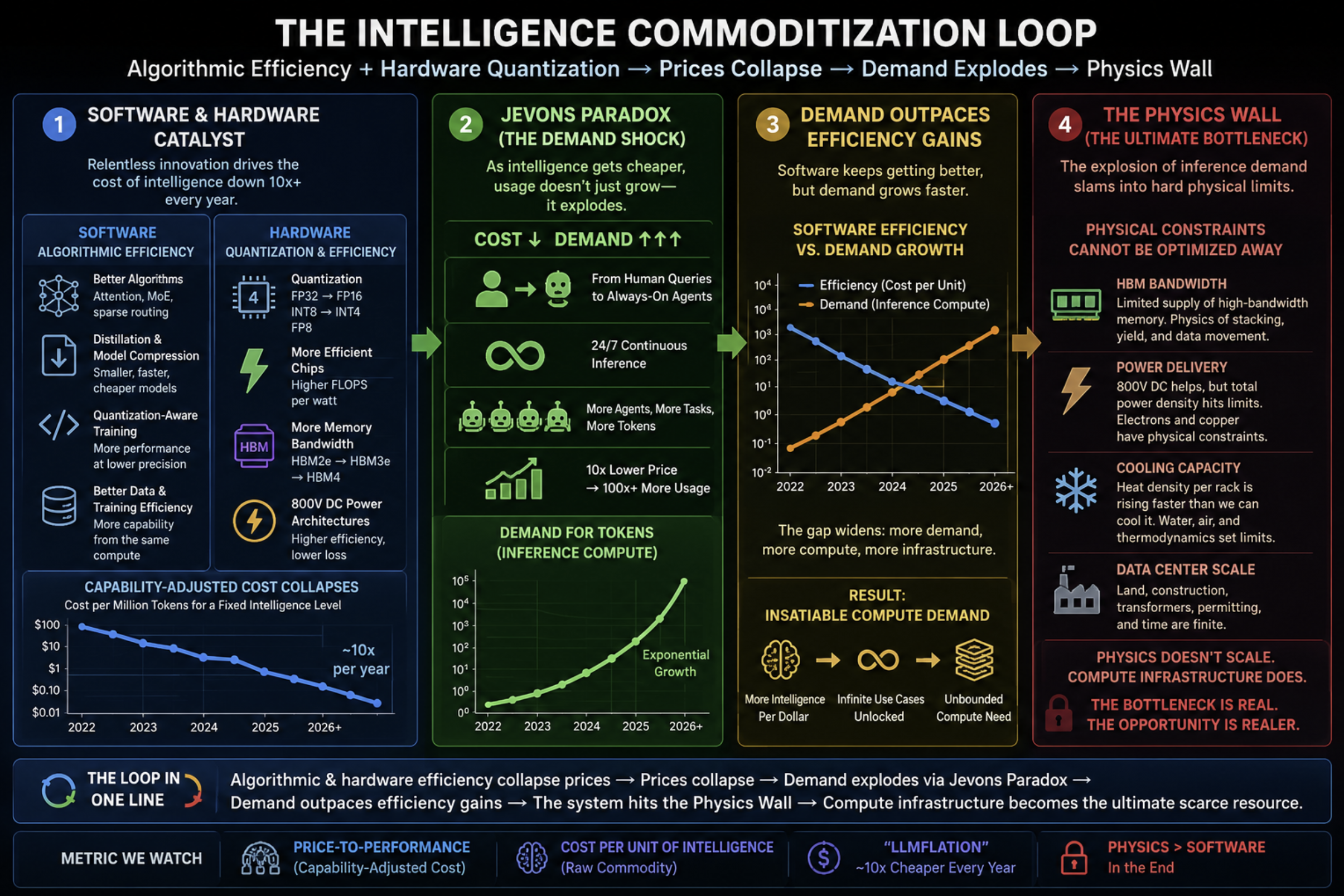
I see it differently. As in 2025, the market is mistaking a new stage of the cycle for the end of the cycle. The proliferation of high-performing models suggests that frontier capability is becoming less dependent on a single laboratory, architecture, or training strategy. Different approaches are converging on similar levels of economically useful intelligence, intensifying competition and driving down the capability-adjusted cost of AI.
That decline in cost should accelerate adoption. As models become cheaper, more reliable, and easier to deploy, enterprises will embed them across a wider range of workflows and applications. AI agents will operate for longer periods, perform more tasks, and generate far more tokens than today’s largely human-initiated usage. This is Jevons Paradox applied to intelligence: efficiency lowers the cost per unit of capability, while the resulting expansion in use drives total consumption higher.
The consequence should be an explosion in productivity at the application layer, accompanied by rising demand for compute, memory, networking, power, and data-center capacity. Model competition may compress economics at the model layer, but it broadens the market for intelligence and strengthens the infrastructure required to deliver it.
Over the past several years, investors have debated whether artificial intelligence will generate enough revenue to justify the extraordinary amount of capital being committed to chips, data centers, networking, and power. That framing has always been too narrow. AI can create enormous economic value well before it appears as a distinct new revenue line. Its first and potentially most powerful effect is to lower the cost of performing intellectual work, creating what I have previously described as intelligence liquidity.
In November 2025, I wrote a paper titled QE for the Mind: How Artificial Intelligence Is Flooding the Economy with Intelligence Liquidity. The paper argued that AI was replacing the financial liquidity of the QE era with intelligence liquidity, lowering the cost of work, expanding margins, and allowing companies to manufacture productivity through the income statement rather than engineer returns through the balance sheet. That framework fits directly with the current discussion because it shows where the benefits of falling model costs ultimately flow. Competition among Kimi, Meta, OpenAI, xAI, and others makes intelligence cheaper, while Jevons Paradox expands its use across agents and applications, accelerating both corporate productivity and aggregate compute demand.
Quantitative easing lowered the cost of capital and flooded the financial system with monetary liquidity. Artificial intelligence lowers the cost of cognition and floods the operating economy with problem-solving capacity. Where zero interest rates allowed companies to refinance debt, repurchase shares, and engineer higher earnings per share, AI allows them to automate workflows, compress decision times, improve asset utilization, and lower the labor and process costs embedded throughout the income statement. The original argument was straightforward: QE subsidized financing, while AI subsidizes productivity.
The recent releases of Moonshot AI’s Kimi K3, Meta’s Muse Spark 1.1, OpenAI’s GPT-5.6, and xAI’s Grok 4.5 provide the clearest evidence yet that the supply of intelligence liquidity is about to expand rapidly. Their importance lies in the fact that several organizations, pursuing substantially different technical and commercial strategies, are producing models with strong performance across coding, reasoning, tool use, multimodal understanding, and agentic knowledge work.
This marks the beginning of a breadth explosion in model capability. Frontier intelligence is advancing through multiple scaling approaches, all converging toward similar economically useful outcomes. The resulting competition is shifting the industry’s focus from maximizing raw capability at any cost toward maximizing performance per unit of cost.
Different Paths to the Same Economic Capability
Kimi K3 is perhaps the most provocative example because it combines frontier-level ambition with an open-weight strategy and a highly efficient architecture. Moonshot describes K3 as a 2.8 trillion-parameter model designed for advanced reasoning, long-horizon coding, and knowledge work, with a one-million-token context window. Third-party evaluations have placed it near leading proprietary systems on several complex and agentic tasks.
The precise architecture matters, but the broader economic message matters more. Kimi is attempting to create a vast reservoir of model capacity while limiting how much of that capacity must be activated for each unit of work. Sparse Mixture-of-Experts designs, routing improvements, optimized GPU kernels, and long-context serving techniques allow the system to extract more useful intelligence from each dollar of inference expense. Its open-weight distribution also increases pressure on the proprietary model market by allowing developers and enterprises to customize, host, and integrate the model more directly.
Meta is approaching the same frontier from another direction. Muse Spark 1.1 is a natively multimodal reasoning system designed around agentic orchestration, computer use, coding, tool calling, and the management of contexts as large as one million tokens. Meta emphasizes the model’s ability to divide complicated projects among parallel subagents, automate interfaces when scripting is more efficient, and compress context while retaining the information needed to complete extended workflows.
Meta’s research is explicitly focused on improving the amount of capability extracted from each unit of compute. The company says the pretraining advances behind the original Muse Spark allowed it to reach equivalent capability with more than an order of magnitude less compute than Llama 4 Maverick. It has also trained the model to compress its reasoning and penalize unnecessary thinking time, while using parallel agents to increase performance without allowing latency to rise proportionally.
OpenAI’s GPT-5.6 family makes the economic competition even more explicit. OpenAI introduced three capability tiers—Sol, Terra, and Luna—designed to deliver different combinations of intelligence, speed, and cost. Terra was positioned as competitive with GPT-5.5 at roughly half the price, while Luna targets the lowest-cost and fastest segment. OpenAI’s launch language emphasized “more intelligence from every token” and stronger performance per dollar, demonstrating how directly the frontier competition has moved toward capability-adjusted economics.
xAI’s Grok 4.5 represents another route. The model was trained across tens of thousands of NVIDIA GB300 GPUs, supported by large-scale reinforcement learning, data curation, asynchronous agentic rollouts, and extensive technical-task training. Even xAI, despite its willingness to deploy brute-force infrastructure, is now emphasizing token efficiency. Grok 4.5 is priced at $2 per million input tokens and $6 per million output tokens, and xAI says the model solves comparable tasks using materially fewer tokens and steps than several competing systems.
These organizations use different architectures, training recipes, distribution strategies, and inference systems. Moonshot emphasizes sparse scale and open weights. Meta emphasizes multimodality, orchestration, and efficient parallel agency. OpenAI offers tiered capability and adaptable reasoning effort. xAI combines enormous training infrastructure with reinforcement learning and token-efficient technical execution. Each is pursuing the same economic objective: producing more useful intelligence for less money.
That convergence is the defining signal.
From Token Maximization to Performance per Cost
The first phase of the frontier-model race rewarded scale almost without qualification. Laboratories competed to secure more GPUs, increase parameter counts, expand training datasets, and consume larger quantities of tokens. The industry was effectively maximizing the total amount of compute it could place behind a model.
The next phase is different. Enterprises purchase completed work rather than parameter counts, training runs, or benchmark prestige. They care about the cost of resolving a software defect, processing an insurance claim, generating a financial model, reviewing a contract, reconciling an account, designing a product, or answering a customer.
As adoption matures, the relevant metric therefore shifts from raw intelligence toward capability-adjusted cost: the price required to achieve a standardized level of economically useful performance. A model that appears inexpensive per token may still be costly if it requires four times as many tokens, repeated prompting, extensive human supervision, or numerous failed tool calls. A more expensive model can deliver superior economics when it completes the task in fewer steps and with less correction.
This is why the current releases are so important. Frontier laboratories are now competing across the entire production function of intelligence: price per token, tokens per task, reasoning efficiency, latency, reliability, tool-use accuracy, context management, parallelism, and the amount of human intervention required.
Enterprise customers are increasingly able to route different workloads to different models. The strongest reasoning model can handle high-value, ambiguous decisions. A cheaper model can process repetitive workflows. An open-weight model can support private or sovereign deployments. A multimodal model can interact with documents, images, interfaces, and video. Competition across this expanding model portfolio continuously lowers the blended cost of organizational intelligence.
The result resembles a global easing cycle for cognition, with competition rather than a central bank setting the rate. That easing is being produced by competing laboratories, improving algorithms, quantization, model distillation, better hardware, optimized inference software, and increasingly sophisticated workload routing.
Jevons Paradox Reaches Intelligence
The intuitive response to falling inference costs is to assume that companies will spend less on compute. History suggests that greater efficiency can lead to higher total consumption. Jevons Paradox holds that improvements in the use of a resource lower its effective price and expand the number of economically viable applications.
Artificial intelligence may represent the fastest version of Jevons Paradox ever observed because software can be replicated and deployed almost instantly. When the capability-adjusted cost of intelligence falls by a factor of ten, an enterprise can do much more than run existing workflows at one-tenth the expense. It can automate previously uneconomic workflows, devote more reasoning to existing tasks, and assign intelligence to problems that humans never had enough time to address.
A customer-service system moves from answering basic questions to resolving complicated cases. A coding assistant moves from suggesting individual lines to maintaining an entire software repository. A research tool moves from summarizing documents to continuously monitoring industries, competitors, regulations, and market developments. A logistics model moves from assisting dispatchers to optimizing thousands of freight decisions in real time. A financial application moves from producing static reports to continuously updating scenarios, risks, forecasts, and recommended actions.
The unit of consumption also changes. Human usage is episodic: an employee opens an application, submits a prompt, receives an answer, and moves on. Agentic usage is continuous. Software can monitor, plan, call tools, launch subagents, test outcomes, revise its work, and repeat the process without waiting for a human to initiate each step. One business process may generate hundreds or thousands of model interactions where a human previously generated one.
This is the moment when declining model prices begin creating a broad demand shock alongside the margin benefits available to early adopters. Intelligence becomes cheap enough to embed in every workflow, application, device, and machine.
QE for the Income Statement
The immediate beneficiaries are enterprises and application developers. In my QE Intelligence framework, a modest reduction in operating expenses creates a much larger increase in earnings because cost savings flow more directly to profit than incremental revenue. A 5% reduction in operating costs can produce a 20% increase in earnings per share under reasonable assumptions, while generating the same increase through revenue may require sales growth of roughly 13% to 15%.
Model competition now makes that operational leverage more accessible. Application companies can inherit improvements from OpenAI, Meta, Moonshot, xAI, Anthropic, Google, and other providers without financing frontier-model development themselves. Each new release can lower their input costs, improve product quality, reduce failed tasks, and expand the range of work their software can perform.
That transfers a significant portion of the economic surplus from the model layer toward users and applications. An enterprise may pay less for each unit of intelligence while obtaining a more capable system. The resulting benefit can appear as higher margins, faster product development, better customer retention, lower working capital, reduced error rates, greater employee productivity, or entirely new sources of revenue.
This is intelligence liquidity becoming visible in the real economy. So far, we have seen it most clearly in the rise of AI-native startups. In the coming quarters, large enterprises that successfully redesign their workflows will gain access to a continuously improving input whose cost is structurally declining. The effect compounds because each generation of models can improve the same processes again. Monetary easing moves in cycles, while technological deflation accumulates through better code, hardware, data, and organizational learning.
Intelligence Becomes Abundant, Physics Becomes Scarce
The final implication is that falling model costs are bullish for both applications and compute infrastructure. These outcomes reinforce one another.
At the model layer, competition commoditizes intelligence. At the application layer, cheaper intelligence increases margins and expands the universe of viable products. At the infrastructure layer, total demand rises because the quantity of intelligence consumed grows faster than the cost per unit declines.
Every efficiency gain unlocks more agents. More agents generate more tokens, tool calls, simulations, and actions. More inference requires additional accelerators, high-bandwidth memory, networking, power delivery, and cooling. Eventually, rapidly expanding software demand encounters physical constraints that improve far more slowly than software.
This is the physics wall. Algorithms can be revised overnight, while semiconductor fabrication plants, power generation, electrical grids, cooling systems, and data centers take years to build. Model architectures can reduce active computation per token, but the increase in total token volume can overwhelm those savings. Reasoning can become more concise, while cheaper reasoning is deployed across billions of additional tasks.
The most important message from Kimi K3, Muse Spark 1.1, GPT-5.6, and Grok 4.5 extends well beyond their individual benchmark scores. Together, they show that the frontier is broadening, competition is intensifying, and multiple technical paths are converging on high levels of useful intelligence. That competition is forcing every laboratory to maximize performance per dollar and pushing the capability-adjusted cost of cognition steadily lower.
The next phase of the AI cycle is likely to be defined by the consequences of that decline. Enterprises and application developers will gain access to increasingly abundant intelligence, allowing productivity improvements and operating leverage to spread beyond the technology sector. At the same time, Jevons Paradox will convert lower costs into greater consumption, pushing aggregate compute demand toward the physical limits of memory, networking, power, and cooling.
QE flooded markets with financial liquidity and raised the price of assets. AI is flooding the economy with intelligence liquidity and increasing the productive capacity of companies. The recent releases from OpenAI, Meta, xAI, and Moonshot suggest that this process is moving rapidly from theory into deployment, as competing approaches converge on similar levels of capability while driving the cost of intelligence steadily lower. That decline will expand adoption across enterprises, applications, and agents, creating both a productivity boom and an accelerating need for compute infrastructure. Investors should respond to this moment with less anxiety and more awe at the speed of advancement, because the defining feature of this cycle is not that intelligence is becoming scarce, but that it is becoming abundant faster than the physical world can support it. The pace of AI progress is exceeding our ability to absorb its implications, ensuring that this will not be the market’s last AI therapy session.

