

Bottom Line: UST Yield Points
Near term inflation risk, that would have led to tighter financial conditions has been lowered post CPI/PPI, but it is not gone. The Retail sales report indicated real personal consumption expenditures are running at +2%. As Gerard noted, there is a positive launch effect for Q3. The launch indicates real consumption will stay at +2% for 3Q. In short, the combination of +2% Real consumption and strong capital spending (~1% contributor to GDP growth) suggests economic growth is strong enough that inflation RISK will remain elevated. The above is why a September hike is still a coin flip and expect 10yr yields to hover around the 4.5% level for now. A slowdown in economic growth or labor market is necessary for 10yr yields to move much below 4.5%.
Relevant News: Rest of World Influence on UST Bonds
As John Roque pointed out yesterday, French 10-year yields are at their highest level in 17 years. John notes that G-7 bond yields trend homogeneously over time. The move in G7 bond yields reflects a broader shift to a higher-rate regime, driven by persistent inflation risks, large fiscal deficits, elevated government bond issuance, and stronger-than-expected economic growth rather than a temporary country-specific story. In short, don’t expect a sharp move lower in UST yields when the rest of G7 yields are moving in the opposite direction.
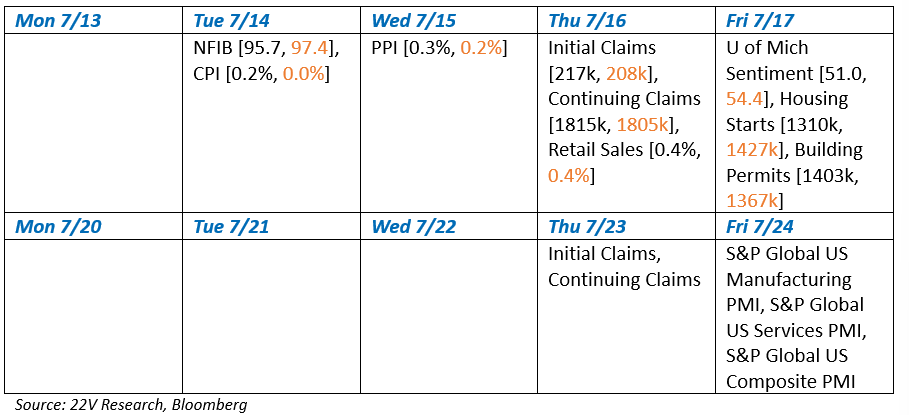
Things to Watch [Consensus, Results]:
Strategy:
Investor Focus on AI Capex Signals – (HERE)
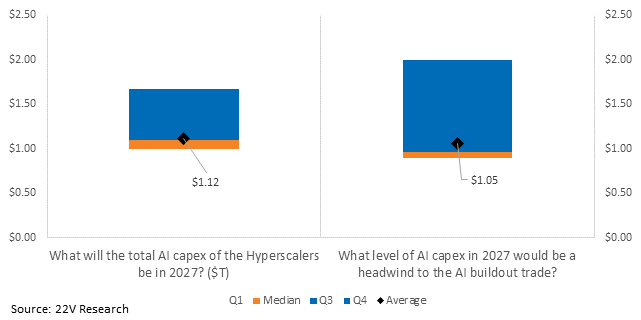
Most investors expect the level of Hyperscaler capex in 2027 (median $1.1T) will support the AI buildout trade. Investor estimates for 2027 Hyperscaler capex range from $1T to $1.7T, with a median estimate of $1.1T. Investors have a wide range of estimates for what level of capex would be a headwind to the AI buildout trade, ranging from $900B to $2T. The median estimate is just under $1.1T.
China:
US-China Risks Are Rising: Trump Speech | AI Competition– (HERE)
Thursday’s developments highlight rising strain in US-China relations across both politics and technology: Trump’s election-interference accusations risk complicating Xi’s planned US visit, while China’s rapid AI progress—underscored by Moonshot’s Kimi K3 and Xi’s support for open-weight models—intensifies competition and will lead to increased calls to slow China’s advance through tech restrictions. Together, these dynamics show the pressures building on the tech and supply chain truce that has been in place since last fall. Risks are rising that, post-US midterm elections, the US imposes new tech restrictions and China responds through tightening rare earths exports. The key near-term watchpoints are planning for Xi’s visit and how both sides manage the escalating AI rivalry.
Europe:
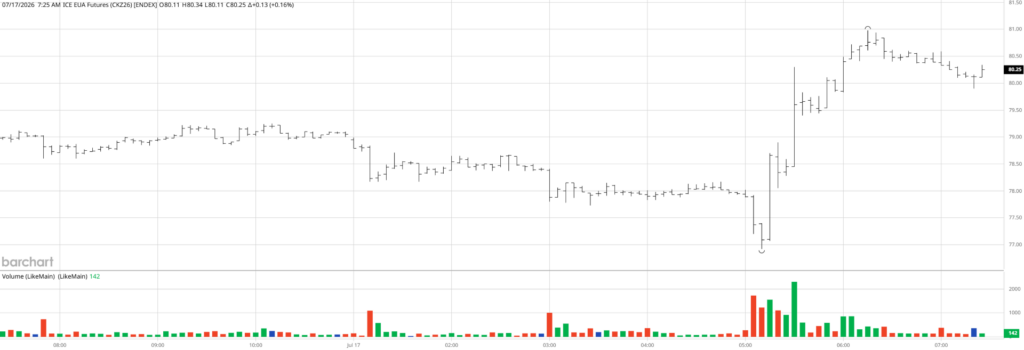
Iran Standoff Continues To Go Around In Circles And The EU Stays The Course of Carbon Pricing – (HERE)
First, the base case remains a prolonged but contained U.S.-Iran conflict: while rhetoric and limited military escalation have intensified, muted oil prices reduce pressure for a diplomatic breakthrough while also making a return to full-scale war less likely. The key variable remains oil—if prices stay contained, a “no war, no peace” equilibrium of low-intensity conflict could persist, whereas a sustained move above $100/barrel would likely push the Trump administration back toward negotiations. Second, the European Commission reaffirmed its long-term commitment to decarbonization by strengthening the EU Emissions Trading Scheme and expanding electrification initiatives, signaling continued reliance on carbon pricing despite competitiveness concerns and the likelihood of prolonged negotiations before implementation.
Source: ICE

