

I noticed Bloomberg had an opinion piece today arguing that when the labor force participation rate is adjusted for demographics, the figure looks very high, rather than depressed. I will skip linking to the piece because I do not want to spread misinformation and because my momma told me to criticize by type, not name, and sometimes I even take my momma’s advice.
Demographic influences are very important and the journalist is wise to want to adjust for them. What struck me as odd and perhaps telling is that the journalist felt a need to do the work by hand, when he could have just compared the actual participation rate with the CBO’s estimate of the potential participation rate. As you can see from the chart below, the overall participation rate is extremely depressed relative to the CBO’s estimate of its potential. In other words, the authoritative take on this is the opposite of what the journalist claims. Not a slight challenge to his take, but implying that he has the sign wrong on a big magnitude.
Yes, there are tons of things going on here and we need to take all these data with a grain of salt and a large dose of Bayes, as I get to below. There may be a trend to early retirement associated with the stock market or end-times reasoning, which the CBO could not be expected to pick up in real time. But if you want to adjust for demographics, it is probably best to farm out that task to people who spend all day every day worrying about it.
So, I asked the journalist about this. His response was to send me my own chart but with the most recent plunge in the actual rate missing, I assume because he wanted to stick with the CBO’s approach of reporting quarterly averages. He also suggested that his guess is that the CBO is missing the recent big swing of demographics.
CBO is aware that immigration changed
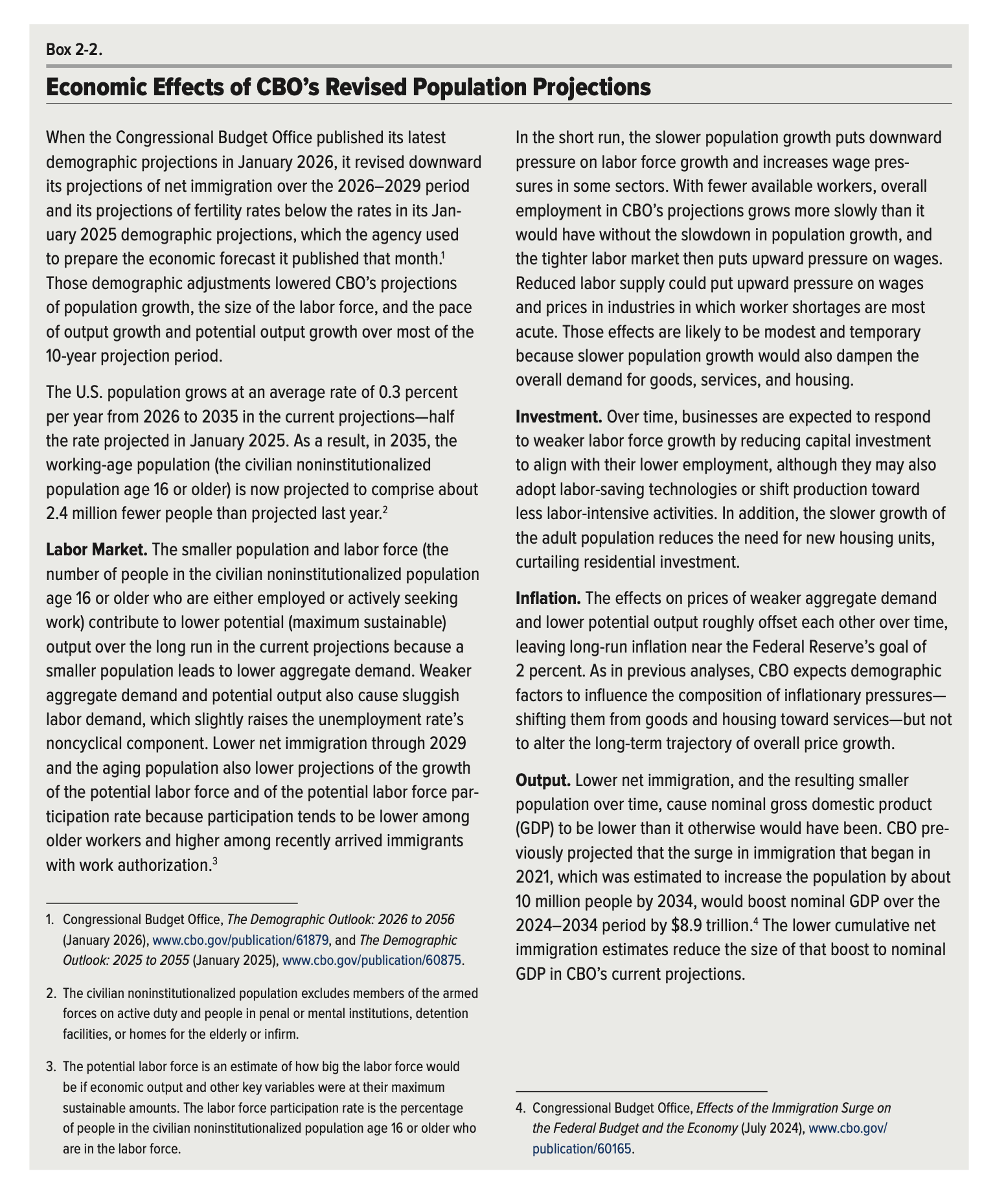
Above, I copy the special item box that the CBO published in their most recent update, admittedly from February, where they are crystal clear that they are dutifully and carefully incorporating the new information there. So, the journalist got it backwards and when reminded of it casually slandered CBO. Cool cool.
Where this matters from a mercenary perspective is that I do think that people are being a bit too dismissive of the recent collapse in the participation rate and employment / population ratio. (This is not mainly about the journalist. He was explicitly agnostic on June and trying to address the bigger picture.) Having been weaned off their view that the labor market was about to stumble, they are now hesitant to do the Bayesian updating in the other direction. The labor market looks a bit less robust than it did. Saying the June participation rate and related e/pop are misleading is both highly plausible and beside the main point. The mean of the probability distribution is always in motion. We should try to identify it and move with it.
The immigration issue has not affected participation best guess much
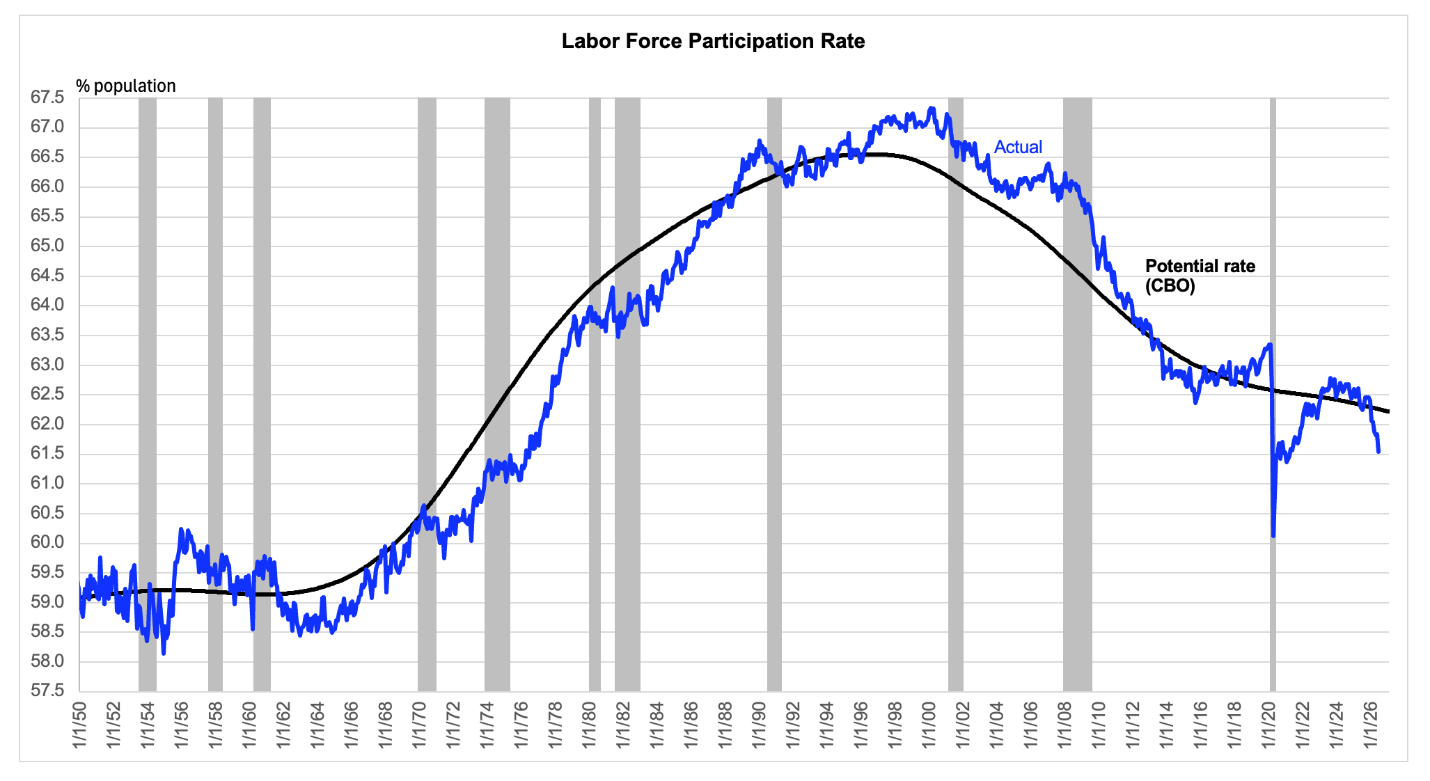
Potential participation rate is February vintage. Labor market data are actual to June.

