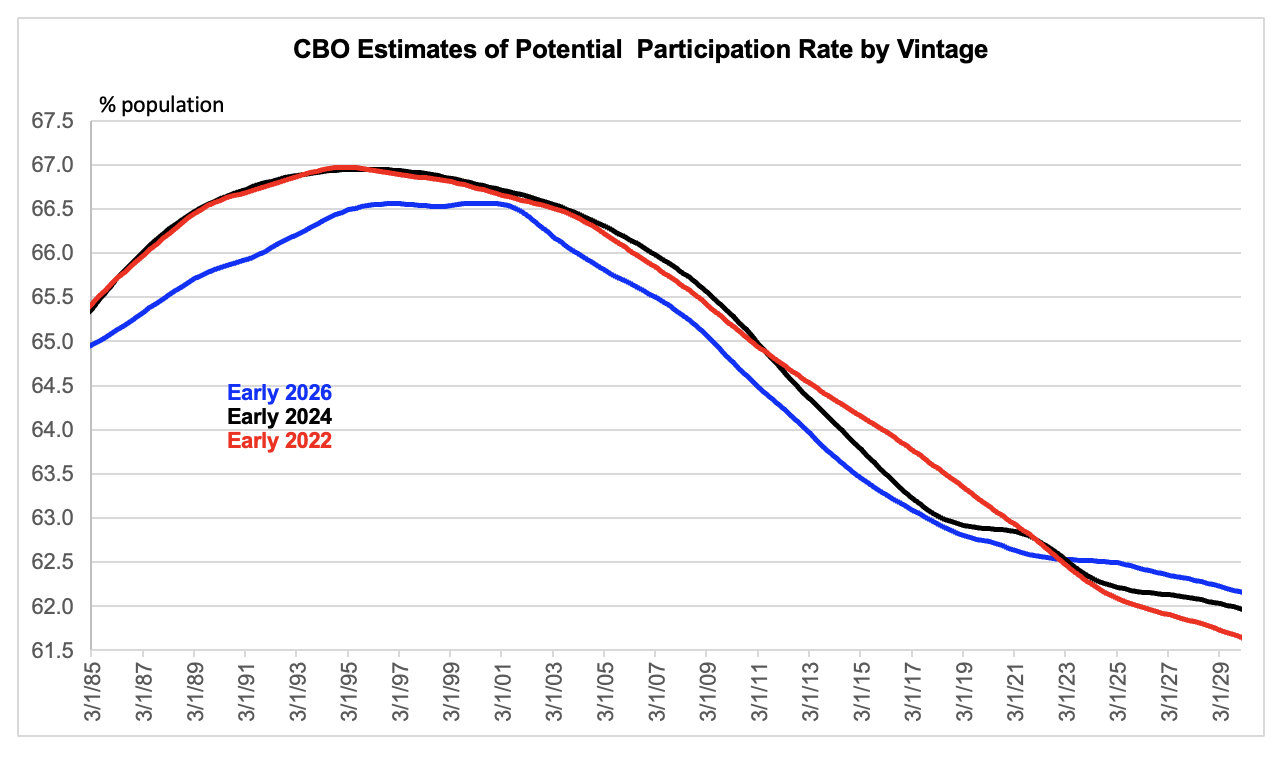
I apologize for hitting you twice with a note on the same subject. But it occurred to me after I sent my last note that I should check how the CBO’s estimates of the potential participation rate have changed over the past few years of wildly shifting immigration patterns.
In the forecast and for the contemporaneous period, changes to the estimated labor force participation rate are driven primarily by demographics. Demographics are not the only variable driving estimates of the potential labor force participation rate, but the other influences, like wealth effects, the opportunity cost of leisure, or cultural change, are easiest to estimate in retrospect.
lt would be very convenient if the CBO broke out its estimates of the participation rate into demographic influences and “other.” And maybe they do somewhere, just not to my knowledge. However, a working man’s proxy of the estimated effects of demographics would be the rate of change of the potential participation rate recently and in the near future. Note in the chart below, that the estimated effects of aging are both slowing relative to history (slope of blue line) and getting revised weaker (relative slope of lines).
So, it would be odd to say that the recent plunge in the labor force participation rate is mostly about demographics. Of course, demographic influences come in two forms. First, there are just changes in the distribution of numerical ages, etc. That is what most people mean by demographics. But there are also intra-cohort effects, occasioned by people living healthier lives or by shifting over time into occupations where age is less a disadvantage. For example, macro analysts can go longer than coal miners. And this is implicit in the CBO’s estimate of “demographic” effects, which I assume drive the slopes of the lines for the very recent periods and the nearby outlook.
My own view is that intra-cohort effects are legitimately demographic. As they say, especially when old, what’s in an age? Seriously, what do we really mean when we say “age?” Age-related tendency to work? Well that depends on age and the derivative of tendency to work with respect to age. This is example MCMXVLXI in my case against essentialism in macro.
I admit to making an appeal to authority here. I am strongly inclined to go with CBO over back of the envelope calculations. But this is a kind of interesting subject. Having looked at this, I am a bit more committed to my earlier practical point. But this is probably worth understanding better. It is seemingly not what people think.
CBO seems to be backing away from idea that population aging matters much