DAILY STRATEGY: Yesterday we laid out equity internal sensitivities to 10yr yields given a higher fair value range for the 10yr. Higher yields caused by a higher neutral rate + a mild degree of restrictiveness supports continued fundamental factor leadership, but it will take the market time to digest a higher neutral rate. For now, internals are still reacting to yields above 4.5%.
Reescalation with Iran is putting upward pressure on yields and we don’t know if that will continue. We are more focused on the potentially more durable upward pressure on yields ex-Iran given nominal demand indicators are accelerating higher.
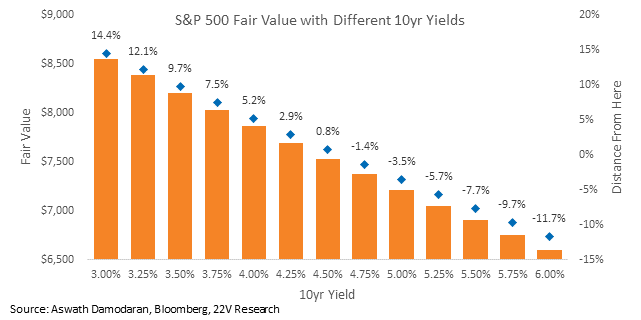
Today, we focus on the S&P 500 index level. The setup is similar. The S&P 500 is increasingly sensitive to 10yr yields above 4.5%. Over the medium term, however, higher 10yr yields are driven in part by a higher neutral rate not restrictive policy, making the increase less of a market headwind. Leaning on our fair value model*, the 10yr moving from 4.25% to 4.5% is only a -2pp hit to fair value.
Setting aside the mechanics of our fair value model, the underlying economic backdrop does not suggest 4.5% is a problem. Two or three rate hikes to get nominal demand back down to +5% does not imply meaningfully high recession odds. The economy is resilient thanks to remarkably healthy consumer and corporate balance sheets. IF demand falls too quickly, the Fed has room to cut rates. This is not like the post-GFC when the Fed had no room to cut and spurring demand was the problem.
For the index more specifically, there is a once in a generation general purpose technology that appears to be delivering margin expansion (HERE). Earnings are expected to grow +25% this year. A 10yr yields at 4.5% does not jeopardize that growth.
Net net, a higher rate environment is not a reason to get short the S&P.
*Our fair value model, based on the work of valuation guru Aswath Damodaran, discounts future cash return (dividends + buybacks), akin to valuing the index like a single stock.
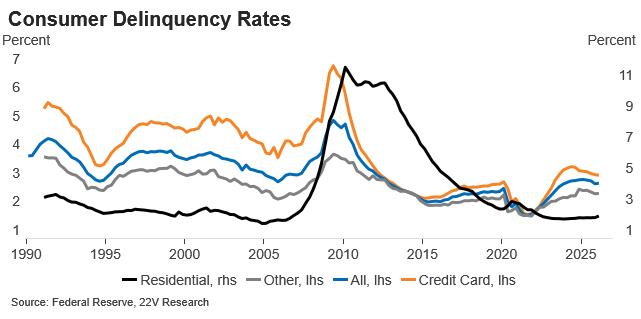
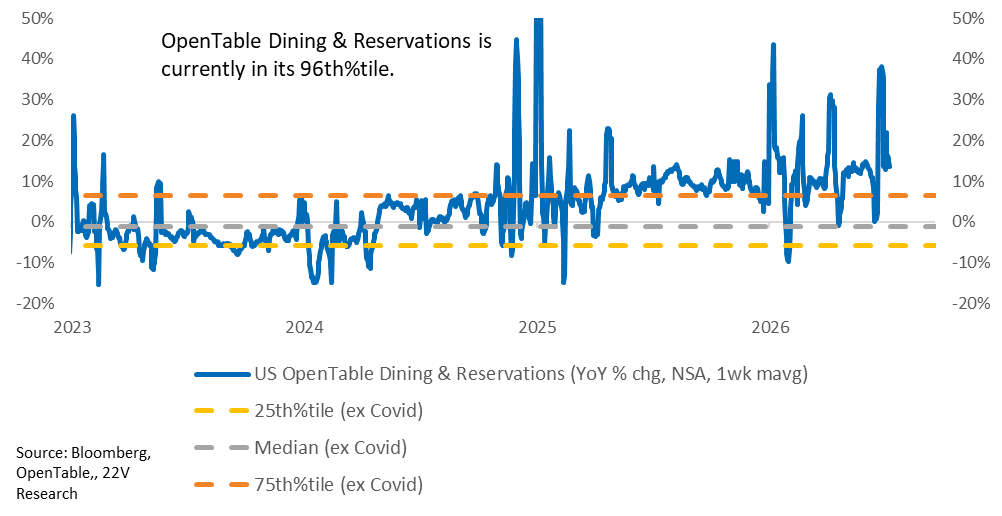
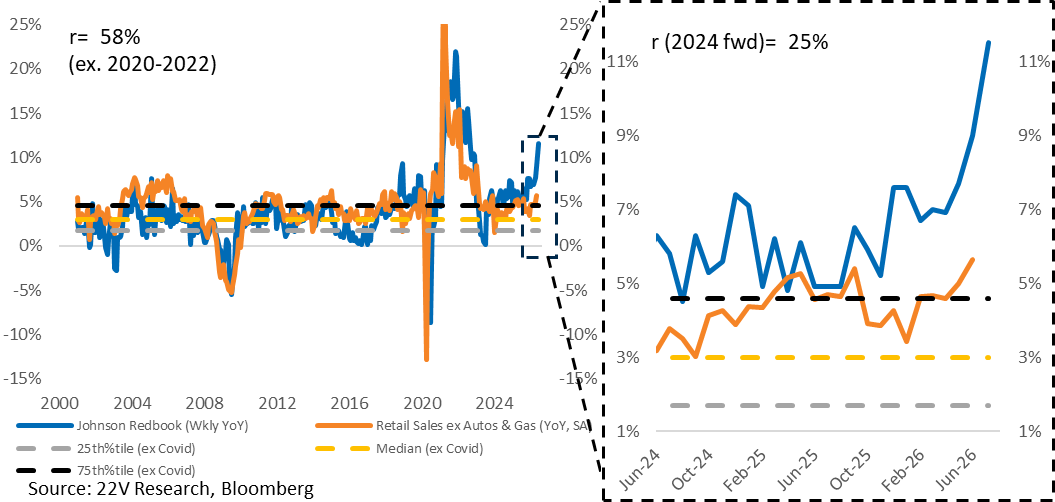
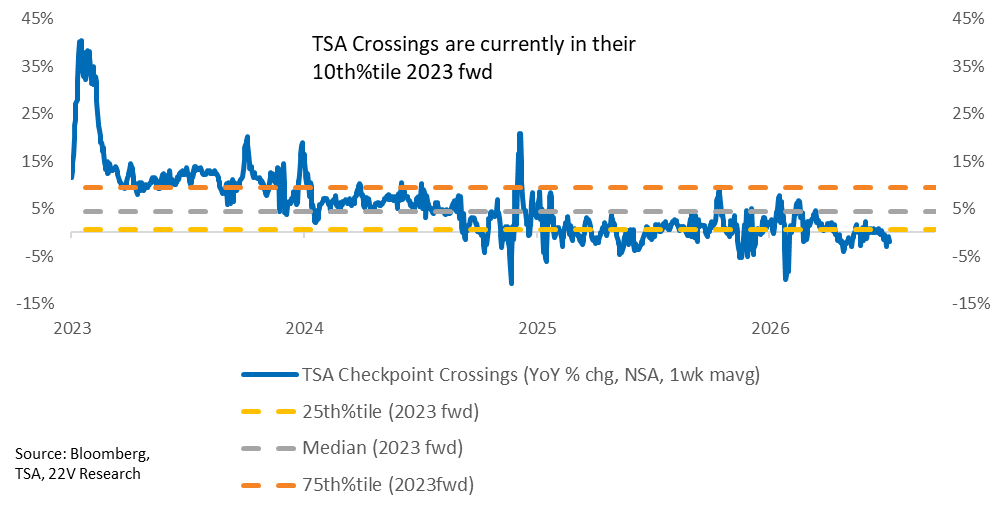
MORE ON DEMAND: High frequency indicators of demand are inflecting higher. Johnson Redbook Same Stores retail sales growth is +11.5% YoY. OpenTable dining is trending higher, now to +15% YoY. TSA crossings are flat YoY despite higher airline ticket prices and Spirit dropping out of the market. Consumer delinquency data is improving. Charts below.
Charts…
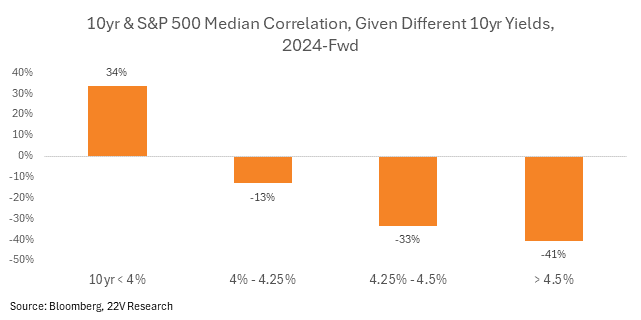
The S&P 500 is increasingly negatively correlated to 10yr yields after yields increase over 4.5%. We suspect higher yields won’t be a medium-term headwind given they are moving higher partly to reflect a higher rate of neutral, rather than restrictive policy.
S&P 500 Fair Value based on different 10yr yields is below. Higher yields are a headwind via a higher discount rate and a lower cash return ratio (more earnings must be retained to grow earnings at the risk-free rate). The headwind is small in magnitude; the 10yr yield moving from 4.25% to 4.5% shaves -2pp from Fair Value. That is inconsequential compared to earnings growth.
OpenTable dining reservations are trending higher.
Redbook same store sales are now at 11.5% YoY.
TSA checkpoints crossings are flat YoY despite higher ticket costs and Spirit Airlines going out of business. FYI, Airlines are talking about how they aren’t lowering prices because demand has been so surprisingly strong (HERE).
From Peter Williams yesterday, “After a few months of strong nominal (although still negative in real terms) consumer credit growth, it went slightly negative again in May.
Continued US consumer deleveraging is likely necessary but not sufficient condition to keep the economy from overheating (if we were seeing debt/income rising it would be much harder to realize disinflation) but is also a source of cyclical robustness. Consumer balance sheets look great, delinquencies are flat-to-down, and nominal income growth is solid-to-strong.”