

Main point: Governor Waller’s speech yesterday carries a reminder of the dangers of trying to shoehorn every inflation episode into the Phillips Curve. Relatedly, we need to pay attention to what inflation in goods and services market is doing, rather than relying exclusively on what it should be doing, according to one income and even dubious model. Separately, interest rate guidance does not really even exist when the economy is safely away from liquidity trap or the effective lower bound on interest rates. So, obsessing over its influence is not a great use of time.
Fed Governor Chris Waller gave an interesting talk in Rome yesterday, ostensibly on the role of rates guidance within monetary policy transmission. I think he made some largely valid points on the main subject, which I will get to below. But what most interests me here is the apparent confirmation bias in his discussion of the drivers of the disinflation that followed the Biden fiscal stimulus. His comments fit my view that an attempt to shoehorn all inflation cycles into the Phillips Curve can lead to both confusion and a discrediting of the actual role of labor market conditions in the inflation process.
Waller is on solid ground when he points out that the disinflation after the middle of 2022 ended up being much steeper – and less dependent on a sharp rise of the unemployment rate – than some interpretations of the Phillips Curve had suggested at the time. Waller argues that the reason for this is that the inflation was caused as much by vacancies as by a depressed unemployment rate and that the cure was largely a renormalization of vacancies once Covid-related matching frictions in the labor market abated.
In other words, he accepts the consensus intuition that the whole discussion must be nested in the Phillips Curve, but – simplifying – he believes that the best measure of labor market slack is the ratio of vacancies to unemployment, rather than the gap between the unemployment rate and its estimated (long-term) natural rate. Waller’s take does fit the data and – to his credit – he has not developed this take in retrospect. He was also offering it in real time.
But another interpretation is possible, one that I used to call “Two Stage Disinflation.” This interpretation holds that much of the inflation surge during 2021 and 2022 reflected that businesses did not attempt to adjust their output to the huge nominal demand surge related to the re-opening and Biden fiscal stimulus. As a result, the nominal demand pulse went as much into price as into even desired output, which meant that the inflation pulse was larger than what could be rationalized by labor market tightening, however measured. The labor market did tighten, but it was not the only or even main driver. Somewhat related, I suspect, without being able to prove, that the apparently ad hoc reliance on elevated vacancies was a convenient way to shoehorn the outsized inflation rise into the Phillips Curve. After all, confidence in the role of vacancies developed after the spike in inflation.
In fairness, I adopted the Two-Stage Disinflation thesis after Waller came up with his emphasis on vacancies. So, I need to be careful about tense here. But the thesis held that a lot of disinflation would be delivered by the mere passing of the Biden fiscal stimulus. And it argued further that the last mile of disinflation would probably require a rise of the unemployment rate of about a percentage point (I said), something Waller had dismissed as largely unnecessary. In the event, the unemployment rate did end up rising all the way to the Fed’s estimate of the natural rate, which fit my take. And this gives rise to a minor irony. By trying to fit the entire episode into the Phillips Curve, the conventional view missed that the labor market did in fact have to ease the hard way, i.e., via a rise of the unemployment rate. Of course, that increase of unemployment was not associated with outright weakness, let alone recession, because we stumbled into a population boom, which is a separate discussion.
The point here is that there are at least a couple competing interpretations of what happened after the middle of 2022, and so it might not be right for the pitcher to be calling strikes and balls here. But score settling or unsettling aside, what are the practical implications of this debate?
I would say there is one related to method and one related to our read of current conditions within a particular method. The method issue is that it is not obvious that every inflation cycle can be fit neatly into the logic of the Phillips Curve. And even if we were to accept the logic of the Phillips Curve as fully determining, we need to be aware that we don’t really know the correct quantification or parameterization of it. Is the natural rate where we think it is? Should we be using the unemployment rate or, say, the ratio of vacancies to unemployment or some other metric?
The second issue is closely related to the first. Let’s say that we accept Waller’s view – that the correct measure of labor market tightness is the ratio of vacancies to unemployment. That measure shows quite a bit of tightening recently. It also suggests that the labor market is as tight as at any point in the history the ratio can be calculated, excluding the Biden inflation period. So, if this is the metric, then Waller should be leaning hawkish, not dovish. But we don’t really know. And we should therefore keep our minds open to the possibility that something other than the Phillips Curve can drive inflation cycles. Closely related, we need to watch how inflation is actually behaving, rather than lecturing it about how it ought to be behaving, based on that highly reductionist and dubious construct.
Vacancies helped make the 2021-22 labor market tightening look more dramatic
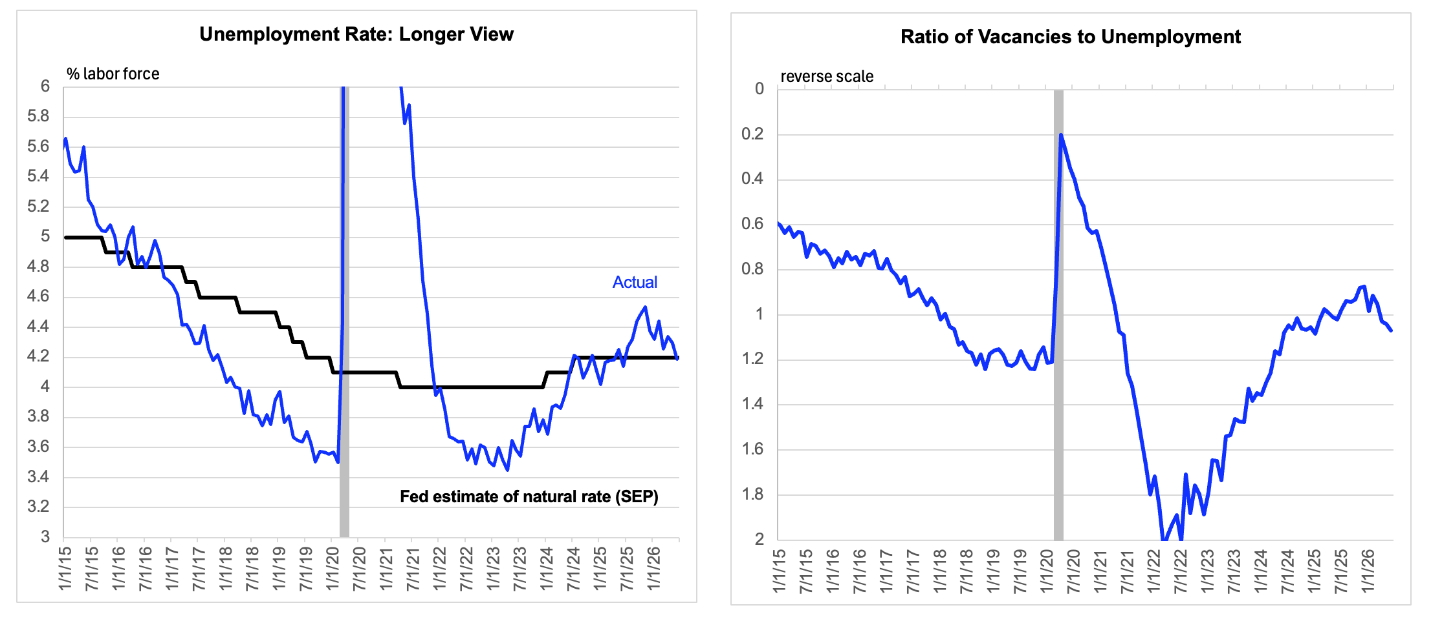
Unemployment rate is actual to June. The vacancy data are actual to May but I assume that vacancies are unchanged in June to allow an estimate of v/u for last month.
Rates guidance as a means of reneging
On Waller’s discussion of guidance within monetary policy transmission there seems to be less to quibble with, at least regarding the facts. Waller says that guidance can speed monetary policy transmission, especially if (my spin) the Fed is constrained by earlier promises not to raise the funds rate until a certain set of conditions are met. That seems right, although the practical lesson I take from it is a bit different than Waller’s.
Waller specifically mentions the run-up to the initial Fed rate hike in March 2022. On his reading, which seems right, the Fed was able to deliver a tightening of financial conditions well in advance of that via forward guidance. And he infers from this that forward guidance can be quite helpful in shortening the lags.
But we need to remember the context of that period. As Waller himself mentions, the Fed had committed to a very dovish – indeed time inconsistent – reaction function with the release of the September 2021 Press Release, which operationalized the framework review concluded in August. In a case of extremely bad luck, the inflation backdrop deteriorated dramatically shortly after the September FOMC meeting and the Fed faced fairly immediate pressure to renege. But they were hesitant to do this explicitly, so they engaged in two tricks. First, they slightly moved the goalposts around what they had promised. And second, they used forward guidance to deliver a tightening of financial conditions without actually raising the fund rate – until March 2022. Clearly, this experience is a comment on the dangers of time inconsistent forward guidance and not on the advantages of using forward guidance to speed monetary policy transmission to the real economy. Waller’s interpretation of this event seems both wrong and, if I may, extremely self-serving.
The whole experience left a sour taste in the mouths of Fed officials and inclined them away from using forward guidance in the future, especially when not needed. And it is a basic principle of monetary policy, I think, that forward guidance is not needed when the economy is far away from liquidity trap and the Fed has ready resort to interest rate cuts, if needed, to support aggregate demand. This is a point I have been pushing for a while and I notice it recently surfaced in a Bloomberg Opinion piece written by former NY Fed President Bill Dudley, which I circulated. When away from the zero bound, rates guidance is all disadvantage and no advantage, to the point where it is only a slight exaggeration to suggest that rates guidance does not exist. So, obsessing about how to contain its damaging effects is not the best use of time. It is not that Waller – or even Warsh – are wrong on the somewhat distinct points they raise against rates guidance in the current setup. It is that they are tilting at a windmill.

