

Business professor and politics blogger Scott Galloway has an interesting thesis that China could do severe damage to the US* simply by giving us their cheap AI. A key premise of his argument is false, and I think by enough to disqualify the argument itself. But as often in matters like this, there is an interesting kernel that we ought not overlook simply because the argument seems wrong overall.[1]
The premise of Galloway’s argument is that the US* business cycle is propped up on an AI bubble. Leaving aside whether the AI impetus is anchored in a bubble, Galloway is wrong in his specific claim that more than half the GDP growth, by which I assume he means demand, during the past two years has been AI capex.
There are two problems with this old chestnut, at least as typically expressed. (I am not sure where Galloway gets his figures.) First, analysts often measure the add to GDP in terms of real dollar aggregates, rather than doing proper chain weighting. This may sound like a pinheaded quibble, but it really matters when relative prices of the goods directly involved are moving rapidly and the base period used to create the real dollar aggregates is in the distant past, both of which apply in spades in this application. Macro is hard and the data here are imperfect and incomplete, but let’s at least avoid the super obvious errors.[2]
Maybe they mean Taiwan?
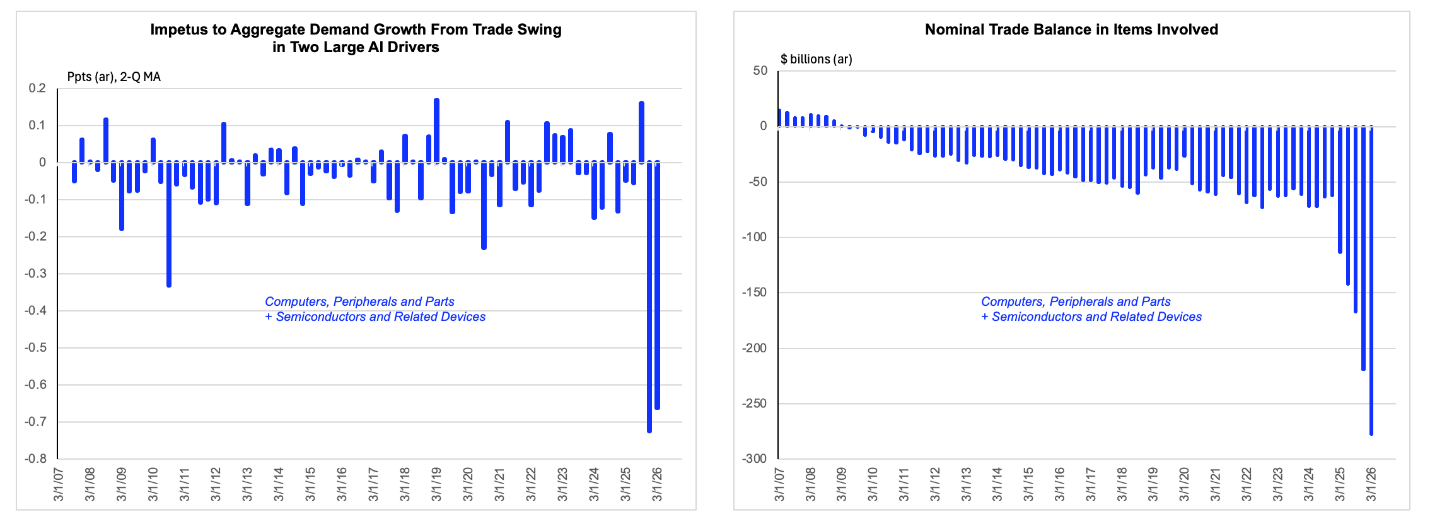
Data are actual to 2026 Q1.
Second, many of those capital goods to which Galloway refers are importable, which means that there is trade drag that is directly endogenous to the capital spending impetus itself, even if properly measured. One way to get around this issue is to look at value added analysis, as I have emphasized. But that brings up other issues, such as the role of inventories and the impetus to value added further up the supply chain, and I recognize that it is a bit abstract anyway. So, to make this more tangible, just take a look at the drag on GDP growth from the swing in net exports recently in two major capital goods items that are directly related to AI. Maybe the AI boom here explains more than half of Taiwan’s GDP growth over the past two years. But the US*? Not so much.
The problem with radically overstating the impetus to US* aggregate demand growth from the AI buildout is that it results in also overstating the hit to US* GDP growth in the event the AI boom were merely to slow. Indeed, Galloway makes this very mistake (0:40). And there is the peripheral issue of whether a hit to aggregate demand here would affect the rates path or realized GDP. If you believe, as I do, that the speed limit is the more binding constraint, then such a hit would operate more on rates than on realized GDP growth. And this is especially the case if the likely hit is moderate, rather than the overwhelming shock that Galloway has in mind.
But let’s not throw the baby out with the remedial arithmetic errors. Until recently, I have been making the case that the AI boom is not only the main driver of GDP growth but that it is more likely than not sustainable anyway. The second part of this thesis has arguably aged out, because the spending side of this boom is now looking a bit more extended than it did previously, although thankfully it is not yet supported by credit excess. Moreover, we are now getting signals from both the companies involved (e.g., Anthropic) and informed observers (e.g., Galloway’s insight) that there may be some discipline imposed here.
Galloway imagines the Chinese undermining the US* by giving us free AI. Part of the way they would damage us would be directly through the aggregate demand side, which is overstated, as discussed. And part of it would be through the stock market, because much of the rally is propped up on this AI boom, which seems like a less controversial claim to me, although I defer to my betters there. It does seem like it would be quite relevant across a lot of fronts if China were somehow to bridge the moats that the AI leaders have spent so many hundreds of billions trying to dig. To me, that is the kernel that we ought not ignore simply because some of the arithmetic is wrong.
It is also fun to ask if this would be a way for China to damage the US*? Subject to Galloway’s basic (non-macro) insight being correct, I would say this would be a matter of timing. If China were to let this run for a couple years until a gigantic bubble formed and then were to release the cheap AI, then yes, that would seem predatory and cleverly so, especially if they later withdrew the cheap AI somehow. Absent that, I am not sure a free productivity boom is a threat.
But that aside, if Galloway is right in its basic premise, then China doing this now would be a major favor to the US*. True, the AI leaders’ equity would get crushed, but that would be a loss to their shareholders, not the US* economy overall. And it is coming at some point anyway, on Galloway’s logic. Indeed, China would be saving us from a massive misallocation of capital, if Galloway is right, and if China were to act now. Not that I know, but that would be how I would bet. This might be the undead version of China selling our Treasuries. Remember that one? Less snarkily, I do think the reflex to view the outlook for US economic growth as being entirely about the demand side is a vestige of long past liquidity trap.
[1] H/t FIFA for the asterisk.
[2] Relatedly, errors like this matter more to the share of GDP growth when GDP growth is itself slow, as it has been recently, necessarily, because of the speed limit issue.

