

The BEA has announced that it will be revising the methodology used to calculate three separate contributions to the PCE inflation rate. These involve prices for portfolio management and advisory, legal services, and software.
The effect of the last two items is expected to be roughly offsetting on the recent 12-month inflation rate, with the contribution from legal services moving higher and the contribution from software moving lower by just slightly more. The net effect will probably be slightly negative, on the order of a couple bps or so. But the real action will be in those notorious portfolio management and advisory fees. The contribution to the 12-month rate of inflation during May may be revised down by about 15 bps.
It will still be a positive number, but keep in mind that the weight assigned to portfolio management and advisory has risen steeply in recent years, with the broader trend to financialization. So don’t think of the “normal” contribution being zero. For example, if this item’s inflation rate had mirrored overall PCE inflation during the 12 months to May, the contribution would be seven basis points. I make this point because others do not seem to. But, yes, the main point is that contribution is set to be revised lower, by about 15 basis points.
This will have very little effect on my sense of the underlying trend in inflation because I have long stripped out portfolio management and advisory fees as a matter of course. The way the government has measured these prices is obviously misleading and has created a false impression that a rallying stock market is inflation. In the past this quirk did not matter much, but during the past two decades the weight assigned to this item has doubled, while the inflation rate has gone up with equity returns.
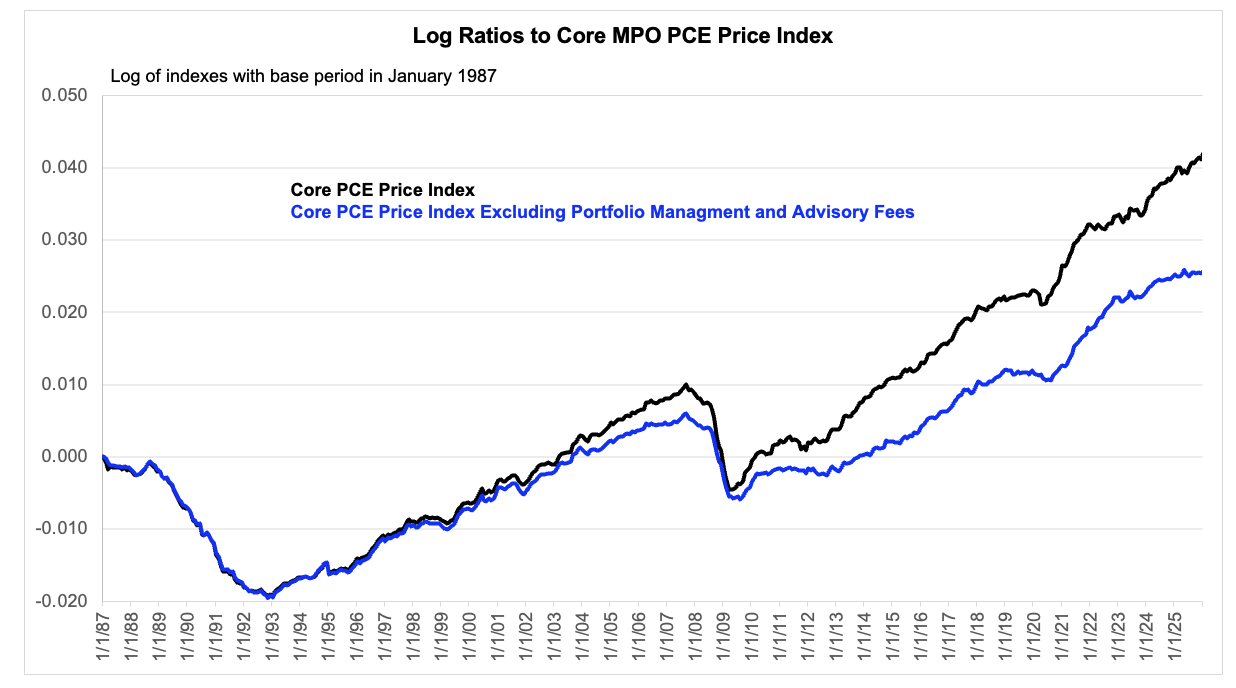
There is a secondary consideration here, though. I have long pointed out that it is wise to strip out portfolio management and advisory fees which is mostly simply done by observing the trend in the Market Price Only (MPO) version of the Core PCE. That stripping eliminates a big source of noise, especially at short horizons, as discussed. But one implication of it is that it introduces a slight downward bias in the reported inflation rate over time because non-market prices tend to rise relative to market prices over time.
BEA reminded me to look more closely at this
Data are current vintage to May 2026.
The way I handled this was to add 20 bps to the measured 12-month change of the Core MPO to get a sense of underlying inflation. This roughly accommodates the fact that the gap between Core PCE inflation and Core MPO inflation has been 27 and 17 basis points over the past 10 and 20 years respectively. If portfolio management and advisory fees are now to be correctly measured and if that correct measurement means they rise in line with the rest of the Core PCE, then the relevant gap would be closer 15 basis points, based on 10- and 20-year inflation differential of 20 and 10 basis points. This is reflected in the blue line in the chart above having a slightly less steep trend than the black line. The actual effect should be sightly lower if the “true” rate of inflation and portfolio management and advisory fees is quicker than that in the rest of the Core PCE. This will be most obvious if the new data show that, as they probably will. But strictly speaking it would be the case so long as the premise is true, whatever the data show.
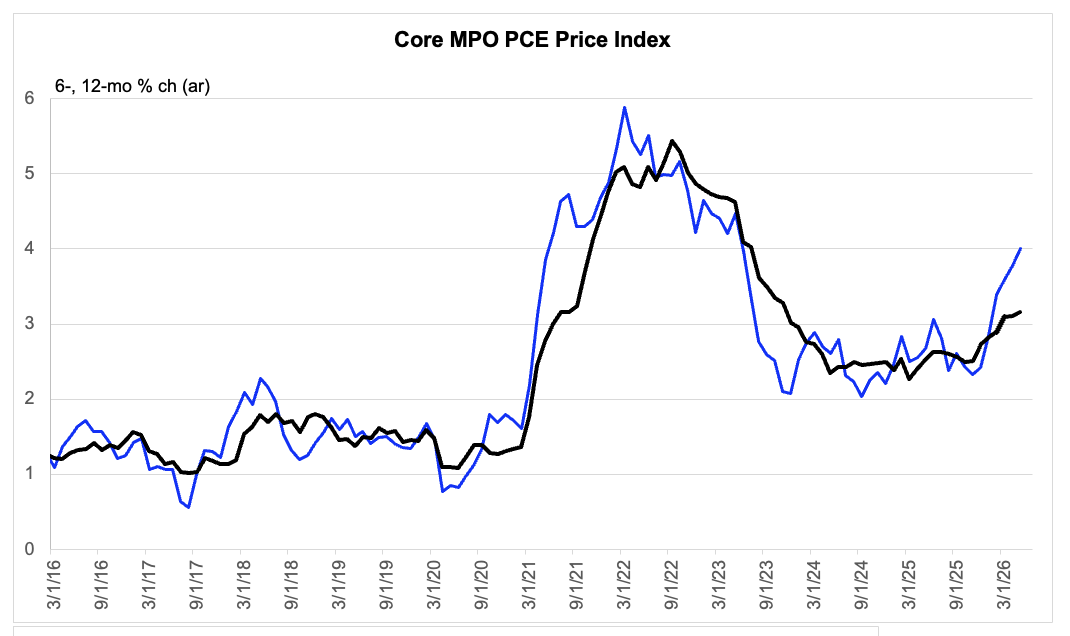
As of May, the Core MPO PCE inflation rate was 3.16%. I figured that mapped to an underlying inflation rate of 3.36%. Maybe that figure falls to 3.14% and maps to a true PCE inflation rate of 3.30%.
Speaking of inflation, I notice that Kevin Warsh mentioned at Sintra that inflation risks have fallen recently. That is a controversial point, not necessarily widely shared across the FOMC. I hope his frequent public commentary on this important issue does not force him to become anchored and hesitant to incorporate new information, as new Chair Warsh has suggested is a big risk when communicating too much on items that are not clear. Sorry, going forward I will try not to obsess about this. But this guy is truly a new breed. In fairness, he has nothing to do with these revisions.
3.14% mapping to 3.30%, rather than 3.16% mapping to 3.36%
Data are current vintage to May 2026.

