

SUMMARY
- High oil prices during the Iran energy shock led to demand destruction in China, while the role of substitution for electric vehicles and other sources of energy played only a modest role in reduced oil consumption; this means China oil consumption should rebound as oil prices fall and activities return to pre-Iran crisis levels.
- The longer-term impact of electrification will be significant; China’s government is accelerating adoption of EV trucks, which will have a particularly large impact on oil consumption towards the end of this decade.
- The main near-term wild card for China’s crude imports is how much and how quickly China refills strategic and commercial inventories. We do not have great insight into this area, but our impression from analyst commentary is that Chinese buyers – particularly the government – are not under high urgency to refill inventories, which entered the Iran conflict at high levels.
A key question for global markets is the extent to which China’s sharp decline in imports of crude in recent months will persist, and the implications for global crude prices. We are not experts in China’s energy sector, particularly how to assess China’s strategic and commercial reserves.
However, we do have thoughts on the demand side of equation:
First, we assess that the decline in China’s oil consumption is significantly smaller than the roughly 4 mb/d decline in oil imports. Second, the key driver for reduced consumption was demand destruction induced by high oil prices, while the role of substitution of other energy sources (coal, electric vehicles) was modest. The implication is that China’s oil consumption should return to pre-Iran crisis levels in coming months, as crude prices fall and China resumes pre-Iran conflict levels of activities in areas such as logistics.
The main wildcard for China’s crude imports is how quickly China’s government and industry refill reserves of crude and refined products. We do not have particular insights here but assume that buyers, especially the government, will not be under major urgency to refill these stockpiles quickly. China entered the Iran energy shock with strategic oil reserves of 1.3-1.4 billion barrels (per the U.S. Energy Information Administration), equivalent to more than 3 months of oil imports at the pre-conflict rate. Most analysts see the draw on these inventories during the crisis as modest, as Beijing also curbed import demand by restricting exports of refined products such as diesel.
Evidence for a Temporary Dip in Demand
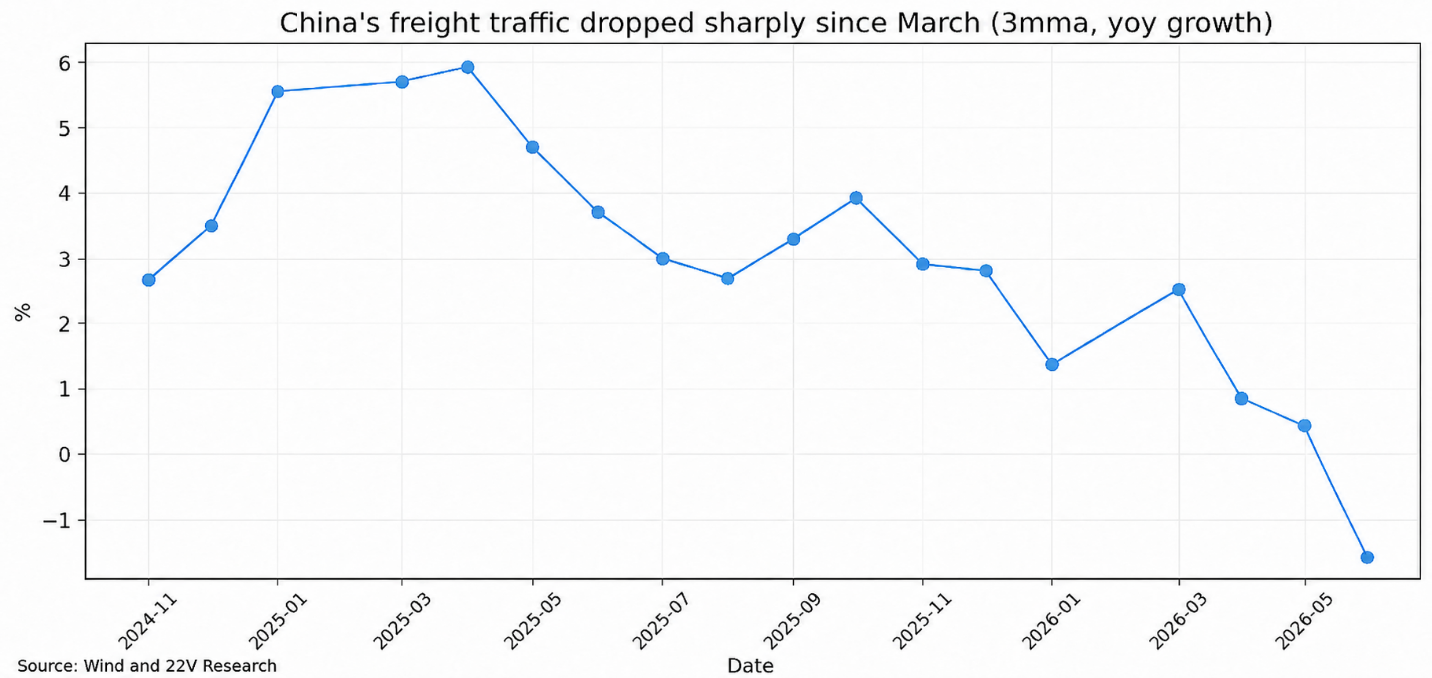
China’s transportation-related fuel demand likely declined by single digits during the Iran energy shock (March to May), reflecting both high oil prices and soft underlying growth. Freight volume was down 1.6% y/y from March to May, roughly 5 percentage points below normal. High oil prices probably account for ~70% of the decline, while the cyclical slowdown in China’s overall economy accounts for ~30%. That decline in freight volume implies about a 1.5% decline in China’s total oil demand, or roughly 0.2 mb/d. Given that part of fuel consumption was likely met through inventories, a single-digit decline in fuel consumption is probably consistent with the high-single-digit decline in refinery runs in this period.
The widely cited ~20% drop in China’s retail sales of oil-product volumes – which would imply a much more substantial decline in demand for crude is likely biased. That measure may be disproportionately affected by purchases by independent truckers, who were among the groups most negatively affected by high prices.
For most petrochemical products, we do not have reliable final-demand data. However, we are not aware of any double-digit production declines in major petrochemical products.
A modest decline in oil demand rather than aggressive substitution is also supported by coal data, since coal is the primary candidate for substitution in some industrial and chemical uses. Coal apparent demand, defined as domestic production plus net imports, edged down y/y over March to May. Coal-fired power generation rose only 3.4% y/y over the same period. These data do not suggest a large-scale shift from oil to coal.
Electrification is a Longer-Term Story
While China’s electric vehicle (EV) penetration rate has increased significantly since March, we are skeptical that this pace can be extrapolated. With gasoline prices now meaningfully lower, ICE vehicle demand will likely improve in coming months. In addition, China’s EV penetration rate is already close to 50%, which means further gains are likely to become incrementally harder.
Semi-trucks will be a major driver of China’s long-term oil-demand decline. In China, one semi-truck is equivalent to roughly 50 passenger cars in terms of fuel consumption. However, for EV semi-truck penetration to take off, several bottlenecks still need to be resolved. Battery swapping is widely viewed as crucial because it can both reduce the upfront purchase price and shorten charging downtime. But this requires unified battery standards and a sufficiently dense network of battery-swap stations.
Beijing has been promoting EV truck adoption and recently published a new plan. We think this will meaningfully accelerate EV adoption. Key 2030 targets are listed below. Near-term progress is likely to be limited because infrastructure and standardization bottlenecks need to be addressed first, but there is potential for longer-term overachievement once those constraints are resolved.
Indicator | 2030 Target |
|---|---|
New energy heavy-duty truck penetration rate | 40% |
New energy heavy-duty truck fleet size | Over 1.6 million units |
Share of new energy heavy-duty trucks in total heavy-duty truck fleet | About 20% |
Heavy-duty truck charging and battery-swapping stations | About 3,000 |
Share of highway freight volume carried by new energy heavy-duty trucks | 18% |

