

I With apologies to Ernest Hemingway’s description of how one can go bankrupt, one could this week ask Russia “How did you lose Crimea?”, and “gradually, then suddenly!” might be the answer. Ukraine’s accelerating strike campaign against Russian military logistics and infrastructure in and around Crimea has this week proven materially more effective than consensus would have predicted earlier, and the situation could over the summer quickly deteriorate dramatically for the Russian occupiers, clearly unable to protect Crimea against Ukrainian drone and other attacks. This could suddenly force very painful dilemmas in front of Russian President Putin in the coming months, and lead to escalation in the war.
Russian occupation authorities have now declared a full state of emergency for Crimea, as the occupied region suffers from acute fuel, power and other shortages. Thousands of vehicles are video verified to be waiting to leave Crimea along the Kerch Bridge, and Ukrainian President Zelensky has publicly drawn attention to the deteriorating condition in Crimea and ordered the intensification of Ukrainian strikes on Russian targets here. Summer camps have been cancelled, and the Crimean summer tourism season will almost certainly fail.
Ukrainian forces have successfully destroyed material parts of Russian air defenses in and around Crimea, and now have relatively unhindered access to striking key military and infrastructure targets across the region. Road and railway transportation links have, with the exception of the Kerch Bridge, been largely cut, via repeated drone and missile attacks, and truck-based Russian logistics in the region heavily targeted (Figure 1).
Figure 1: Key Russian Logistical Routes In and Out of Crimea Targeted by Ukraine This Week
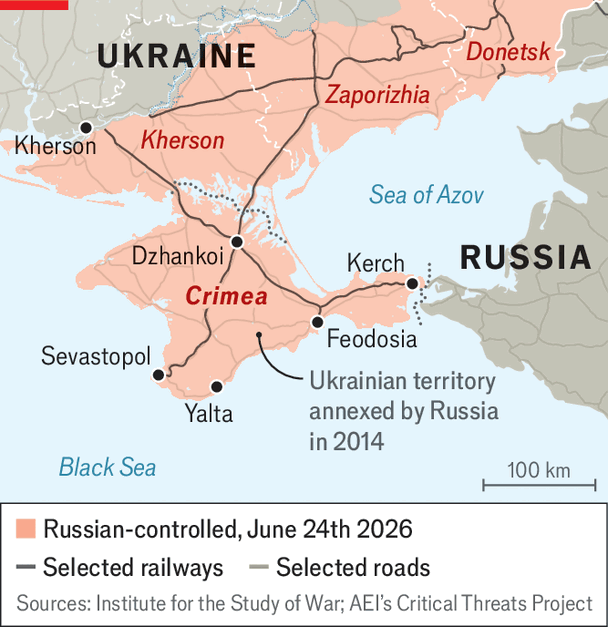
There has been successful strikes on Crimea’s gas-powered power stations, supplied by gas piped in from Russia, that have caused widespread blackouts and will quickly threaten Crimea’s water supply, reliant on pumped water from outside Crimea. In short, as Russia appears unlikely to restore air defense cover of Crimea, the supply of basic infrastructure services and with it Crimea’s ability to continue to operate as a logistical hub for Russian forces across Southern Ukraine is likely to continue to deteriorate in the coming months.
This may at some point lead to more systemic collapses in the basic Russian occupation economic and governance structures in Crimea, as what is increasingly an outright enforced embargo on Crimea takes it accumulating toll. The sudden development of civilian and military emergencies in Crimea can therefore no longer be ruled out as mere “tail risks”, but should be watched closely by observes affected by the outcome of the Russia-Ukraine war.
Crimea represents both the “historical jewel of Russian imperialism” in Ukraine, and the bloodless 2014 annexation of it by Vladimir Putin, uncontested by Ukraine or its Western allies, the pinnacle of the Russian president’s political power inside and outside Russia. A no longer implausible collapse of Russian authority in Crimea therefore represents not just a body-blow to Russia’s overall imperialist narrative in Ukraine, but a stinging personal defeat for Vladimir Putin. How he might suddenly be forced to respond to “things going south” for Russia in Crimea hence marks a possible turning point in the war.
Recalling the three possible future action scenarios for Putin’s coming “change of Russian actions” laid out in the previous note – actual peace negotiations, a shift to a more defensive war strategy for Russia, or escalation led by renewed mobilization of Russian manpower. IF a decision is forced on Putin soon by a rapid deterioration in Crimea, it will likely increase the probability that he will choose the escalatory option, and go for mobilization inside Russia.
For Putin to start real peace negotiations with Ukraine, while the situation in Crimea is rapidly deteriorating would put him in a very bad negotiating position, and it would not be likely that Ukraine would merely accept an unconditional ceasefire and agree to simply freeze the conflict. Similarly with regards to a possible shift to a more defensive war strategy for Russia, which would be far less likely to be acceptable to Putin, given that Ukrainians would in such a scenario be able to continue to strike Crimea with near impunity.
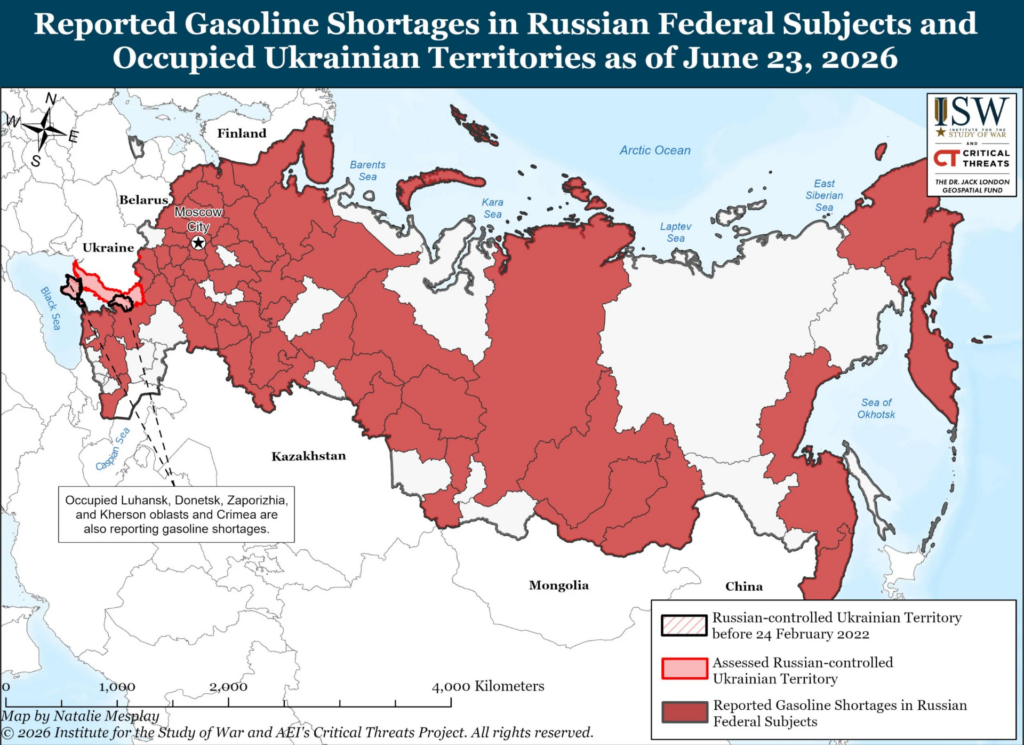
Rather, with Crimea suddenly possibly at stake, Putin would likely seek to tap into public support in Russia for “Crimea being Russian” and launch another round of mobilization to keep control of it. Linking mobilization with Crimea might serve to lower the public backlash against such an order. Putin might also try to link a mobilization order with a narrative to “restore general order” inside Russia, where fuel supplies have dwindled rapidly, following Ukraine’s increasingly successful strikes against Russian refineries (figure 2).
Figure 2: Reported Presence of Fuel Shortages in Russia This Week
All told, the war is not going well for Russia – further aggravated by the significant decline in global oil prices from the ceasefire in the Persian Gulf seen this week, too – and if things go from bad to worse in Crimea, Vladimir Putin in the coming months looks more likely to choose escalation, rather than negotiations.
II This week the government mandated German Pension Expert Group published its set of no less than 33 reform proposals for the German public pension system, increasingly under pressure from an ageing population, rising dependency ratios, and ever higher contribution rates facing both German employers and workers to keep the system solvent. As self-evidently clear from any “reform” consisting of 33 different proposals, this is an overall incremental reform of the German public pension system, rather than a dramatic “big bang solution” to the ageing challenge in Germany.
The potent political controversy surrounding most pension reforms ensures both such incrementalism and regretfully dictates that measures are generally only phased in too gradually, when Germany’s dire demographic outlook ought to warrant far faster reforms. At the same time, most of the individual proposals push in generally the right direction towards a more financially sustainable and intergenerationally fair German public pension system, and encouragingly the German government has agreed to implement the set of reforms in their totality, subject though to the possibly diluting “political input” of the German parliament before it becomes law.
The reform consists of several key provisions. First, the expert group wants to continue raising Germany’s retirement age beyond the already approved increase to 67y by 2031. After that statutory retirement ages must automatically increase by 8 months for each additional year of increased life expectancy in Germany, allocating the working-life-to-retirement ratio in Germany broadly at 2:1 for future life expectancy increases. With current life expectancy projections in Germany, this implies that retirement ages increase by about 6 months every decade, plausibly reaching 70y by the 2090s. While directionally correct, this is not in European comparison a particularly ambitious life expectancy linkage of the statutory retirement age (In neighboring Denmark that I know well normal retirement age will hit 70y by 2040, fully 50(!) years before Germany).
Secondly, and more importantly, the proposal will undo much of the labor supply damage done by the 2015 easing of access to early retirement in Germany. The access to retire two years early with 45y of contributions will be abolished and early retirement only possible with benefit deductions, and the reform will raise the threshold for early retirement with deductions to a maintained within three years of the rising statutory retirement age. Given that up to 50 percent of German workers today utilize the early retirement option, this in an urgently needed reform that must be implemented immediately by lawmakers.
Thirdly, the reform will reintroduce and raise the so-called pension sustainability factor in 2032. Before its inexplicable 2025 suspension, the factor mandated that a quarter of the cost from demographic ageing is borne by retirees through lower pension benefit cost of living increases, while the remainder is paid by contributors through higher pension payments. The reform rather timidly suggests increasing the share borne by retirees to one-third going forward. Given, the already high contribution rates in Germany and only very gradual increases in retirement age, this ought sensibly have risen to half.
Fourth, the reform envisions establishing Germany’s first major pre-funded pension scheme, with an additional 2 percent of wages paid in contributions phased in from 2028 to 2031 in annual half percent increments to be channeled into individual capital accounts to help pay for future pensions. Inspried by Sweden’s pre-funded Premium Pension Scheme, German workers will be able to choose from a standard publicly managed savings product, and a limited number of certified alternative savings options. A two percent contribution rate would see an estimated €35bnm or 0.8 percent of GDP channeled annually towards funded pensions in Germany by 2031.
A number of further minor elements make up the remainder of the package, which the German government intends to pass into law by the end of 2026. As noted, the reform proposal is directionally correct, and it seems probable, judging from the development in other European countries with such options available, that the soon-to-be-established prefunded pension pillar in Germany might quickly be expanded upon by Germany’s social partners through sectoral or occupational supplementary plans, putting Germany on a path towards a more rapid buildup of a prefunded domestic pension fund system.
Politically, it is also clear that the passage of an admittedly overdue major German public pension reform less than six months before the next French presidential election will have a major shaping effect on the relationship between Chancellor Merz and the incoming French president. Unless the next French president succeeds in also implementing a major and directionally correct public pension reform in France, where the need is far more urgent than even in Germany, the Franco-German relationship will be immediately strained under the next French President.
Jacob

