May Core PCE Inline Which is Enough for Some Relief
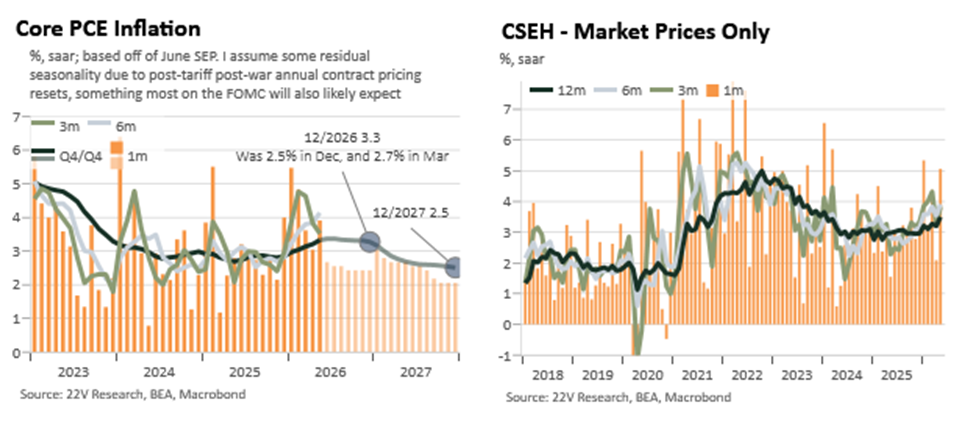
- May core PCE came in right inline with consensus at 0.32% but softer than some expectations and worries.
- Core services ex housing was still very hot at 0.50%; even excluding volatile non-market prices it was 0.41%. Regardless of the exact definition used, CSEH has reaccelerated since last fall after spending roughly 2 years stalled +1p.p. above its pre-covid pace.
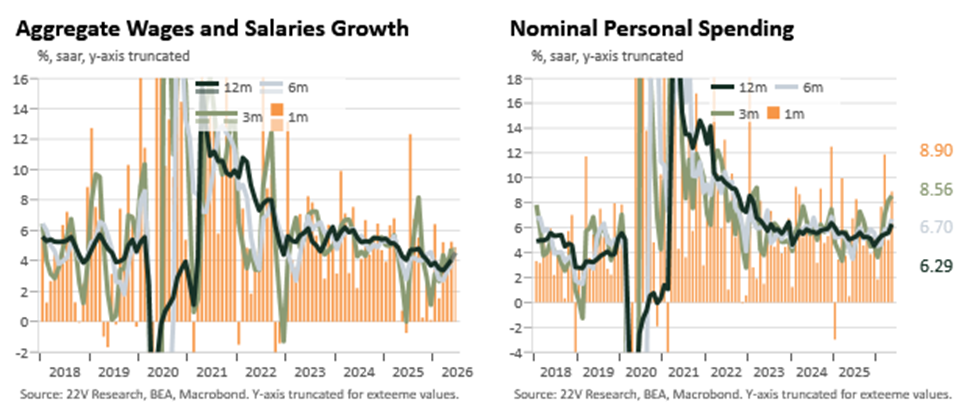
- Income and spending growth rebounded after April. Nominal spending’s acceleration and real growth’s recent steadying point to underlying household strength, although tariffs and the war have been a clear drag on real spending since last fall (inflation ramped faster than nominal spending overall).
- Durable and capital goods orders continue their acceleration in another sign of cyclical strength.
- In a sign of further inflation to come, on top of a +14% YTD gain in IT equipment prices, Apple’s announcement of increased consumer goods prices outside the iPhone (most were roughly 25% with the highest I saw at almost 55%) points to the current inflationary effects of the AI boom.
A Bit of Relief Because Inflation Wasn’t a Hawkish Surprise
Core PCE was roughly in line with consensus but the fact that it did not surprise on the hotter side may have generated a bit of additional relief (the mild bull steepening in rates this morning seems consistent with this).
Core services ex housing was the source of most disagreement among forecasters and may be the source of a bit of relief in rates as well, relative to expectations. However, we should not be too sanguine here. Until last fall, CSEH had been fairly stable for 1-2 years (the market prices only version steadier for longer) at roughly 3%, a full percentage point above its pre-covid pace. Many seem excessively focused on the war and tariffs, which have of course played key roles in the surges in core goods and headline inflation, as well as raised risks to inflation expectations, but the inability of CSEH to further decelerate and its recent reacceleration are more troubling for hawkish Fed officials. This reacceleration points to two possibilities, neither particularly helpful. The first is that we are seeing second and third order relative price impacts from the other shocks making their way into more general measures of inflation; there remains some debate around whether or not the Fed should look through these medium-term effects given their potential causal origination in supply shocks or actively offset non-demand impacts at horizons monetary policy can impact (it can’t offset headline shocks to oil prices over a few months, 6-24m a different story). Alternatively, underlying inflation simply remains too high and with easy financial conditions and improving corporate sentiment pricing power is increasing.
Nominal Spending Strength and a Modest Supply-side Are Potential Medium-term Problems
Income growth bounced back after a soft April; this applies to more cyclically meaningful wages and salaries income as well as the overall measure which had been dragged down by shifting farm subsidies. Aggregate wages and salaries growth was quite soft last fall and winter, as the labor market appeared to be troughing, but has seen a recent reacceleration to roughly 4.4% from January on.
Real spending growth was revised down in Q1, largely reflecting financial services and insurance payments there’s little cyclical signal in, but recent trends remain solid. Real discretionary spending has been bouncing around 2% despite the war but overall growth has clearly slowed a bit since last fall.
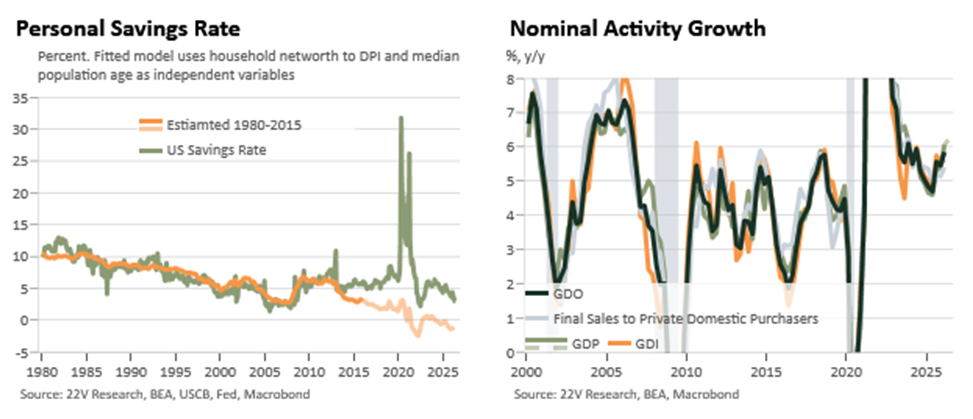
The savings rate remains at a quite low level, although as almost always happens, it was revised up a bit over the past few months. Relative to demographics and household net worth trends, US households continue to behave fairly conservatively. For these reasons, and the continued
I place relatively little forward-looking signal in the recent real deceleration though. As inflation has ramped up, nominal spending growth has also accelerated but on a slightly lag, although that appears to be changing in recent months. As the headline price effects of the war fade, aggregate nominal spending paces of >5% will allow for real activity to rebound a bit as inflation comes off its recent boil.
In an environment of elevated inflation volatility I have generally found it more helpful to forecast real growth on the basis of nominal growth – inflation = real activity, rather than the convention of treating real side as a short-term anchor. Over the medium- and long-term, real supply-side forces matter too of course. In this framework, the recent slower trend in real activity, most concentrated last fall as tariff inflation started to bite, is less cyclically concerning because it reflects supply-shocks drags on activity, and productivity, growth as temporarily increasing inflation eats away at spending power and most productive prior practices (depending on if one wants to emphasize the demand or supply-side). However, if nominal spending is growing at a 5% pace or hotter, given labor supply growth between 0.0% and 0.5% and productivity growth of roughly 2% that may be slowing, inflation is naturally a concern.
Whether or not underlying inflation of up to 2.5%, or even a bit higher, is really consistent with “price stability” is an open question and one which Fed officials seem increasingly hawkish on, given the fading risks on the labor market side of the mandate.