

Bloomberg is reporting that the foreign exchange value of the dollar has popped and that various inflation hedges have weakened because Fed Chair Warsh has proven more hawkish than people expected. I think there is something to this, but that it is a matter of degree, as there are other things going on as well.
My own take on Warsh was that he could not be all that dovish because he had to bring the Committee along and that he knew this. As I mentioned on Fed day, the Press Release had as its first point that there were no dissents!! And I found the Press Conference strongly confirming in that regard, but I updated — along with everyone else — in a hawkish direction. Separately, we should have all known that Warsh would be less beholden to Trump once in office and that some of his sillier arguments for cutting rates (Trimmed Mean, balance sheet trade off, etc.) probably would not survive inspection. But I do think it probably is fair to say that Trump’s faltering health and the bleeding away of his political capital makes this point somewhat stronger. Warsh could probably withstand criticism from Trump, but I suppose it will help at the margin if there is none forthcoming.
I am generally skeptical of recurring claims that a move in the dollar this way or that is a reflection of some macro reassessment. It seems to me that the consensus finds far more cycles in the dollar than actually occur. Part of this has to do with the tendency to look at DXY, which is basically just the EUR upside down. I prefer to look at the Fed’s broad trade weighted dollar which is far more representative. There is a reporting lag in its publication, but we can get around that by just replicating it with the bilateral exchange rates as in the chart immediately below. The series goes to June 18 but I place a horizontal line at where it is as of noon today. The idea that the market has taken out some Warsh risk and that this has had a meaningful impact seems plausible to me.
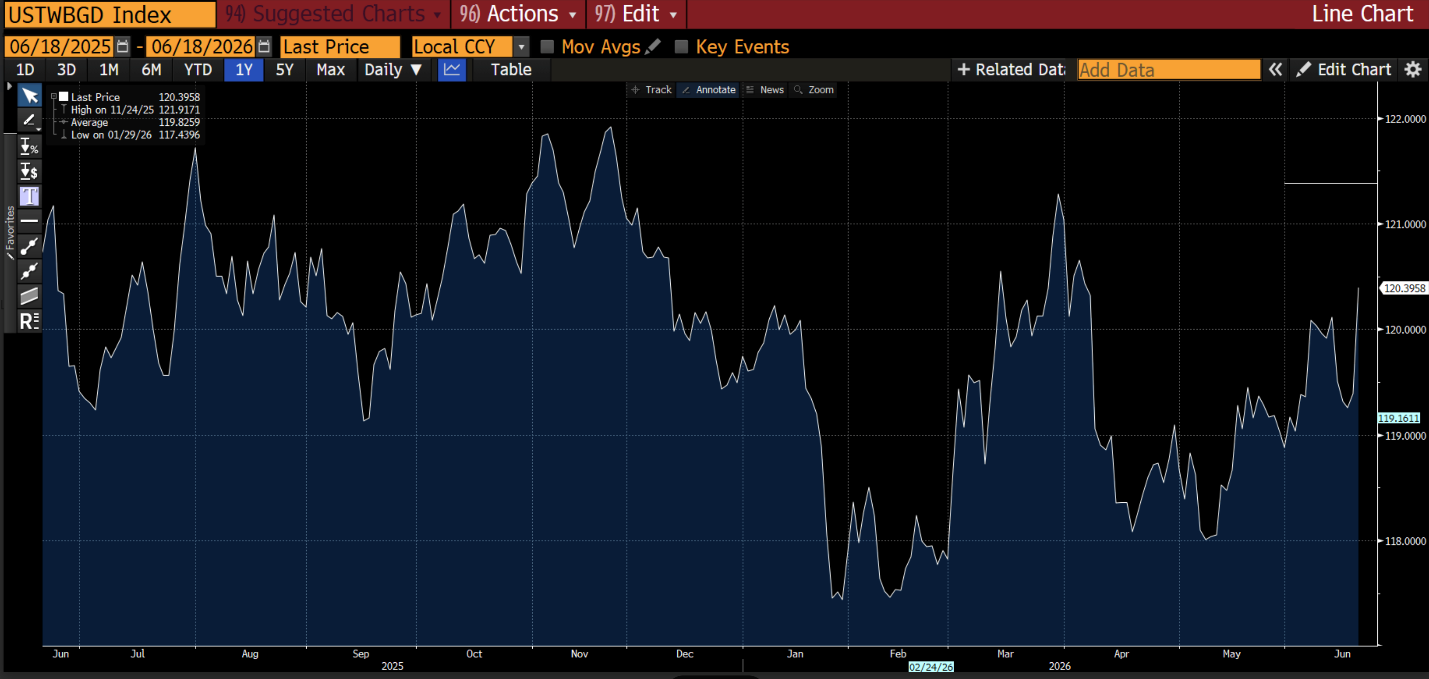
Official pricing is to June 18. Horizontal line is estimate of value as of noon today.
But there are other things going on, which we might be able to get a sense of by taking a longer view of the real exchange rate, as in the chart below, which I also update to noon. I bailed on my earlier short view on the dollar early in the year because the currency had made a meaningful move, sentiment around it had turned very negative, the case for a tighter Fed was coming into view and — especially — because I was surprised by a pronounced improvement in the international trade data. That turned out being decent timing, although I did not subsequently get bullish the currency. I am still waiting for an opportunity to get newly negative, which may take a while. As a general point, economists should stay away from opining on currencies. It needs to be super obvious for me to get involved. Best leave currencies to those guys who draw the squiggly lines.
An important issue here involves the role of fiscal policy. The Bloomberg story implies that the large fiscal deficit fits into the “debasement” theme that is currently being challenged. I think that take is very backward. The capital markets still treat the federal debt as a risk-free asset, so a very heavy supply of it should incline US rates higher and the dollar to appreciate. And this seems especially to be the case in an environment in which the trade data are generally behaving well, because that adds up to a large private sector financial surplus which is clearly bullish the currency on very conventional grounds.
Higher realized inflation is probably also bullish the currency, because of its effects on the Fed path. Fed acceptance of higher inflation would be an entirely separate issue. The inflation that the Fed rejects is currency bullish but an inflation the Fed accepts would have the exact opposite implication. Note that the dollar has rallied more against the majors than against EM, as indicated in the lower panel. That does fit the view that a reassessment of Warsh has played a role here. It is just that there are far bigger forces at play that will probably outlast this reassessment of Warsh, which I happen to believe is correct if perhaps a bit overdone.
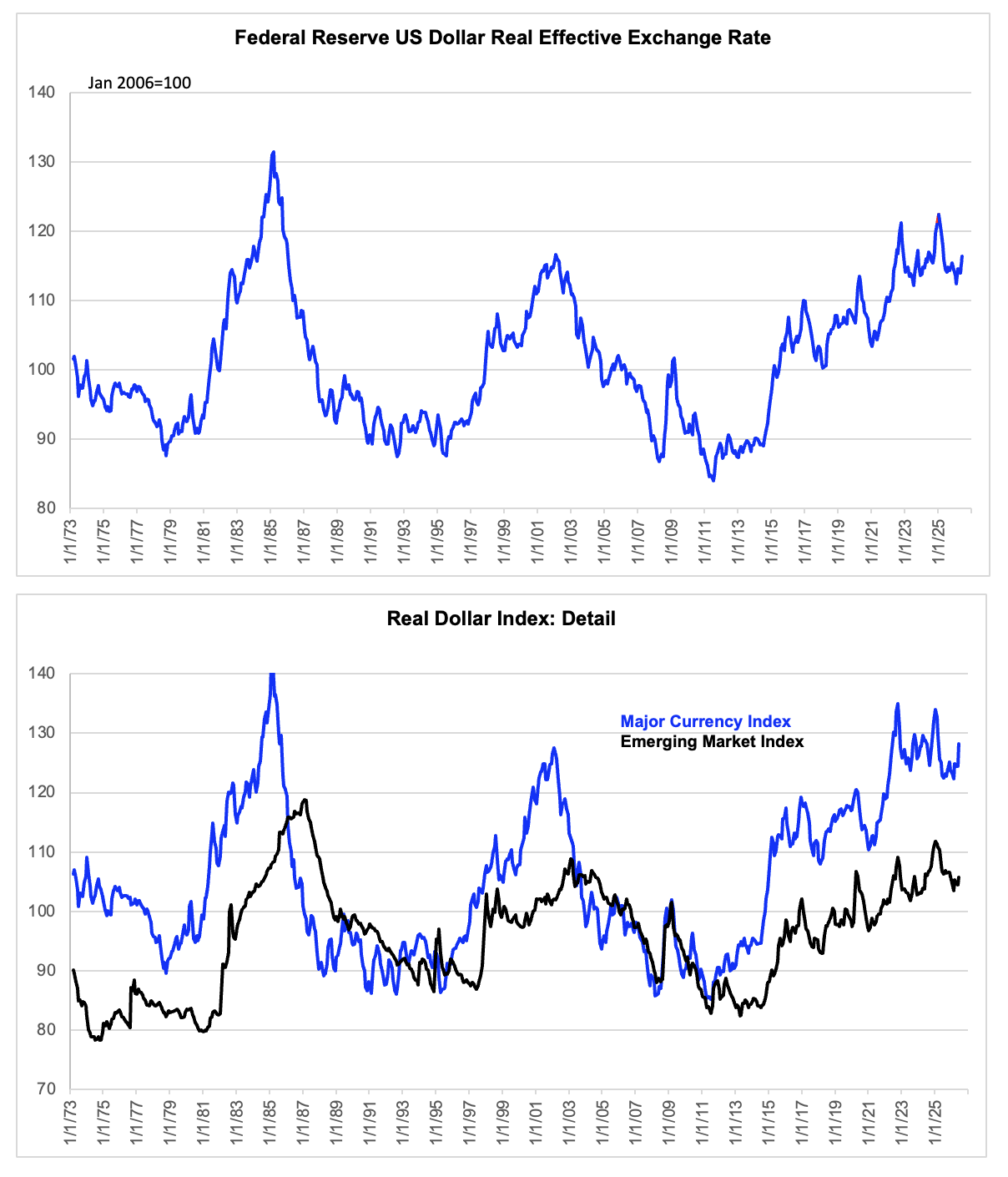
Data are monthly and official to May. I estimate to noon today based on bilateral exchange rates.

