

AI macro — Mythos restriction and token price pressure:
Mythos remains restricted with no resolution in sight; headline risk around the outcome and any lingering repercussions remain top of mind. Additionally, the trend towards increased adoption of open-source and lower-cost models has continued: Microsoft is reportedly considering integrating DeepSeek into its Copilot suite, and a second Chinese model, Kimi, has gained traction. The SDLLMTK has continued to trend lower, signaling a continued shift toward lower-cost models — (directional indicator however methodology is not verified).
ROI, cost, and model fit are all factors being evaluated and driving the move to incorporate lower cost models. A benchmarking site (aistupidlevel.info) offers an interesting cost-benefit ranking of available models.
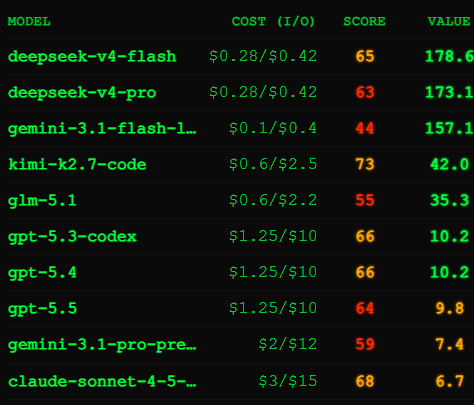
Source: aistupidlevel.info
Capex spend estimates for hyperscalers and the powered shells (bitcoin miner conversions) have continued to trend positively in the past 30 days. While the rate of change is slower than the past 90-days, growth remains consistent at a ~$1+T annual spend level through the end of the decade.
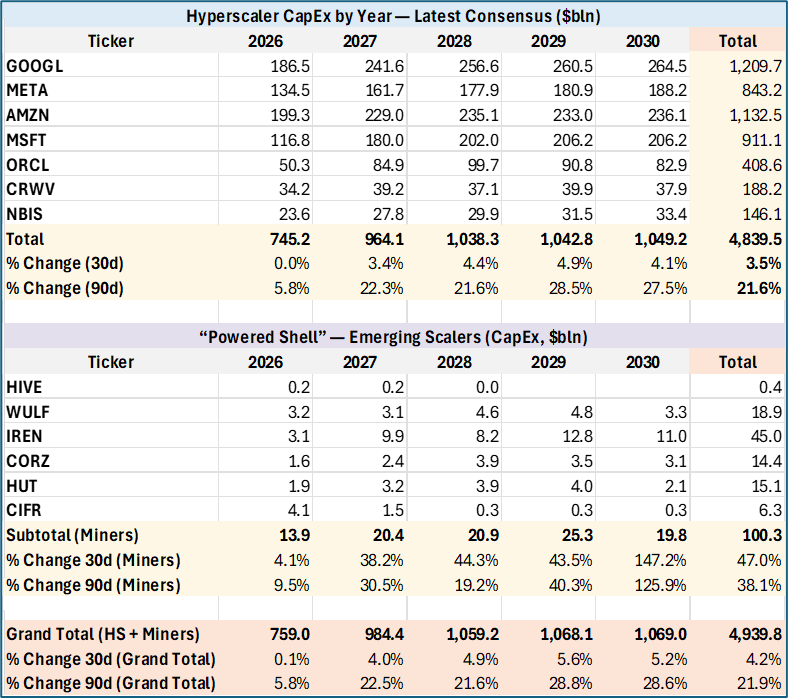
Source: Bloomberg; 22V Research
Consensus FCF estimates show a near breakeven year in 2026–2027; however, 2028–2030 estimates indicate a return to FCF growth — consistent with anticipated returns on current AI capex.
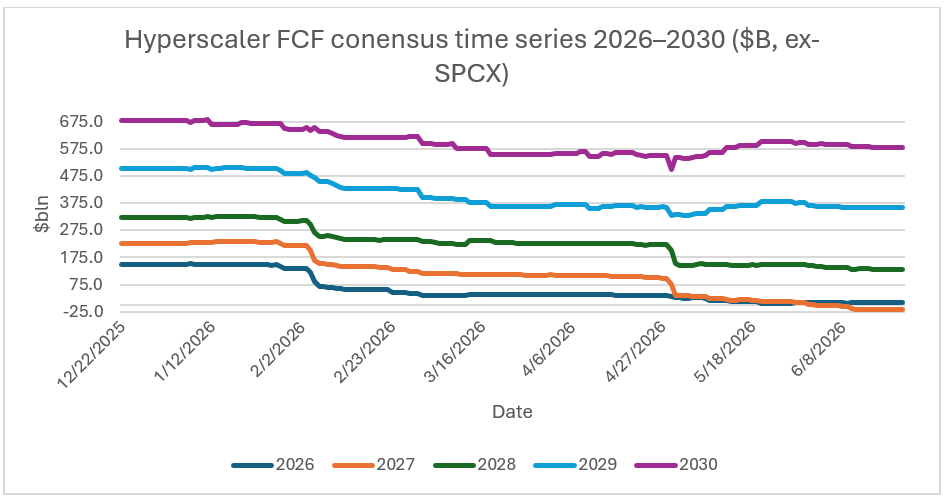
Source: Bloomberg; 22V Research
Investor and client themes — top of mind:
SPCX and ODCs: Investor interest in SPCX remains selective; the wall of worry around the event path and business model is an ongoing debate. There is emerging recognition that ODCs will make headlines, be tested, and may ultimately establish a place within the AI infrastructure stack. We believe the SPCX catalyst path will remain rich over the coming 6–12 months, albeit with wide ranges of volatility and sentiment.
Bottlenecks and the second derivative: Clients continue to search for bottlenecks in the AI sector; however, concern is mounting over whether a slowing rate of change represents a structural shift. The macro headlines around regulation, AI spending, and token price challenges are fueling this dynamic.
Differentiating among AI focused stocks and themes: There is an increased focus on finding names in AI tied sectors that truly benefit from AI capex versus those that have tagged along. The interconnected nature between companies is also being monitored. The OpenAI–Oracle relationship is one example: analysis of OpenAI’s limited financial disclosure indicates lofty expectations around gross margin trajectory — which, even before any potential for token price compression, implies one or more equity raises to sustain $600B in capital commitments through 2030. (Emerging Disclosure: OpenAI, Price Discovery, and the Path to the S-1, 6/18/26).
Data center moratoriums: Investor concern has largely dissipated. Moratoriums have not surfaced above the level of regional matters; and investors have digested that well-planned projects are moving forward, focusing on data points — CRWV capacity adds per quarter, ORCL’s 1GW addition last quarter — as evidence that compute is being brought online.
Marking to market — liquid cooling:
Liquid cooling remains a clear need within AI factory build-outs; the trend is agnostic to compute and model competition above the infrastructure layer and benefits from AI adoption and the need for AI infrastructure. In the current environment we believe liquid cooling focused companies have structural tailwinds and individual stock catalysts.
A custom 22V liquid cooling basket (ECL, MOD, DOV, ETN, JCI) has outperformed hyperscalers, +5% since mid-May while the Mag 7 is –8.5%. The attributes driving outperformance include company-specific catalysts and technology differentiation in liquid cooling and advanced thermal management for AI factories.
ECL is up 3.2% YTD and trading above the 200-day. WTI crude in the low $70s removes the raw material overhang, redirecting investor focus to hyperscale and semiconductor capex exposure. The CoolIT acquisition close will prompt updated guidance and create cross-sell opportunities within the emerging one-Ecolab model.
MOD has consolidated following its earnings and a strong $4B capacity order. The upcoming Performance Technologies spinoff, remainco margin expansion and a continuing order cycle are the catalysts to close a multiple discount to peers.
Please reach out if you’d like to discuss further.

