

Main Point: There are two largely separate issues about which Fed Chair Warsh’s Fourth Task Force must be clear when advising on the appropriate role of the balance sheet in monetary policy. First, Warsh’s own idea that a smaller balance sheet would create space for lower interest rates in the context of roughly unchanged overall stimulus has little merit, simply because so-called portfolio balance effects are weak, as is indeed now (finally) consensus. Within a plausible range of what might be delivered on the balance sheet there would be little to offset.
Second, and more to the point of this note, the idea that a large central balance sheet enables fiscal recklessness is wrong. QE has little effect on the rate at which the federal government funds itself, as alluded to above. More importantly, monetization is identified by inflation, not by balance sheet operations. Indeed, the direction of causation runs from the risk of inflation tolerance to the risk of monetization, and not vice versa. In a very practical sense, inflation causes monetization. If Warsh wants to avoid enabling fiscal recklessness, the main thing he can do is be clear about his commitment to maintaining the low inflation target. The rest is largely a distraction.
This note is involved and both abstract and tough sledding in parts. If you accept the points immediately above, then you may easily skip running through this. I plan to spare you arguing these points every time I refer to them going forward.[1]
Remit of the Fourth Task Force
In this note, I return to the purpose of Fed Chair Warsh’s fourth task force, the one reporting on the appropriate role of balance sheet policy in the monetary policy toolkit. One reason for my return is that I have a high-conviction and differentiated take on the role of the balance sheet, in terms of both its influence on broader financial conditions, and therefore the path of the fund rate, and its role in “enabling” possibly reckless fiscal policy. If my perspective is correct, the relevance of it will play out over time, especially if worries around fiscal strains eventually move to the forefront. Moreover, the argument here is a bit counterintuitive, so there may be a case for a bit of repetition and marker setting ahead of time.
Meanwhile, there is an aspect of this that is immediately relevant, as I have mentioned in a couple earlier notes. To the extent that balance sheet policy is largely a distraction, and this should be obvious to anyone focused on the issue, plausible innovations in policy around it are unlikely to have much effect on the path of the funds rate. For example, the widely recognized hawkishness around Warsh’s first outing as Chair last week was not tempered at all by balance sheet considerations, despite the emphasis that Warsh placed on this issue while trying to land his role as Chair.
In fairness to the new Chair, Warsh has not been uniquely guilty in spreading confusion around the role of the balance sheet. In the wake of the Global Financial Crisis (GFC) and the US sinking into liquidity trap, the leadership at the Federal Reserve in particular was eager to emphasize that policy was not really constrained because they could rely on the portfolio balance effects of QE. The Bernanke Fed especially was very keen to emphasize that the portfolio balance channel did not require that the Fed soften its commitment to the inflation target. And this is ironic, I would say, because the consensus has recently begun to shift to the view that the only way balance sheet policy might be that relevant would be through its signaling effects, specifically on inflation tolerance.
In any event, by emphasizing that balance sheet policy was highly relevant, the Fed leadership may have exposed itself to the claim that its implementation might even have been dangerous, which arguably created an opening for Warsh. Noble lies or fibs can sometimes get away from those who tell them.
The economics involved here are complicated. And while I believe that I have a strong grip on the main drivers, the formal modeling is largely beyond my competence. To some extent, my purpose here, then, is in surfacing conclusions developed by academic economists, working within the mainstream, and focusing on aspects of the debate that I believe are most important. With that caveat in place, I think I may safely assert three points related to the economics involved here.
First, the most interesting and truly relevant issue on which the Fourth Task Force will have to report involves the question of whether the Fed will want to maintain an ample reserves regime. Reasonable people can and will disagree on this, although it does seem that fans of ample reserves currently hold the upper hand. If it is determined that an ample reserves regime remains appropriate, then the Fed can deliver that regime in a way that is independent of concerns around the “imprimatur,” to use Warsh’s term, of the asset side of the balance sheet on public capital markets or – separately – on the risk of the Fed enabling reckless fiscal policy.
For example, the Fed could continue its recent policy of buying bills to back a rising reserves stock, as I will get to immediately below. Or it could engage in repo of longer maturity securities, with an equal effect on the reserves stock without either affecting its imprimatur on capital markets or enabling fiscal expansion.
One idea making the rounds, in part because a study co-authored by Stephen Miran raised the issue, would involve the Fed deregulating the banks in a way that would reduce their demand for reserves. This would presumably allow the funds rate to balance at target in an “ample” regime, with both a lower reserves stock and a lower asset side of the balance sheet. That idea truly puts the cart before the horse, in the sense that it proposes subordinating bank regulation, which is important, to the role of accommodating a precise target for the asset side of the balance sheet, which is not important. Leaving aside that opinions understandably split around regulatory policy, I am surprised this point is not more widely noted.
The second point of economics I would venture here is that the role of bills purchases in this discussion seems particularly easy to assess, especially with the support of an academic paper that I will refer to shortly below. Within an abundant reserves regime in which the central bank’s immediate target — or policy instrument – is the level of overnight interest rates, bills purchases will have no systematic effect on broader financial conditions – i.e., the thrust of policy – beyond allowing the central bank to maintain the desired volume of liquidity. Separately, and more to the main point here, bills purchases, unlike long-maturity bond purchases, will have no systematic effect on the Fed’s incentive to use inflation to finance fiscal expansion, as I will elaborate on a bit below.
The third issue here involves confusion around what monetization even involves. This is not something on which the Fourth Task Force is unlikely to unburden itself. But it is worth getting straight, because it will influence their conclusions (if they are forthright) and because it is worth being clear about in the broader context of understanding fiscal policy and its effects.
To be clear, the issue of monetization has only recently become even theoretically relevant. For example, despite the surge of federal debt and on-again / off-again Fed balance sheet expansion after the GFC and during much of the 2010s, worries over monetization were wildly premature, because r* was far below g* and was clearly greenlighting fiscal expansion under conventional public finance.
But with market-based measures now suggesting that r* is probably drifting above g*, and with the political process seemingly not yet willing to incorporate that signal to slow the pace of fiscal expansion, worries about how fiscal sustainability tensions will ultimately be resolved are now actually relevant – if probably not yet pressing. Still, the role of the central bank in this dynamic is quite different from what is perceived – and from what new Fed Chair Warsh has suggested. Specifically, the Fed would not enable reckless fiscal policy by buying government debt, at least not in the way that is often assumed.
Monetary economists focused on this issue often model monetization as central bank purchases of government debt. Importantly, they tend to draw a stark distinction between a surge of the monetary base (funding debt purchases) that is transitory vs one that is meant to be permanent. It is only the permanent expansion that involved enabling fiscal expansion, they say.
That is fair so far as it goes, but it does leave an unfortunate impression that the monetary base expansion and debt purchases are causal of the “enabling” – or of inflation. But that is a question of which form of reductionism fits most easily into the algebraic modeling, rather than a statement on what is the primitive here. As the recently passed Alan Greenspan might remind us, don’t confuse the map for the territory.
In fact, even the mainstream theorists recognize that monetization effectively occurs when the central bank accepts inflation as a means of financing the deficit, either because inflation reduces the real value of the debt or (more likely) because tolerating inflation would allow the central bank to keep nominal and lower than adhering to an inflation target would allow.
Indeed, within what we might call the textbook approach, the size of the balance sheet has no relation to monetization, beyond any incentive it might deliver to tolerate inflation. Inflation (tolerance) causes monetization, not vice versa. But the popular consensus really has a ton of trouble with this one, not because people are stupid but because of historical accident and the incidental modeling preferences of many theorists.
Warsh will not drive this (red line) but he might applaud it
For Warsh, the practical implications of this should be as follows — once he gets beyond his mistaken obsession with the size of the balance sheet and its imprimatur and enabling effects. If he wants to avoid enabling fiscal recklessness, surely a noble objective, he should do what matters most in this context. He should make crystal clear that he is committed to the low inflation target and will not allow monetary policy to be influenced by political considerations. Backing away from fake reasons to cut interest rates would be central to this effort, and he seems already to be doing that.
Warsh might also want to use his bully pulpit to encourage the government to slow the rate of fiscal expansion to reduce the risk of fiscal dominance. And somewhat related, although secondarily, he might occasionally mention the benefits of lengthening the maturity of the federal debt. The maturity of the federal might have little influence on the incentive to deliver surprise inflation to reduce the real value of the debt. But a longer maturity does increase the incentive (for government officials to pressure the Fed) to tolerate a bit more inflation in order to create space to maintain lower interest rates for longer than might otherwise be appropriate.
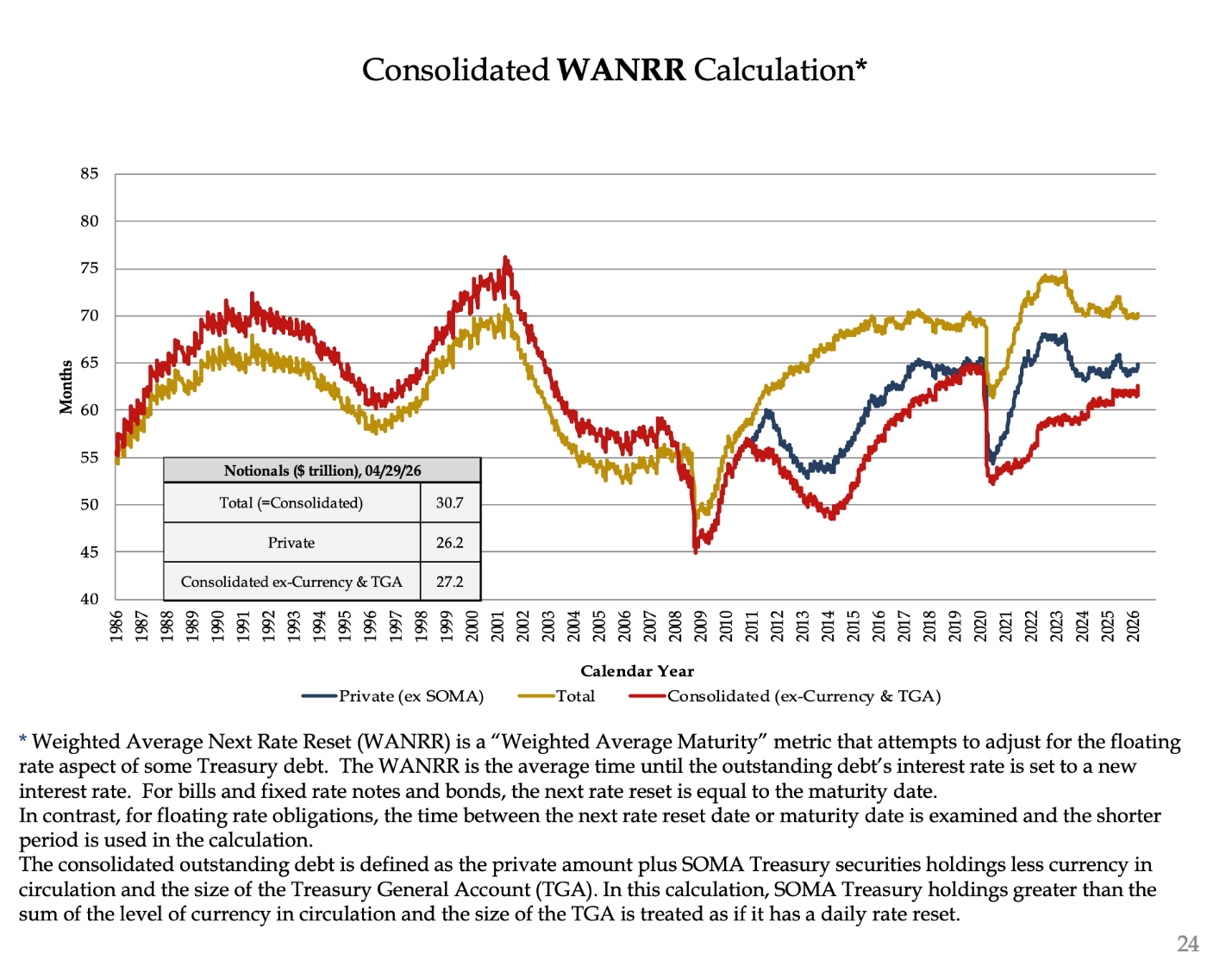
Before getting a bit deeper into the economics involved here, with support from my betters, I want to make a quick comment on how the maturity of the federal debt is actually behaving. The Treasury’s presentation to the most recent TBAC meeting contained a novel (to me) treatment of this issue, which I think is quite helpful. The conventional measure of the average maturity of the debt fails to take into the account the role of floating rate notes, the size of the Treasury’s account at the Fed (basically negative bills), and the role of the Fed’s balance sheet (SOMA), in shorting the effective maturity of the federal debt, once we pierce the Treasury-Fed veil and recognize that QE is just the Fed shortening average maturity on behalf of the Treasury.
Note in the chart above that this more realistic measure of average maturity does show that the debt has been getting termed out in recent years. Part of this has to do with QT, the effect of which has not been undone by the recent bills purchases program, because buying bills does not take out much duration.
Looking forward, though, the effective maturity is much more likely to be determined by the Treasury than by marginal tweaks at the Fed. While the Treasury is overseeing a surge of the debt that may now actually be unhelpful and perhaps ultimately a bit dangerous, they are getting this part right, at least from a fiscal stability perspective. Whether the Treasury providing supply into a newly elevated term premium is efficient from a funding perspective is a separate discussion.
Academic paper sheds light, if incidentally
Much of what I present regarding enabling and monetization above will read as assertion. I hope you will tolerate this on the grounds that I want to start with the somewhat counterintuitive conclusions, in the interest of brevity, and then argue the points over time. By the time this is relevant, hopefully I will have crystalized the argument to the point it is clear, leaving aside for now whether it is right. ☺
To get a start on that, I would like to draw to your attention (again) to the most recent version of an academic paper co-authored by Gauti Eggertson, who is arguably one of the top theorists in conventional macro working today. The fact that the paper supports conclusions that are palatable to me does not itself mean that it is authoritative, very obviously. But I will lean on it because it seems to start with the right questions, addresses issues that seem relevant to me, based on my own reasoning, and makes very explicit its chain of reasoning.[2]
Its conclusions vary sharply with widely held perceptions that have been conditioned by Fed propaganda and backed up with “event studies” of the announcement effects of balance sheet policy innovations. I am no better able to assess the econometrics of event studies than I am to comment on the algebra driving the Eggertson paper. But my prior is that event studies are basically useless because I know from having been on a trading floor that announcement effects plainly do not measure enduring effects, at least in this case.
The main purpose of the Eggertson paper is only indirectly related to the theme I push here. It argues that QE “works,” not through portfolio balance effects, as the official Fed story suggests, but through rates signaling. The paper is crystal clear that there is little reason to believe that the official story about portfolio balance effects has any merit, and for reasons that would probably have seemed obvious to most observers, were it not for the concerted propaganda effort initiated by the Fed once it confronted liquidity trap and was searching for means of providing stimulus, by operating on confidence, rather than perceived inflation tolerance.
According to the paper, QE creates a financial incentive for policy makers to tolerate higher inflation. The expectation of higher inflation in the future can be helpful in the escape from liquidity trap, both because higher inflation expectations directly reduce real interest rates and because an expected toleration of higher inflation in the medium term can help short term interest rate expectation. But the Fed might not be able to convince economic agents that it will tolerate higher inflation in the future, because by the time they are in a position to actually deliver that result, liquidity trap will have passed and the incentive for an unconventional approach to inflation will have evaporated, encouraging the central bank to renege. The way to get around what would otherwise be this time inconsistency problem is to create that financial incentive.
In modeling how this works within the conventional New Keynesian set-up, with sticky prices, rational actors, and game theory considerations made explicit, the authors imagine two roles for the Fed. The first – and central case — involves the Fed being just part of a consolidated public sector, operating in tandem with the Treasury. Within this set-up, the Fed issuing reserves to purchase long maturity bonds (QE) has the same practical effects as the Treasury substituting bond supply for bill supply. In both cases, withholding duration from the public creates an incentive for the Fed to tolerate higher inflation upon escape from liquidity trap, which would be helpful in escaping liquidity trap via expectation effects.
In an alternate second conception of the Fed’s role, it is meant to be independent of the Treasury, but face its own balance sheet constraints in the form of being averse to financial losses. Under this set-up, the Fed issuing reserves to buy bonds (QE) creates an incentive to keep interest rates lower for longer, even accepting inflation as a result, in order to avoid losses on what amounts to a carry trade.
However the Fed’s role is modeled, the effects of withholding duration from the public is directionally similar, although the quantification is slightly different, for any given amount of duration withholding, I assume because a given dollar of duration hoarding has a different effect within the context of the Fed’s balance sheet than within the context of the broader federal debt.
What I find relevant to the purpose of this note is not so much the discussion of “how” QE works. In fact, I find it a bit amusing that there is such a strong pretense that QE even does work. No, what is relevant here is that the authors make very explicit within a conventional modeling framework that any enabling of fiscal recklessness operating through the balance sheets works via the inflation incentive and not through the purchase of government securities, which are relevant only to the extent they affect inflation tolerance. This fits my strongly held view that inflation causes monetization, not vice versa. And secondarily, it makes explicit the conventional economic reasoning behind my insistence that there is no enabling aspect to bills purchases, very much contrary to Warsh’s expressed intuition.
Whether the QE that we have actually experienced created a meaningful incentive for the Fed to inflate is a separate discussion that involves questions of degree and not just type. While the paper presents a very involved argument for QE to be directionally relevant via its signaling, and while the logic presented there bears directly on the qualitative policy issues I choose to offer in this note, the authors do not find quantitatively large effects from QE programs, at least away from QE1 when the capital markets were obviously dysfunctional.
As they document on page 34, for example, they believe that QE2 reduced – via signaling effects – the expected funds rate average over 2- and 10-year periods by 10 and 11 basis points respectively. And this maps to a 14 basis point increase of the 10-year inflation expectation, via the commitment channel emphasized in the paper. These effects are far smaller than the standard story offered in real time by the Fed, which emphasized portfolio balance effects to the utter exclusion of signaling effects, at least until the Taper Tantrum.
In the interest of full disclosure, I should mention that the Eggertsson paper does find that QE had huge effects on output, via these signaling effects, which resolve the time inconsistency problem. Please see the discussion on page 33 for that. I admit to being surprised and to wondering about the mechanism linking such minor changes in expectations to such dramatic real side effects. But that is a question for another time. For me, the main value of the paper is in making explicit, within a very conventional framework, how balance sheet policy might and might not enable fiscal recklessness. Their conclusions on that point are very palatable to me and I am happy to lean on their expertise in modeling.
[1] We can imagine an extreme scenario where the federal government has difficulty funding itself in public capital markets, perhaps as default approaches. In that scenario, the central bank’s efforts to support fiscal operations on a day to day basis could lure the central bank along a path of short-term decision making that makes monetization causal of inflation, contrary to a central claim of this note. However, my point here is in assessing the role of balance sheet policy in the current regime in which the Treasury easily funds itself without issue. That is the regime on which Warsh wants his task force to comment. I wonder if part of the confusion around how the direction of causation works here might also be related to a failure to make this distinction.
[2] The paper has been floating around since the mid 2010s, but the version currently found on Eggertsson’s research cite dates to 2022.

