

Main point: If the fourth task force is honest, they will tell Warsh that the asset side of the balance sheet doesn’t matter at all. There will certainly be no trade off of lower rates for a smaller balance sheet. These are familiar points, but I update with some data through the first quarter in this note.
At the Press Conference following yesterday’s FOMC meeting, incoming Fed Chair Warsh announced the establishment of five separate task forces to investigate various issues bearing on the conduct of monetary policy. These task forces will be staffed by – and consult with – the very best minds in the country from within the Fed and without. Their objectives were discussed with energy and purpose at the two-day meeting concluded yesterday.
One task force will “review the benefits and risks of the current ample reserves regime, and the composition of the Fed’s balance sheet.” Getting a proper handle on the reserves regimes seems like a worthy task, although I doubt the institution is currently confused on this point. Maintaining stable money markets has long been the most urgent task of the Federal Reserve, and we may be confident that they have deep institutional strength in this area.
As I see it, one interesting question they might want to debate is whether it is worth reforming banking regulation to depress banking system demand for reserves, to allow both the liability and asset sides of the Fed balance sheets to contract, as the new Chair seems to believe is desirable. I would assume that experts in this area will inform the Chair that he has put the cart before the horse. Getting the regulatory framework right is paramount, however fraught with dispute that may be. The Fed’s provision of reserves and other supports to money market liquidity will ideally be endogenous to that, and the asset side of the balance sheet will follow in turn. I doubt anyone serious would suggest that the argument start with a target for the asset stock. And keep in mind that the best minds will be working on this.
The task force’s take on the importance of the asset side, the extent to which that provides “largesse” to big corporations and delivers an undesirable Fed “imprimatur” on private markets is probably best viewed as a test of how independent of the Chair the task force members are willing to be. If they are honest, they will report back mostly that this does not matter much. I will not argue this point here because I have already been plenty tedious enough on the point already, although I do think it is practically important. Note, for example, that there was no sign of Warsh going dovish on rates with an offset from a smaller balance sheet at yesterday’s event. So far, my claim that this whole thing is a pointless distraction seems to be tracking.
I would just make one point on the “imprimatur.” It is pretty rich that Chair Warsh would suggest that the Fed wants both to coordinate balance sheet strategy with the Treasury and claim that he does not want the Fed to enable irresponsible fiscal policy. But that is a minor point because Fed purchases have only a minor effect on long-end yields via the term premium and – more to the point – because debt monetization is marked by inflation tolerance. If the Fed sticks to its inflation target, then balance sheet policy is just the Fed acting as maturity manager on behalf of Treasury and has no monetization aspect at all. The monetization is identified by the inflation tolerance. So far, Warsh is making the right sounds on that. And if he sticks to that script, his confusion about enabling will be harmless.
The Fed’s mortgage holdings present a more interesting case. It is possible that the stock of mortgages being held on the Fed’s balance sheet may be depressing the conventional mortgage yield by, say, 20 bps relative to what they would otherwise be. This may represent a distortion or imprimatur in the new Fed Chairs words. And the microeconomists I am sure can work up some analysis showing welfare triangles or deadweight losses to society from this departure from free market capital allocation. But for God’s sake, who cares? Get a life.
And this brings me to the data aspect of this screed, which involves just updating a point I have made before with data through the first quarter from the Fed’s US Financial Accounts. Slightly more current data are available elsewhere, but this is a very slow moving story, and I happen to find the presentation available from the Financial Accounts convenient. The first point to note here, evident in the chart below, is that the oscillation between QE and QT recently has not had much effect on the public debt to be taken down by actors outside the Fed. In the left panel, the blue line and black line have a very similar shape, which just tells us that fiscal policy has had a much more important effect on duration supply – which supposedly operates on the term premium – than has the Fed’s balance sheet policy.
During what we might roughly call the QT period, the stock of Treasury debt held by the Fed has been falling, although it still amounts to about xx% of GDP. However, that ratio overstates the Fed influence on the term premium (which I judge to be very low anyway) probably by a factor of about two. The reason is that about half of what the Fed owns is either bills or notes inside five years maturity. And the stock of debt there has little effect on term premia, even for those inclined to overstate the importance of QE, because term premia are simply not that volatile at the nearby maturities. It is the stock of debt that is meant to matter (among QE enthusiasts). But just to complete the thought, the Fed has recently been accumulating bills, not longer maturity securities.
The mortgage story is somewhat different, in part because the efforts at manipulating net supply here may have a slightly less trivial influence on price. In the chart below, I show the stock of mortgages on the same vertical scale as that for Treasuries to highlight that there is less going on here in terms of face value – although, as mentioned, manipulation may matter more here dollar for dollar. Note that the mortgage stock has been falling, as a ratio to GDP, since the GFC and that the Fed’s earlier purchases sped the decline of the stock to be taken down outside the Fed. There were probably periods where that mattered. A client I respect is convinced that mattered quite a bit, if briefly, just after the Covid shock. But looking forward there is not much play from this issue because there seems to be a general agreement that the mortgage stock will be allowed to run off passively. There are caps in place to avoid rapid run-off during a refinancing wave. And even with an acceleration inside those caps, the Fed would – by definition – be lightening up into market strength.
This whole balance sheet debate is largely fake, and its main purpose seems to have been to distinguish Warsh among his competitors to be Fed Chair in a way that would be palatable to the person who nominated him. I think it is an underappreciated point that Warsh can now be his own actor, simply because he has tenure and because Trump’s political capital is now wasting rapidly. Perhaps he now needs to go through with this for appearances sake. But don’t be fooled, it is almost entirely a distraction. And to repeat, we got a clear glimpse of that fact right out of the gate yesterday.
With and without Fed
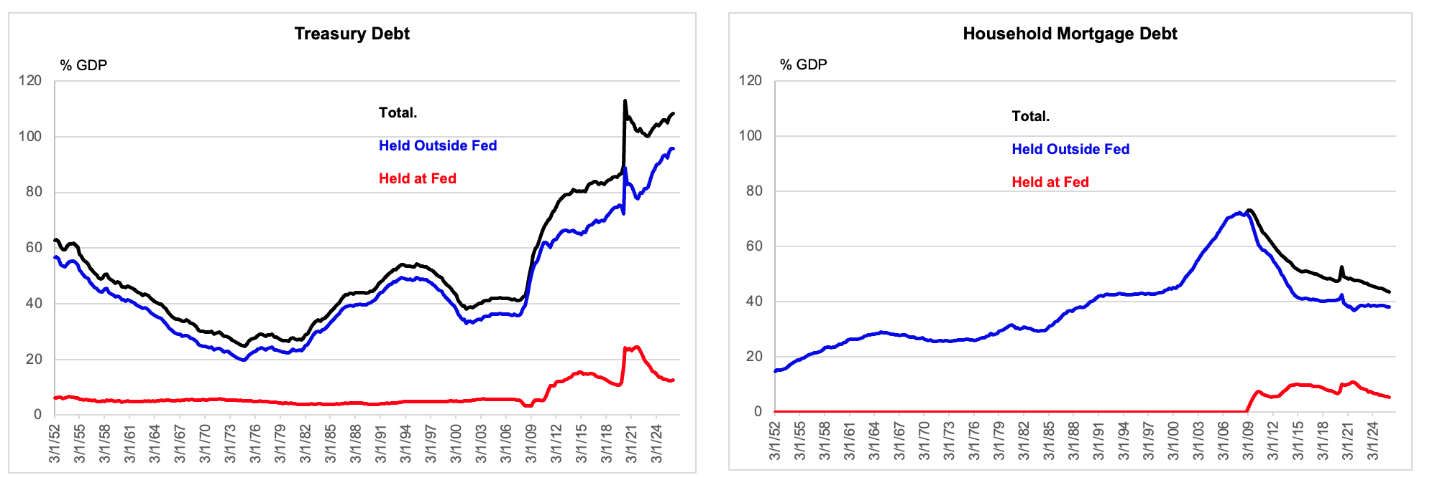
Data are actual to 2026 Q1.

