

Don’t fight the Fed seems like very good advice. People who fail to take it can see their month, quarter, year and – for the really stubborn — career ruined. We might say that in some ways market participants are captive to the Fed. And for a while, I saw an analogy to Stockholm Syndrome here. By some accounts, people who are taken captive often come to admire and see wisdom in their captors. They confuse power with virtue.
While one ought never reason from a metaphor, this seemed to me to be a good way to get our heads into the right space when considering how people may mistake the Fed, by being overly deferential to it. The Fed can seem all powerful without actually being all knowing. And it is important to keep that distinction in mind when considering the space in which one should avoid fighting the Fed. Basically, don’t fight their intentions, but feel free to fight their forecast or at least their expressed forecast. But the problem is that the Stockholm Syndrome apparently does not replicate in experimentation. So, I probably should not lean on it, even as an analogy.
Still, it certainly does seem as though the consensus discussion in the media and among market participants and observers is slavishly beholden to the whims of the Fed leadership. And that returns me to a point I made yesterday about the current nonsensical obsession with Fed communication strategy. I see the Bloomberg has a story this morning asking whether incoming Fed Chair Kevin Warsh will “sever the Fed’s policy anchor?” It is a reasonable question, given the uncertainty that is creeping into how seriously the Fed is committed to its inflation target. But that is not what the Bloomberg writer means by policy anchor. The journalist refers to communication strategy, inevitably. This reminds me of the scene in Anchorman where a staffer jokes that Ron Burgundy will read ver batim anything that is put in front of him, however ridiculous. (See note earlier for the economic reasoning behind my assertion here.)
And what important guidance it was!
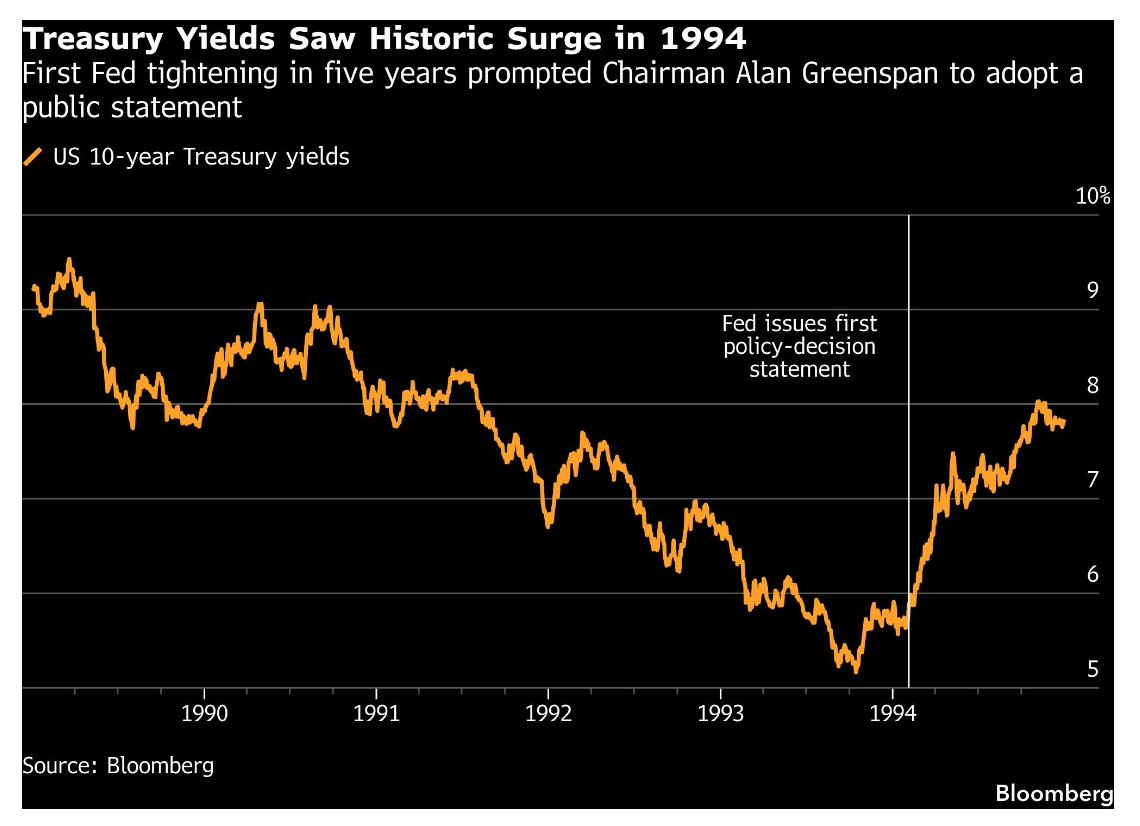
The story includes a review of the Fed tightening cycle beginning in 1994. In the journalist’s telling, the bond market overreacted to that tightening because the Fed was too nuanced in its communication around the first rate hike, which is why Greenspan eventually responded by introducing a Press Release to give the market greater guidance. But the problem is: that is an utter misreading of the history. Most of the way up in rates (measured in time) during that cycle, the Fed was crystal clear that it saw only limited further increases of the funds rate, because it was misreading the situation.
The economy failed to respond to the incremental rate hikes, which inclined the Fed to accelerate until the coupon yield curve went pancake flat at around 8% yield. By that point, the Fed stopped talking about how limited the rate hikes would be and adopted more a whatever it takes approach. And of course, the dopes at the time described this change in tone as being what put a peak to the rate cycle. The Fed finally got the message right!
No. Rates got to a point where they were actually able to slow the economy, and there was a negative to shock to demand, price and confidence from the Mexican peso crisis. But in the seemingly conventional telling, this was all about getting the communication right. In fact, the Fed simply stopped being dead wrong about everything. It is the reality, not the communication. But the captives will have none of that.
Closely related, the story has a quote about how we all grown up in markets having an anchor to tell us what is going to happen. Sometimes that is helpful, but sometimes it is unhelpful, as when conditions change. That too is a severe misstatement of how Fed interest rate guesses work. Unless we are in liquidity trap, at which point Fed rates guidance is prescribed by logic and actually exists, there is no such thing as rate guidance.
For example, during the Fed tightening program of 2021-23 (the tightening started before the first hike), the Fed changes its best guess of the likely funds rate at the end of 2023 nine times. By September 2023 they so knew where the funds rate would be in December. I point this out not to insist that the Fed is stupid. They did a reasonably decent job of dealing with the Biden inflation and extracting themselves from the problem they created for themselves with the September 2021 uber-dovish rates guidance. But the main problem is that they were wrong, not that they communicated poorly.
This whole thing is a massive distraction, which may even be intentional from Warsh’s perspective. I used to fit it into Stockholm Syndrome, which in retrospect I see was a mistake – of psychology. Now, I would just say that this probably fits into a general overestimation of the importance of the Fed. We ought not fight them. But the idea that they are the cause of all things is far too much. The errors around the Fed’s (and our) forecast are far more important than any debate we might have about the Fed’s reaction function or how they talk about it. Or as William Shatner is meant in jest to have said while addressing a Star Trek convention, get a life.
Ninth time was a charm
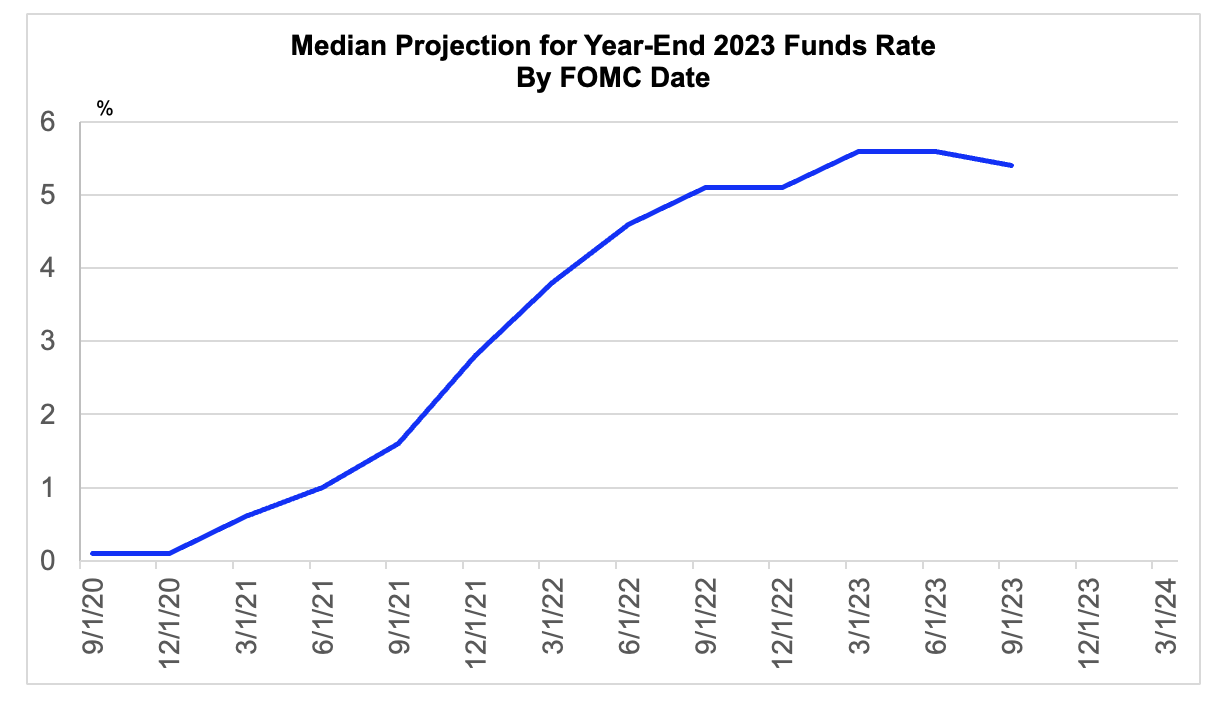
Data are actual to the September 2023 Summary of Economic Projections, where the dot was actually right.

