

The informed consensus did not change its best guess for the May Core PCE Price Index in response to the detail in this morning’s Import Price Index. International airline fares came in roughly as implied by the PPI. There is some dispute across the analysts about how to treat this item, but the import price index did not seem to resolve any of it. Still, there was some minor movement after the release of the PPI, on which I have not yet commented. And one of the more reliable analysts who was quite high initially has reduced his best guess by 4 bps, not because of new data but just on a reconsideration of the data in hand. So, I figured a quick update would be appropriate here.
The informed consensus has the Core PCE Price Index rising 32 basis points (false precision throughout). That is another unnervingly high reading, but about 8 basis points of this is due to an add from portfolio management and advisory fees, which is just a noisy reflection of the performance of the stock market, particularly at short horizons. So, it is probably better to focus on the implied consensus for the Market Price Only (MPO) version of the Core. That is expected up 24 basis points or just under 3% at a sequential annualized rate.
While non-market prices provided a big lift to the Core in May, this has not been an issue over the past year taken in aggregate. The 12-month change of the standard Core is on track to print at 3.38%, while the MPO version in on track to 3.15%. However, the MPO typically runs below the conventional core because non-market prices tend to rise relatively quickly over time. Correcting for this bias, the MPO actually points to a marginally higher underlying inflation rate than does the conventional Core. Or more realistically, the two approaches give reads that are so close that the distinction can safely be ignored.
One interesting twist this month is that Core Goods Price Index is expected to be down 10 bps. That is consistent with the notion that the tariff impetus peaked – even in level terms – a while ago, although we probably never relate one month’s result to a macro theme. It might also be evidence that the lift from the AI buildout, which would logically be less transitory and more worrying than the tariff effect, might be a bit smaller than we previously imagined.
The heat this month was in so-called Supercore Services, that is, Core Services excluding housing. That index is on track to be up 49 bps on the month. But keep in mind that the stock market effect is particularly concentrated there. So, the MPO version is on track to rise a more moderate, although still quite warm, 35 basis points.
Meanwhile, we basically know that housing or rents was up 33 basis points. That is quite a bit quicker than my proxy of marginal rents which is rising at just 12 bps a month. I make less of this distinction that I did before because the gap between the levels of marginal and average rents has closed, which I think means that precision trumps lead here. In other words, I am less inclined to just swap out the average rents in favor of the marginal.
Nevertheless, we can complete the thought by doing the arithmetic with a somewhat dovish set of assumptions. Let’s assume that the post-tariff and post-globalization trend in core goods prices is zero. And let’s assume – quite dovishly – than housing or rent inflation is headed to 1.5% sequentially. To get to 2% inflation under these assumptions, we would need SuperCore services to run at 3%. But it is currently running at about 3.7%, which I infer from observing the MPO SuperCore and then adding back the structural downward bias there. So, it is running 70 basis points too high. Or equivalently, its current rate maps to a Core PCE inflation rate of 2.4%, 40 bps above target, under the conditions mentioned above. To the extent the assumed conditions have a slight dovish bias, the issue here is a bit more serious.
It is by no means a disaster. But with the labor market within measurement error of full employment, conventional monetary policy would require some sacrifice of employment to get the underlying inflation rate lower. So, this continues to fit my view that the speed limit on growth is 2% or perhaps lower. Chair Warsh’s presumed preference for the Trimmed Mean may affect this slightly, but it cannot overturn it, because his preference is not widely shared across the committee, for good reason in my view.
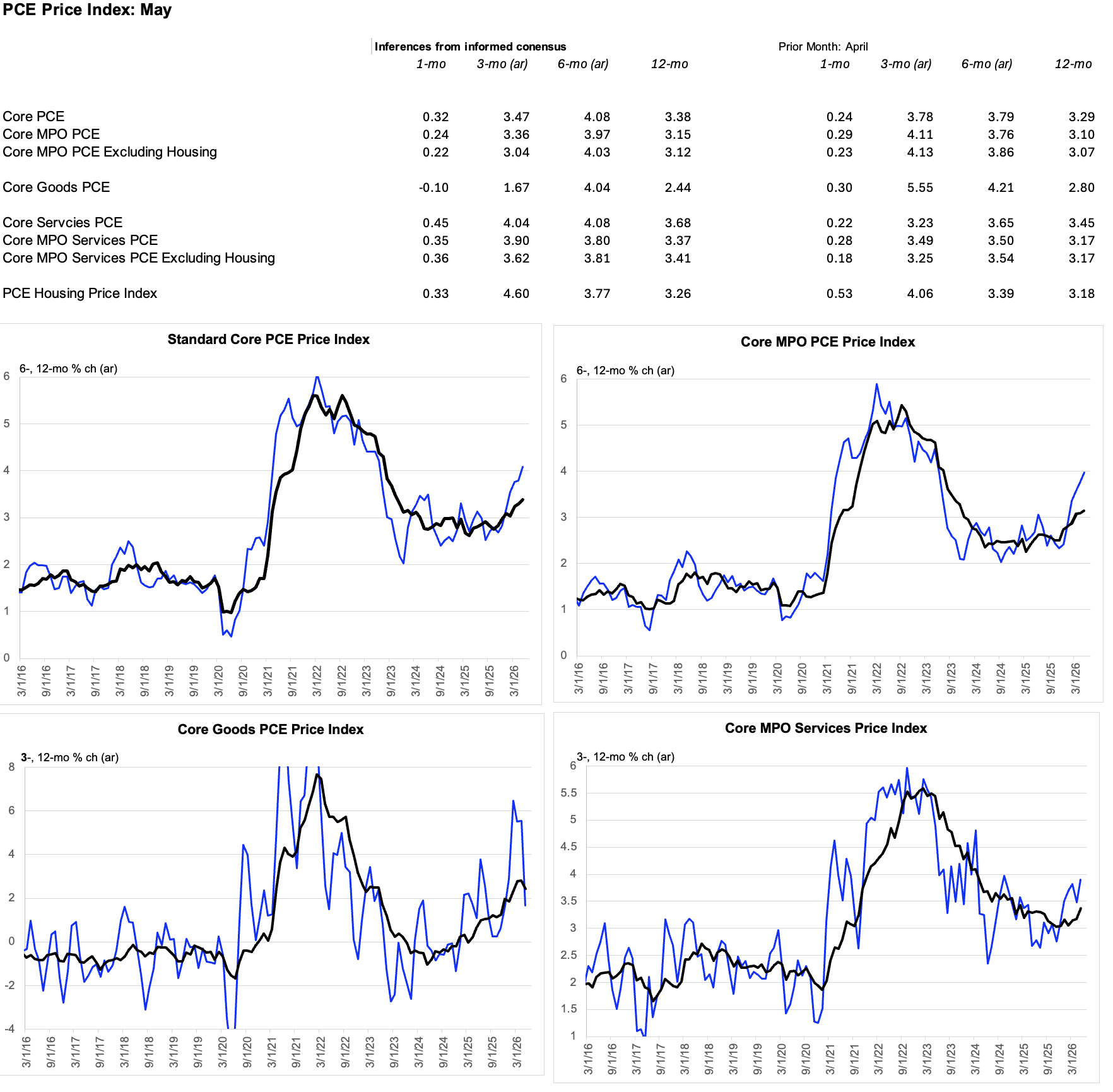
Data are actual to April and consensus for May.

