

The situation in the Persian Gulf remains characterized by ongoing low level tit-for-tat military strikes between U.S. forces in the region hitting select Iranian military targets, and Iran striking back against targets across the Gulf region. Global oil prices on the back of among other things large U.S. SPR releases, rapidly declining global inventory levels, and dramatically lower Chinese imports meanwhile seem to have found a new temporary “benign equilibrium” since late May with both WTI and Brent futures (July) below $100.
This is a level so far not adequately economically punishing for Donald Trump to politically compel him to strike what will be an unappealing deal with Iran to end the conflict. This degree of uncertainty and elevated oil and natural gas prices (European TTF prices currently fluctuating just below €50/MW) are however, based on the most recent euro area macro data likely to be force the ECB to raise rates more than once. It is consequently now the base case that the ECB will raise rates by 25bp at the coming meeting next week, as well as at the meetings in either in July or September.
Negotiations between the Trump Administration and Iran currently is at an impasse, as Donald Trump is reported to have raised his demands for a deal in terms of the future restrictions required on Iran’s nuclear program and the amount of frozen cash to be released to Iran. At the same time, the Iranian leadership appears content to wait, seemingly convinced that they have time on their side and is unconcerned about the scope and risks associated with ongoing low level exchanges of fire.
What is clear is that Iran is signaling that it will not accept a stealthy return towards the status quo ante without an explicit deal with Trump, and will kinetically respond to continue to establish its de facto control over the Strait of Hormuz, and show its ongoing ability to strike Gulf region infrastructure.
This situation can endure for quite some time, as the WSJ has also reported that Donald Trump will not resume all-out war (or at least dramatically scale up the scope of U.S. retaliatory strikes) unless U.S. troops are killed by Iran. Tehran in other words by that logic has a fairly wide scope for strikes against the Gulf region without risking a more forceful U.S. military retaliation. As was seen with Iran’s strike on the airport in Kuwait on Wednesday, Tehran is likely to make full use of such opportunities.
This is an exposed political and economic situation for the broader Gulf region, and is inherently unstable as Iranian strikes may at any moment “hit the wrong target”. Yet it is also a set of conditions that keeps the risk of a return to full conflict low.
The increasingly loud warnings from top oil company executives about the imminent decline in physical oil inventories to dangerously low levels likely to cause oil prices to rise materially in the coming weeks and months suggests that the current impasse in negotiations over Iran will though not last that long.
While Donald Trump is evidently at the moment not under adequate political and economic pressure to strike the type of “shallow deal” that reopens the Strait, offers sanctions relief to Iran, and restarts nuclear negotiations, materially higher oil prices from eventually depleting physical inventories may soon force his hand. The decisionmaker remains President Trump, and his own personal political and economic pain threshold in this U.S. midterm election year the finger on the scale dictating timing.
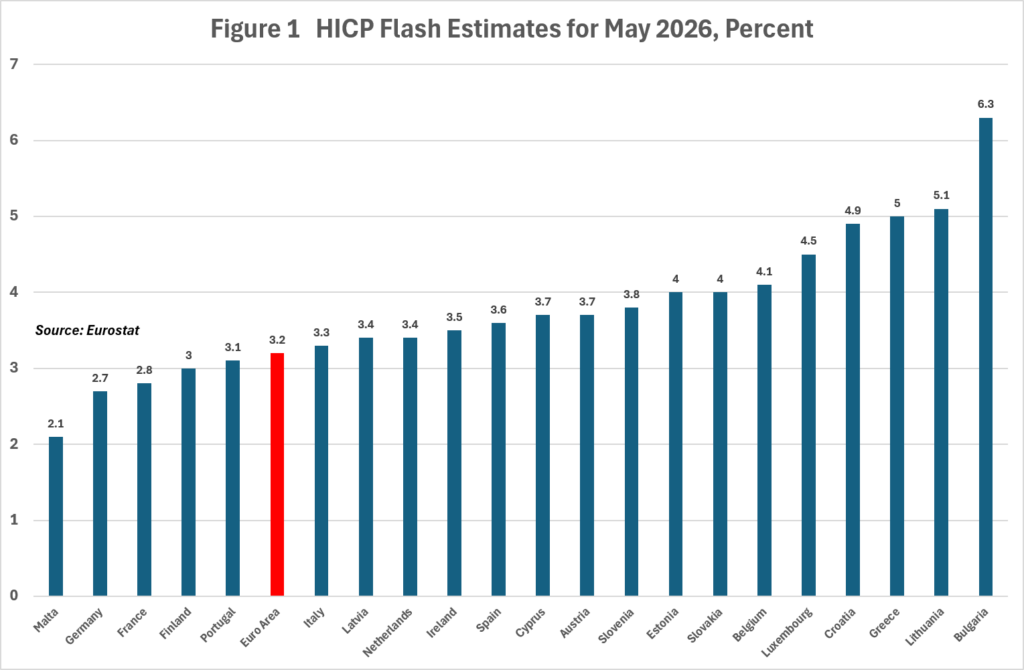
The procrastination in Iran negotiations have ongoing economic consequences around the world, not least in Europe already affected the lingering energy price fallout from Russia’s invasion of Ukraine. Flash euro area inflation data for May saw HICP rise to 3.2 percent and importantly only three members below 3 percent (Germany, France and Malta, see figure 1), while eight euro area members saw headline inflation at 4 percent or higher.
This suggests a sizable constituency on the Governing Council in favor of raising rates, as national governors in the end will cast their vote with national conditions in mind. Services inflation in the euro area rising to 3.5 percent and core inflation to 2.5 percent will also concern Frankfurt.
Counting against a more aggressive ECB monetary response is, as has been discussed in earlier notes, the increasingly precarious economic and labor market situation in especially France and Germany. The announced decline in euro area GDP of 0.2 percent in Q1 2026 superficially supports such restraint from the central bank. However, the decline in euro area GDP in Q1 was entirely attributable to the absurd situation of Ireland’s recorded GDP – driven by mostly U.S. multinational companies’ tax optimization strategies – declining by over 12 percent (figure 2).
Figure 2 EU and Euro Area Member States’ National GDP Growth Rates, Q1 2026.

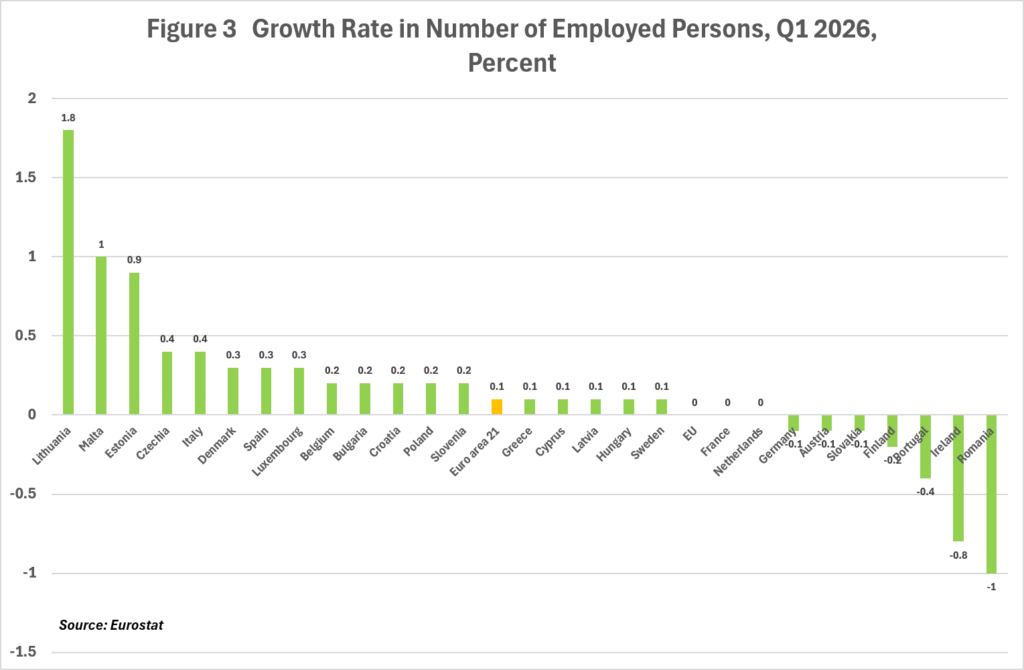
Euro area GDP, excluding Ireland, in fact grew at a fairly stable about .25 percent quarterly rate, more or less unchanged from Q4 2025. Quarterly employment growth rates for the euro area also remained positive in Q1 – though did show a drop in Germany – again not likely acting as much of a constraint on the ECB’s freedom to raise rates (Figure 3).
The combination of recent stable euro area macro data and the most probable path for a deal to be struck between Trump and Iran – i.e. that oil prices will have to first rise from declining inventories to increase the economic and political pressure on Trump – putting ongoing upward pressure on European energy and broader prices in the weeks ahead now makes it the base case that a majority of ECB Governing Council members will want to raise rates by more than 25bp over the next three months. The hike next week seems a given, and either July or September looks likely, too.
Donald Trump’s resistance to an eventually inevitable deal with Iran is not the global economic disaster a prolonged de facto closure of the Strait of Hormuz had been predicted to become, but it is gradually forcing the hands of monetary policy makers around the world. Now in Europe, elsewhere likely soon, too.
Jacob

