

The market’s apparent indifference to this morning’s vacancy data in the JOLTS report may reflect in part that alternative measures of vacancy are telling a different story or that other elements of the JOLTS report came in on the soft side. But I suspect the issue here is more fundamental and relates to my reluctance to try to shove every inflation oscillation into the Phillips Curve.
Before the Covid / Biden inflation shock, we seldom heard about vacancies as an alternate measure of labor market tightness. Vacancies were something labor market specialists talked about, and they were one means of motivating the idea that the natural rate of unemployment might be above zero, due to “frictions.” But the concept of the unemployment to vacancy ratio (u/v) gained particular prominence as a direct measure of labor market tightness during the inflation upswing of the early 2020s. And I think this is because it signaled much more labor market tightness than the unemployment rate alone did. It was “convenient” to those who wanted to apply the standard model to that episode.
My old two-stage-disinflation hypothesis argued that much of the inflation overshoot of that period was due to forces outside the purview of the Phillips Curve. Specifically, businesses adjusted their desired output sluggishly in response to the nominal demand surge caused by the Biden fiscal expansion. As a result, the unemployment rate did not move rapidly, but price inflation spiked precisely because the real side response was sluggish. It is not so much that a suddenly tighter labor market caused inflation “pressures” (although that did happen to some extent) as that the nominal demand pulse just went directly into prices – and with a lag, wages. The inflation was caused by businesses not responding much, and not by their responding with higher labor demand! A truly delicious irony if true.
But for those who wanted to stick to the standard model, vacancies played a useful role. That is, if we replaced — as our measure of labor market slack — the unemployment rate with the ratio of unemployment to vacancies (u/v), we could see a much steeper tightening of the labor market which made it much more plausible to shoehorn the Biden phase of the inflation into the standard model. As I mentioned quite loudly and repeatedly at the time, that smelled of ad hocery.
And I suspect that the market now recognizes it as such, even though I realize this interpretation may strike you as self-serving. I suppose it is. I do this when making fun of the importance of the balance sheet too. ☺ But I will spare you getting into that here, beyond mentioning that nobody ever stayed up all night worrying about the Fed “imprimatur” on the economy. I am terrified of the Fed imprimatur! Help!!
Sorry.
Oh, how very conveeeeenient!
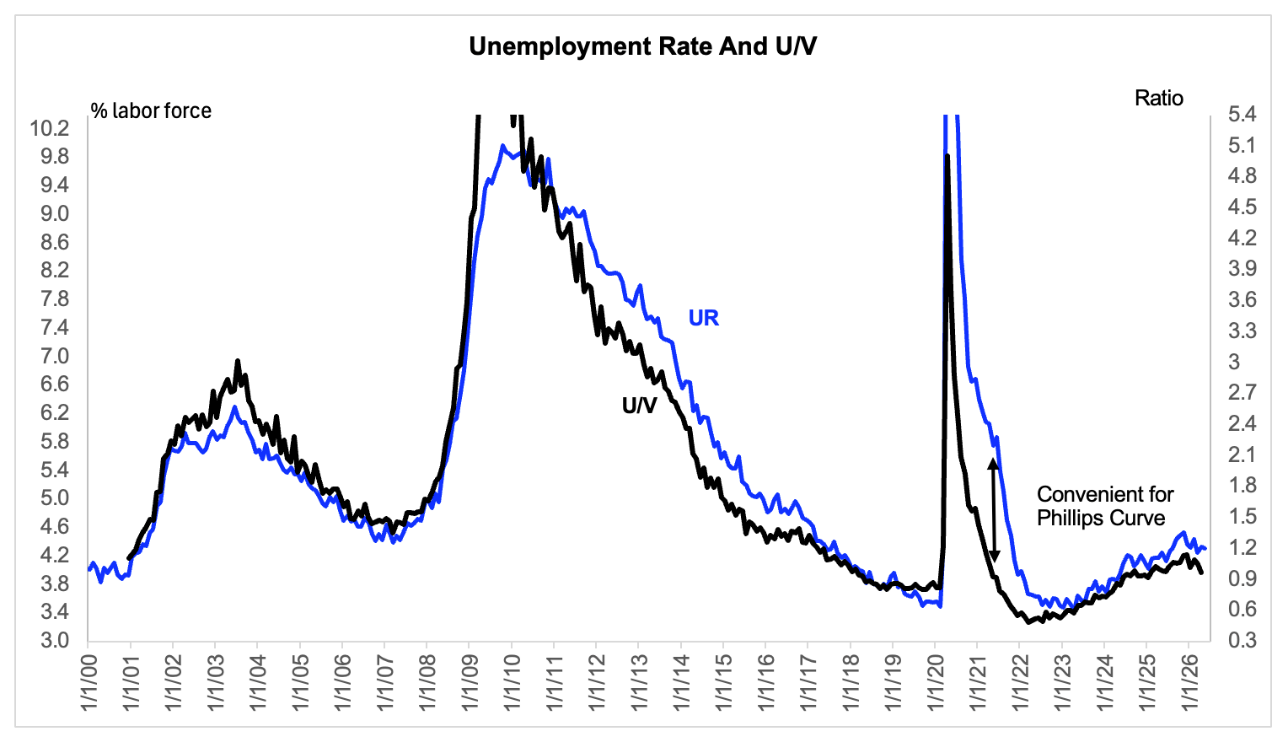
Unemployment rate is actual to April and as implied by consensus for May. U/V is actual to April.

