A Noisy April JOLTS Show a Still Low Churn Labor Market
- In what seems a fairly noisy release, the April JOLTS data had a number of cross currents and outlier-looking series.
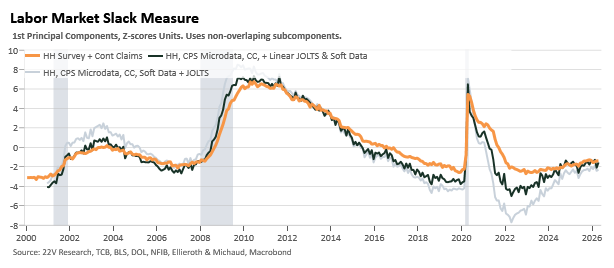
- The net conclusion across measures is that slack probably increased slightly in April and the labor market remains still quite glacial in its pace of churn and turnover. Most all measures of slack seem to have troughed late in 2025 and have seen noisy mild rebound since.
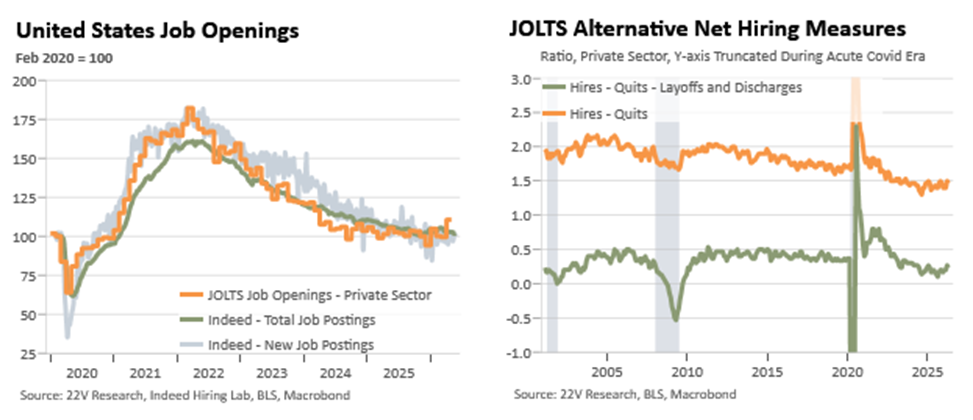
- Openings surged m/m, the rate of jumped from 4.2% to 4.6%, with almost all the gain accounted for by professional and business services. This may be a tentative sign of the AI boom being a boom more broadly (could just be noise too), with the information sector (that has limited overlap with tech) showing signs of higher churn too.
- The quits, hires, and layoffs rates all dipped slightly suggesting that ‘low hire, low fire’ remains the best way of describing the now stable or slightly improving labor market.
- JOLT analogous measures from the employment report’s household survey paint a slightly more optimistic picture, with very low layoffs and high-risk quits rebounding.
The April JOLTS report is one of the messier labor market releases I can recall in some time. Looking across the various sources of hard data and sentiment surveys we have for April suggests that slack was maybe slightly higher on the month but remains inside its recent range. The labor market seems stable but continues to be low churn.
Job openings surged higher, led almost entirely by a jump in openings in the professional and business services sector. The narrowness of the shift higher naturally raises some suspicions about this specific month’s move higher. Looking back over a bit longer horizon, the JOLTS data match the stabilization seen in Indeed’s data as well. Taken together with measures of hiring in recent months, that labor demand has stabilized and might even be starting to tick up ever so slightly.
The quits, hires, and layoffs rates all ticked down in April. Despite perhaps a bit better labor demand, it clearly remains a very low churn job market. The layoffs measure is consistent with the signal from the jobless claims data, although it is slghtly less wildly optimistic than the initial claims data it remains extremely strong. Quits remain inside their recent range, consistent with the stabilization seen in most other measures workers’ perception of the labor market.
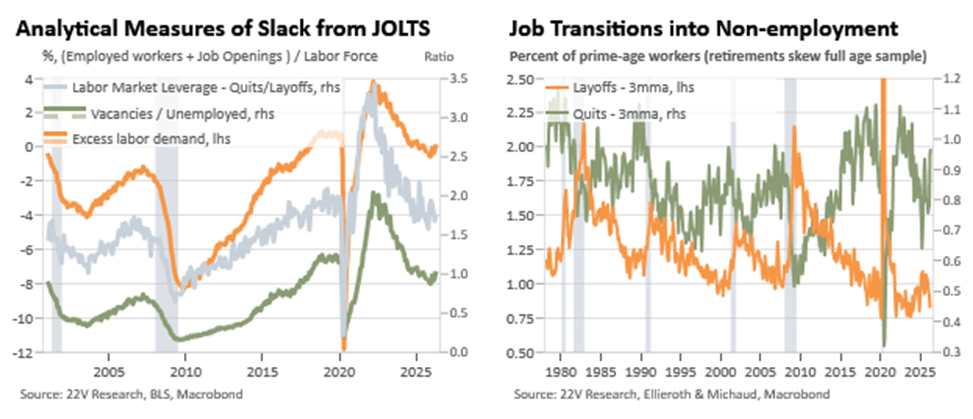
Analytical measures from the JOLTS data generally show that the labor market seems to have troughed at some point last fall, lining up with most other measures as well. Overall labor demand (employment + openings / labor force) is now back in mild positive territory, the now less en vogue than it once was vacancies to unemployment rate has bounced back a bit, and labor market leverage (the ratio of quits to layoffs) is similarly noisily a bit above its recent lows.
JOLTS-like measures from the monthly employment report’s household survey, released with a lag from the same microdata as the Atlanta Fed’s wage growth tracker, point to a similar if slightly more optimistic direction. Quits into non-employment, high risk high confidence quits in other words, have sharply rebounded in recent months. Layoffs of prime-age workers have also fallen notably and are back near cycle lows in a signal fairly consistent with the jobless claims data.