Bottom Line: 10yr Yields
Unless the SOH situation worsens, 10yr yields should grind sideways with a downside skew, as growth slows in H2 2026. The extreme yield volatility that drove May’s risk-on/off swings should fade, favoring fundamental factors (Earnings Momentum, GARP, Growth Momentum) over pure risk factors (high vs. low vol). Easy financial conditions should continue under our forecast, keeping tailwinds intact for Retail, Banks, and Airlines. Unusually weak sentiment relative to the data is also supportive.
Relevant News: Takeaways from last week’s conferences – Consumer & Capital Markets activity a solid positive while investors struggle for the right deposit narrative.
Last week’s conferences reinforced a positive backdrop for banks, with strong capital markets activity, resilient consumer spending, and healthy loan demand driven by AI and infrastructure-related investment. While most management teams remained constructive, deposit costs emerged as a key area of focus, with investors increasingly rewarding banks that can better manage funding pressures. As we move into 2H26, we expect deposit cost discipline to be a major driver of relative bank stock performance.
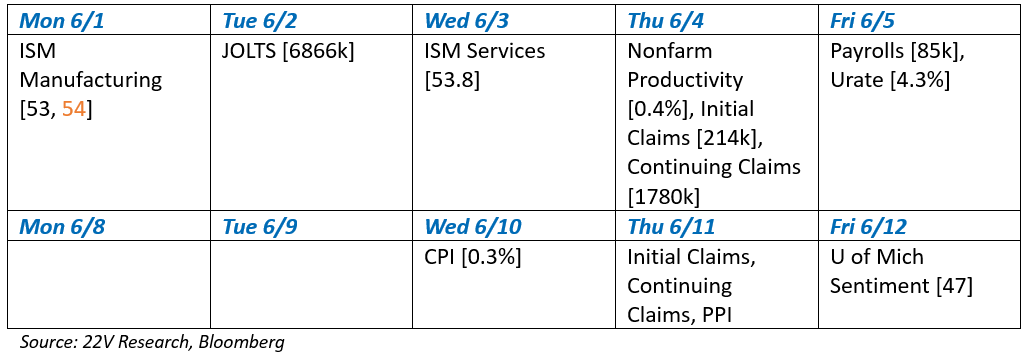
Things to Watch [Consensus, Results]:
Strategy:
Extreme Yield Volatility that Drove May’s Risk-on/off Swings Should Fade– (HERE)
Since the peak in 10yr yields at ~4.7% to the current 4.46% level, the Russell 2000 (small caps) are +3.1% vs the S&P 500. Retail stocks are +2.9% vs the SP 1500, Airline relative: 1.9%. Regional Bank relative: -0.1%. Value gained 1.7% vs the S&P 500 and the Low Earnings Volatility declined -8.0%. The Price Momentum factor has stagnated (0.06). Last week’s internal market regime – a measure of how all factors traded relative to each other – was classified as an Everything Rally. That was the second consecutive Everything rally (10yr yields declined) and followed two consecutive weeks of Broad Sell-off regimes in early May (10yr yields increased).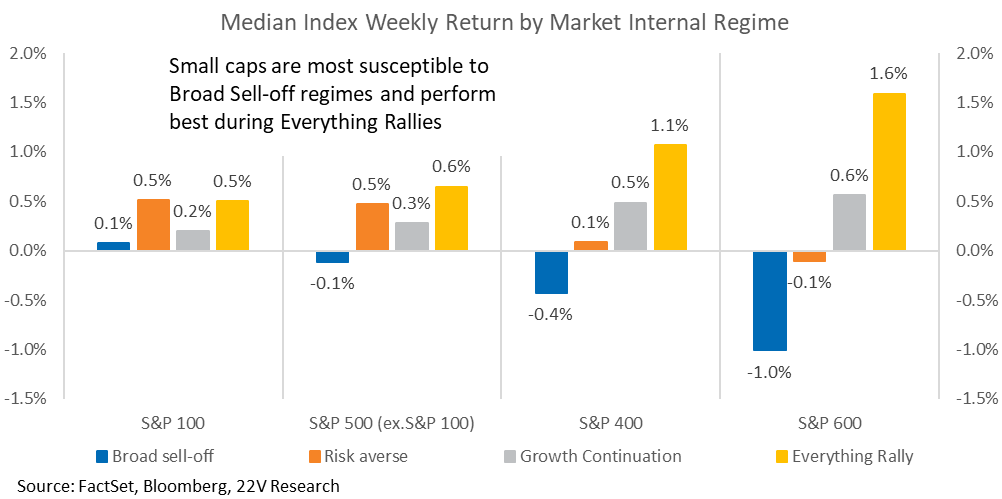
AI Macro Nexus
Dell, AI Factories, and the Industrialization of Intelligence – (HERE)
Dell’s latest earnings report provides some of the strongest evidence yet that AI infrastructure demand is broadening well beyond hyperscalers and into the wider economy. The company reported explosive growth in AI-optimized server revenue and a rapidly expanding customer base spanning enterprises, cloud providers, sovereign entities, and hyperscalers, reinforcing the view that organizations are moving from AI experimentation to production deployment. Management highlighted growing demand for integrated AI infrastructure, enterprise AI solutions, agentic AI workloads, and next-generation rack-scale systems built around NVIDIA’s upcoming Vera Rubin architecture. Importantly, Dell’s position across servers, storage, networking, endpoints, power, cooling, and deployment services gives it a unique vantage point on the AI ecosystem, suggesting that AI is evolving from a technology trend into a foundational layer of economic infrastructure. Taken together, the results support the thesis that the current AI buildout is expanding across industries, use cases, and geographies, with demand increasingly driven by enterprises seeking to embed AI into everyday operations rather than solely by hyperscale data center investment.
Derivatives:
Why I Believe Low-Cost Rate (TLT) and Credit Spread (LQD) Hedges Should be Established Now– (HERE)
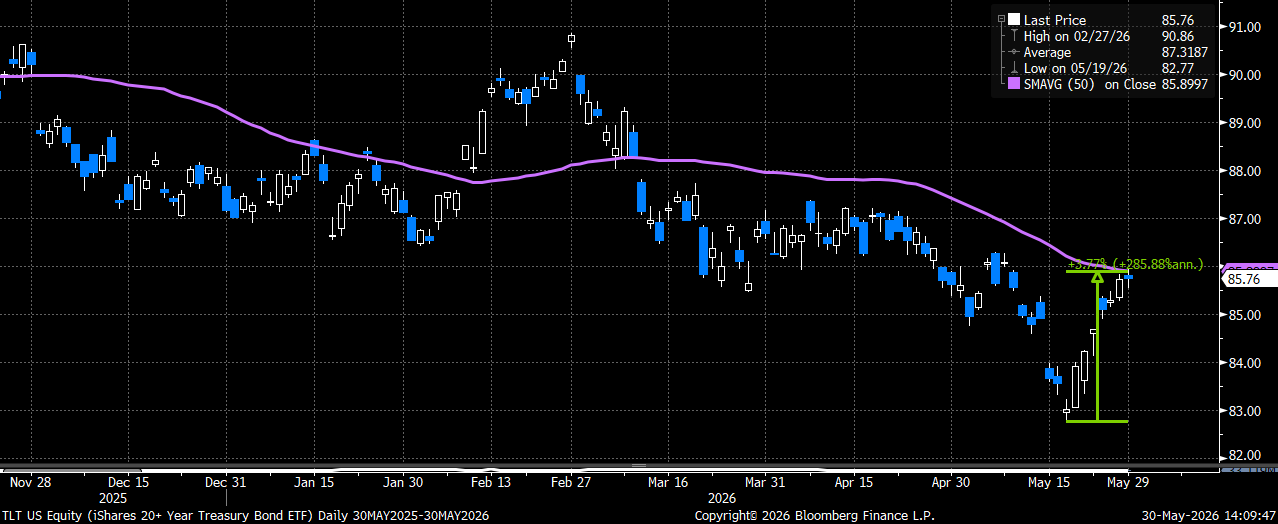
The recent rally in Treasuries has pushed TLT nearly 4% off its May lows and back toward key technical resistance at the 50-day moving average, while declining oil prices and lower yields have helped support bond prices. With 10-year yields now approaching potential support, TLT implied volatility back near its recent floor, and several market-moving economic releases (payrolls, CPI, and PPI) approaching, the risk/reward appears favorable for re-establishing rate hedges. The preferred expression is the July 17th TLT 85/80 put spread, offering defined downside exposure at relatively low cost. Similarly, LQD hedges look attractive as both Treasury yields and investment-grade credit spreads have rallied back toward historically tight levels, leaving limited room for further improvement and increasing the potential for weakness if rates rise or credit spreads widen.