

It is not really a surprise because we knew about the Trump tax cuts hitting in Q1. But this morning’s GDP update confirmed that the domestic private sector moved much further into financial surplus last quarter, entirely in response to a further blow-out in the fiscal deficit. By virtue of an iron accounting identity, the private sector financial balance is inevitably the difference between the fiscal deficit and the current account deficit.
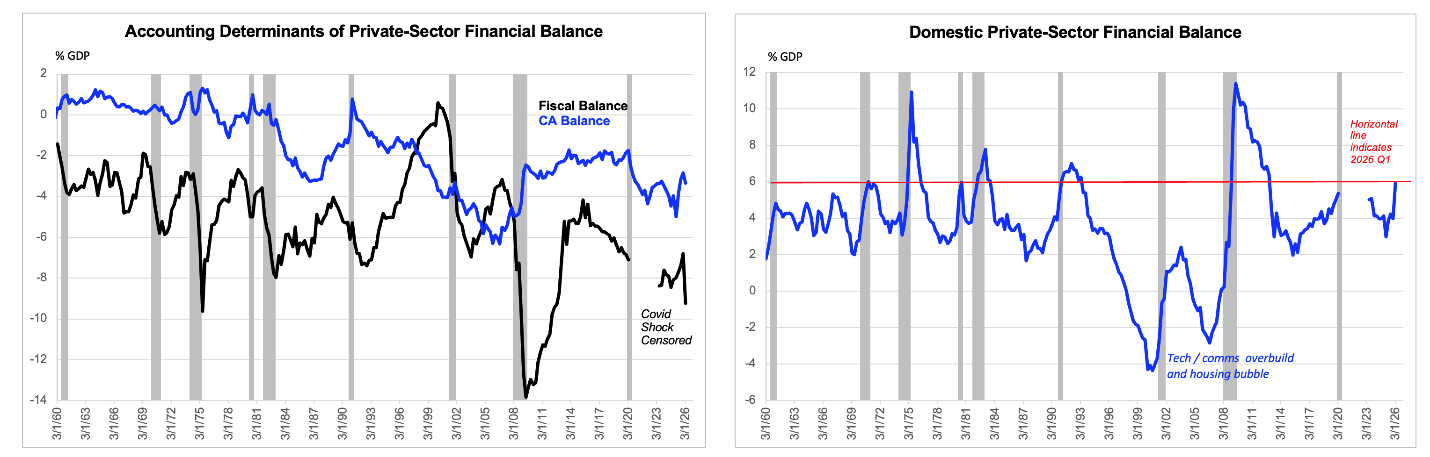
Accounting identities must hold, but there are many paths to them holding, some benign and some less benign. For example, the private sector went into a huge surplus after the GFC and then again after the Covid shock (censored in chart above), because private demand collapsed and fiscal policy stepped in. But once a large private surplus is in place, the outlook for aggregate demand growth from there is likely to be solid.
Applying this to the current set up, we have aggregate demand being sustained at a pace consistent with full employment without having to rely on any overextension of the private sector. This is in sharp contrast with the 1990s boom and period ahead of the GFC, when fiscal policy was too tight (something we see more clearly in hindsight, admittedly) relative to domestic and global economic conditions — and the maintenance of full employment required the inflation of bubbles in the private sector. Not to imply that the Fed did this intentionally. Rather, the pursuit of conventional Fed objectives in an environment of too tight fiscal policy ended up generating that result, followed by bubble collapse. But thanks to the large fiscal deficit, that is not the prospect now.
The idea that a large fiscal deficit is stabilizing in the short to intermediate term requires that markets treat the federal debt as a safe asset. If that premise were ever to be challenged, then this happy talk about the stabilizing effects of a huge deficit would immediately be defunct. And with r* seeming to have pushed above g*, it would be appropriate for fiscal policy now to begin to tighten. Even I would concede that. But the stabilizing effect is probably still the more relevant one because markets still — understandably — treat the federal debt as a safe asset.
There is now actually a case for concern about fiscal sustainability
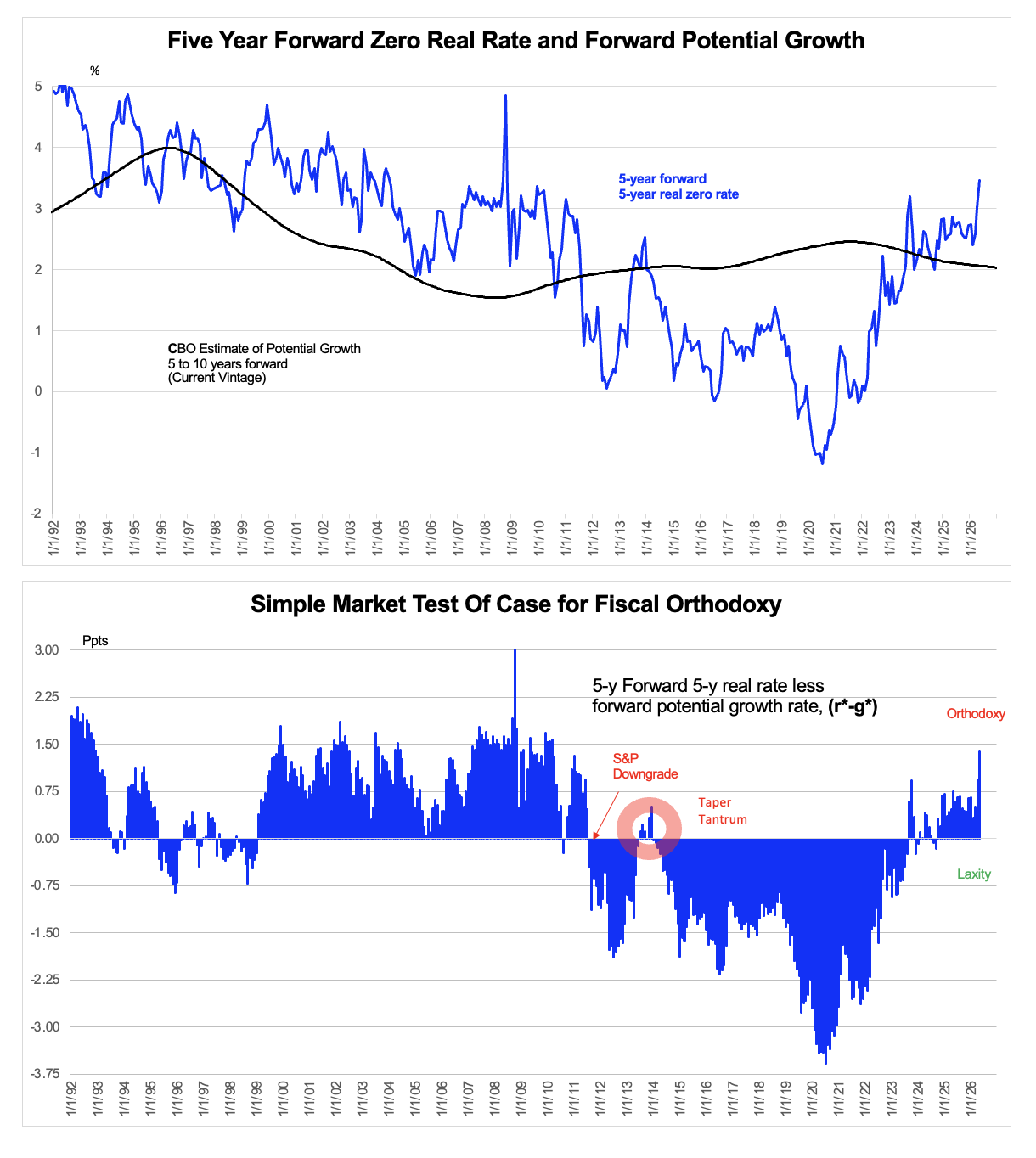
Market pricing is to the close on Tuesday.
There are two caveats to mention regarding the chart above. First, I take the 5-year forward rate as a proxy of the market’s expectation of the 5-year rate five years from now. If the term premium at the 10-year maturity is higher than that at the 5-year maturity, then this approach may generate a slight upward bias in the market-implied r*. Secondly, it is possible that the CBO estimate of potential growth has not yet caught up to the AI boom. But even with these caveats in place, it is no longer appropriate to dismiss concerns about fiscal sustainability as wildly premature, as was the case during most of the post-GFC recovery.
Somewhat related, if some of the darker scenarios imagined around AI were to come to pass, r* would again drop below g*, and we would once again be counting our luck to have such a large fiscal deficit. Still, tapping the brakes somewhat does seem appropriate, not that my opinion on that is the least practically relevant.

