

The Warning From Fujikura
In last week’s paper I argued that the biggest near-term risk to the AI capex boom was no longer weak demand, but rather the opposite: demand becoming so strong that the physical world struggles to keep pace. The concern was that the AI race had accelerated at warp speed into a synchronized global scramble for the same finite supply chains: HBM, advanced packaging, power equipment, cooling systems, optical networking, chemicals, and industrial infrastructure. In that paper, I argued that the AI buildout was beginning to resemble the Strait of Hormuz itself: a narrow choke point through which an increasingly urgent global demand surge was trying to pass simultaneously.
Just days later, the market may have gotten its first real glimpse of what that risk looks like in practice.
In Japan, shares of Fujikura (5803) collapsed after earnings despite reporting extraordinary growth tied directly to AI infrastructure demand. Following the report, the stock gave back more than 65% of its YTD gains over a five day stretch. Here is an overlay of Fujikura before its earnings release and my Optical Index which includes Corning, Coherent and Marvell amongst the 20 names.
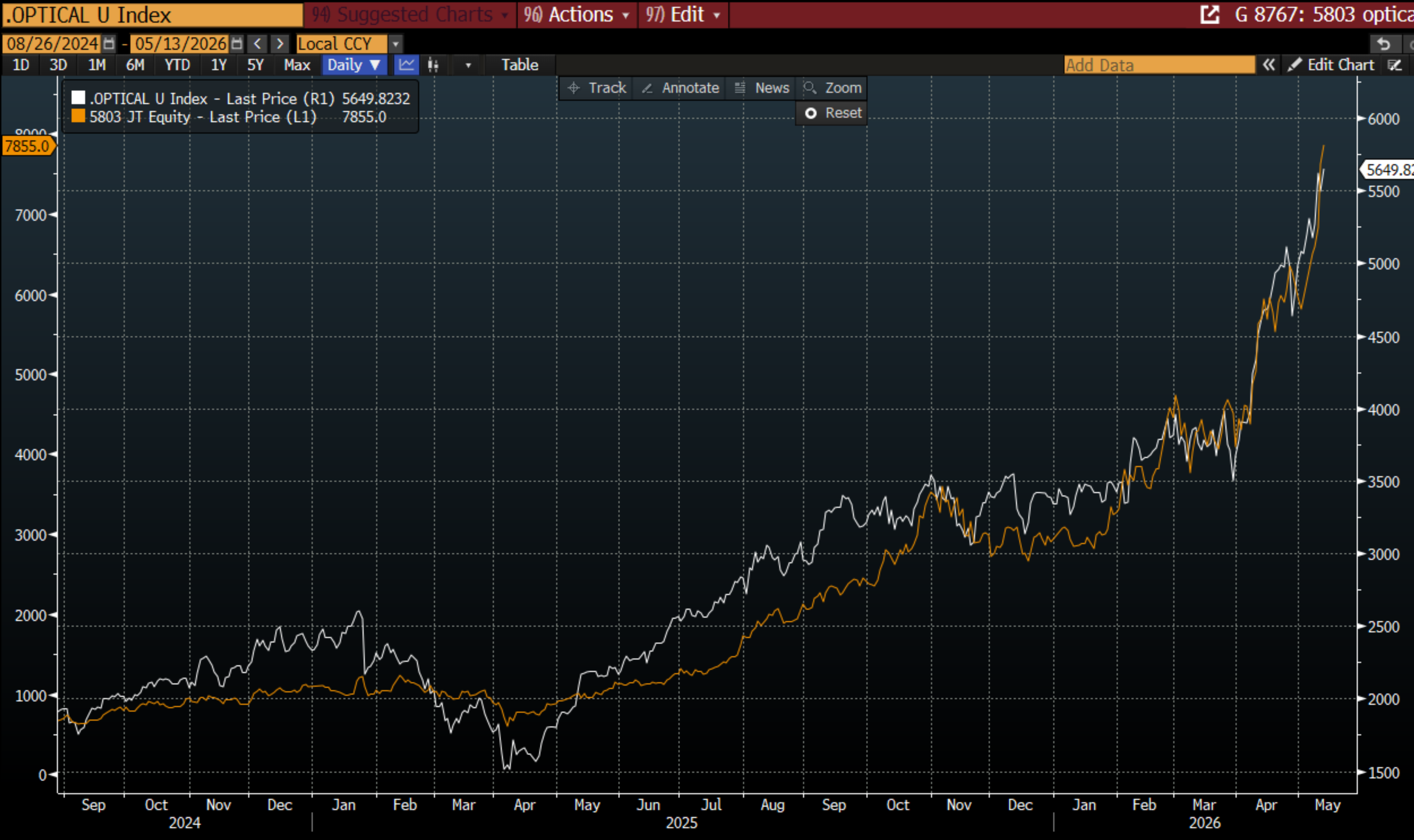
Importantly, the issue was not collapsing AI demand. The opposite was true. Fujikura reported that demand for AI data center infrastructure remained extremely strong, stating:
“Demand for data centers continued to grow against the backdrop of the spread and expansion of generative AI.”
The company’s Information & Communications segment, which includes optical networking infrastructure critical to AI clusters, saw revenue rise nearly 45% and operating profit surge more than 65%. But buried inside the earnings commentary was the real story and perhaps one of the most important warnings yet for the broader AI trade:
“Due to the sharp increase in production of optical cables, there is concern that procurement of some raw materials, such as hydrogen, may not keep pace. In particular, against the backdrop of tightening naphtha supply and demand, there are concerns about supply shortages and price increases for some raw materials.”
“The company plans to aggressively invest in production capacity expansion to respond to strong demand in the Information & Communications business.”
Management also directly warned:
“Currently, logistics stagnation is occurring due to the blockade of the Strait of Hormuz.”
Those comments matter because they perfectly capture the transition now occurring across the AI economy. The debate is no longer about whether AI demand is real; it is about whether the physical world can support the speed and scale of that demand.
What makes the situation even more important to think about is how early we still are in the buildout. In this weekend’s video, I highlighted that based on current industry expectations for AI infrastructure spending through 2031, the market may only be roughly 12% of the way through the expected capex cycle. Yet bottlenecks are already emerging across optical networking, HBM, advanced packaging, chemicals, cooling systems, power infrastructure, and industrial supply chains. For most investors shaped by the software era, demand was usually the primary variable that mattered because supply could scale relatively easily once adoption arrived. But AI infrastructure is increasingly becoming a supply constrained industrial buildout where shortages, logistics, materials, packaging capacity, and energy infrastructure all matter simultaneously. Investors are still in the early stages of adjusting to what may become a years long mismatch between explosive AI demand and the physical capacity required to support it. The violent reaction in Fujikura’s stock following earnings may have been one of the first examples of the market beginning to grapple with what managing through that environment could look like.
Nowhere is this physical limitation currently more critical than in the movement of data. Fujikura’s optical cables are struggling to meet the explosive need to move data between the servers. But before that data ever reaches the fiber network, it must survive an even tighter choke point inside the compute node itself.
No place is the supply risk more important than at the very center of the AI trade: High Bandwidth Memory, or HBM.
The Bandwidth Bottleneck
The artificial intelligence buildout is increasingly becoming a story not just about software and models, but about physical scarcity. As the market transitions from large language models toward reasoning systems, agents, robotics, and embodied AI, the demand for compute infrastructure is accelerating far faster than the physical world can comfortably absorb.
HBM has quietly become the critical choke point of the AI revolution. The industry initially viewed GPUs as the scarce resource. That view is now evolving. The real bottleneck is increasingly the entire system surrounding the GPU: advanced memory, advanced packaging, substrates, chemicals, power infrastructure, cooling systems, and manufacturing throughput.
In many ways, HBM is becoming the equivalent of oil pipelines during an energy boom. Without enough of it, the compute engine stalls regardless of how advanced the AI models become.
This issue is becoming more pronounced as NVIDIA’s AI roadmap accelerates memory requirements with each generation of architecture. Only four months ago at CES 2026, Jensen Huang gave investors their clearest look yet at the scale of what comes next when he unveiled the details surrounding the transition from Blackwell toward the future Vera Rubin platform. That presentation was an important moment because it clarified that the industry is no longer dealing with a normal semiconductor upgrade cycle. The roadmap itself effectively confirmed that AI infrastructure demand is about to become dramatically more bandwidth intensive.
NVIDIA has already begun sampling its GB300 Blackwell Ultra systems, and the company confirmed that the B300 platform will use roughly 50% more on package HBM than current B200 Blackwell systems. But the larger realization emerging after CES was that Blackwell is not the endpoint. Vera Rubin represents another major step higher in memory density, interconnect bandwidth, rack scale architecture, and inference throughput requirements.
That matters because the AI industry is no longer scaling linearly. Every generation of frontier AI systems requires exponentially more memory bandwidth to feed increasingly massive compute clusters. AI systems are fundamentally bandwidth machines. The models only become more intelligent if data can move fast enough through the system.
Fujikura’s optical networking layer solves bandwidth between the servers. HBM solves bandwidth inside the server. The entire “whole rack” AI architecture collapses if either layer fails to scale.
The strategic importance of HBM was reinforced again over the weekend when Huawei unveiled its Tau Scaling and LogicFolding approach, a design framework intended to improve chip performance by optimizing data flow, reducing latency, and relying less on pure lithographic shrinkage. The announcement was important not because Huawei has suddenly eliminated China’s semiconductor constraints, but because it showed where the entire industry is being forced to go. Whether in NVIDIA’s Blackwell and Vera Rubin roadmap or Huawei’s sanctions-driven workaround strategy, the direction is the same: logic, memory, packaging, and interconnect must be designed together. The memory wall has become the central architectural problem of AI. While Huawei’s approach is not commercially proven at scale yet, prolonged bottlenecks in HBM, advanced packaging, or GPU deployment create something equally important: time. If the dominant supply chain struggles to meet explosive demand quickly enough, delays themselves can give alternative architectures, packaging approaches, and creative engineering solutions more time to mature and catch up. In that sense, bottlenecks do not simply constrain supply; they can unintentionally accelerate competitive innovation.
In many ways, CES 2026 was the moment the physical implications of the AI roadmap became unavoidable. Investors were no longer simply modeling GPU demand. They were suddenly forced to contemplate the scaling requirements for HBM, CoWoS packaging, optical networking, power delivery, cooling systems, transformers, and industrial infrastructure necessary to support the Vera Rubin era.
Why HBM Is So Difficult
HBM itself is extraordinarily difficult to produce. Unlike traditional DRAM, HBM stacks multiple layers of memory vertically using through silicon vias and advanced packaging technologies. Manufacturing yields are more complex. Thermal management is harder. Packaging precision is critical. The result is a supply chain with very few qualified participants.
Today, the dominant HBM suppliers remain SK hynix, Samsung Electronics, and Micron Technology. But even these firms are struggling to keep up with the velocity of demand. Supply chain commentary throughout 2026 increasingly points toward tight HBM4 availability, long lead times, and sustained pricing power across advanced memory products.
Importantly, the bottleneck does not stop at memory fabrication. HBM cannot function independently. It must be integrated alongside GPUs using advanced packaging technologies, particularly CoWoS, or Chip on Wafer on Substrate, largely controlled by Taiwan Semiconductor.
The advanced packaging ecosystem is now arguably the single most constrained portion of the semiconductor industry. CoWoS capacity remains heavily booked, with backend lead times extending well beyond 50 weeks in some cases. NVIDIA reportedly controls a substantial share of this capacity, leaving limited room for competitors and exposing the broader ecosystem to concentration risk.
Even though TSMC continues expanding CoWoS capacity aggressively, expansion itself requires additional bottlenecked inputs: substrates, clean room equipment, ultrapure water systems, industrial gases, specialty chemicals, cooling systems, and highly specialized labor.
The Hidden Chemical Layer
One of the least appreciated risks now emerging is the interconnected nature of industrial supply chains. Semiconductor fabs depend on chemicals and gases that also support agriculture, mining, refining, and industrial manufacturing. Sulfuric acid is one example increasingly showing up across industries simultaneously.
Agriculture consumes enormous quantities of sulfuric acid for phosphate fertilizer production. Mining uses it for copper extraction and critical mineral processing. Semiconductor fabs require ultra high purity sulfuric acid for wafer cleaning and etching processes. While semiconductors use far smaller volumes than fertilizer producers, they remain dependent on the same upstream sulfur economy.
This is becoming increasingly important because China has restricted sulfuric acid exports at the same time that Middle East instability is threatening hydrocarbon refining and downstream sulfur production. The result is rising pressure across multiple industrial chains simultaneously.
Fertilizer companies like Mosaic have recently warned about sulfuric acid and input shortages tied to the Strait of Hormuz disruption. Copper mining faces similar pressure. Semiconductor chemical supply chains may not be immune either.
The important point is that AI infrastructure is no longer just competing with other technology companies for resources. It is increasingly competing with the broader physical economy itself.
The New AI Risk
This creates an important conceptual shift for investors and policymakers. For years, technology was viewed primarily as a deflationary force driven by software scalability. AI is changing that framework. The next phase of AI increasingly resembles an industrial mobilization effort requiring enormous quantities of atoms: power, memory, cooling, chemicals, copper, transformers, optical fiber, packaging materials, and energy infrastructure.
At the same time, hyperscalers are not slowing down. Companies continue racing to secure compute capacity ahead of future demand. That dynamic encourages hoarding behavior throughout the supply chain. Memory buyers secure inventory early. Packaging slots get reserved years ahead. Power contracts are signed aggressively. Optical networking equipment gets preordered. Chemical inventories rise. Every participant attempts to front run scarcity.
Historically, this type of behavior amplifies volatility.
Instead of smooth economic cycles, industries experiencing constrained supply and explosive demand often produce parabolic expansions followed by sharp air pockets whenever bottlenecks intensify. The semiconductor industry has always been cyclical, but the AI cycle may prove structurally different because demand is being driven simultaneously by sovereign competition, hyperscaler spending, enterprise adoption, and agentic AI proliferation.
The danger is not that AI demand disappears. The danger is that the physical world cannot keep pace.
The Strait of Hormuz Inside the AI Trade
HBM sits directly at the center of this risk.
Without sufficient HBM supply, next generation GPUs cannot achieve targeted performance. Without advanced packaging, HBM cannot be integrated efficiently. Without chemical stability, fabrication throughput becomes vulnerable. Without energy stability, manufacturing expansion slows. Without coordinated infrastructure investment, the entire AI deployment cycle faces mounting friction.
And that brings the story back to Fujikura.
The market’s reaction to Fujikura last week may ultimately be remembered as one of the earliest warnings that the AI boom is entering a new phase built on bottleneck risk. The company did not report weak demand. It reported overwhelming demand colliding with raw material shortages, shipping disruptions, and physical world bottlenecks.
That distinction matters enormously.
For the last two years, investors debated whether AI demand was real. Fujikura’s commentary suggests the next stage of the AI cycle may instead revolve around a different question entirely: what happens when the demand becomes so real that everyone starts running into the limits of the same fragile physical supply chain at the same time?

