

Public reaction to the AI buildout, a process fueled by seemingly insatiable capex supply, chip demand, and lagging public policy to address these developments define an ecosystem in which stakeholders defend their equities. None of these falls outside parameters of expectations, including the strong likelihood that frictions among investors and policymakers will be a persistent feature of this relationship, true of all regulated businesses.
- This broad AI phenomenon exhibits elements of a healthy system in which private and public interests run both on parallel and sometimes conflicting paths. The delayed Trump administration AI governance executive order would validate distinct and overlapping roles of federal and private players.
- I believe Congress eventually will be pressed to address gaps in voluntary and rules-based guardrails designed to promote innovation, competition, and individual protection. Next year is the soonest legislative could be viable, in my view.
- Regulatory fragmentation is a core AI policy Sub-federal units of government retain physical buildout oversight (utility regulation, non-federal data center building permits, local employment rules, and non-national fiscal policy). Jordi’s multi-quarter GPU scarcity theme exemplifies private sector resource rationalization, another core AI policy theme.
- My third AI policy theme focuses on the understandable lag in regulation relative to AI technological, community impact, scientific, and capital formation pacing. States, counties, and cities routinely grapple with these issues albeit unevenly. Those governments increasingly rationalize resources, especially grid interconnection, site permits, water, and power generation.
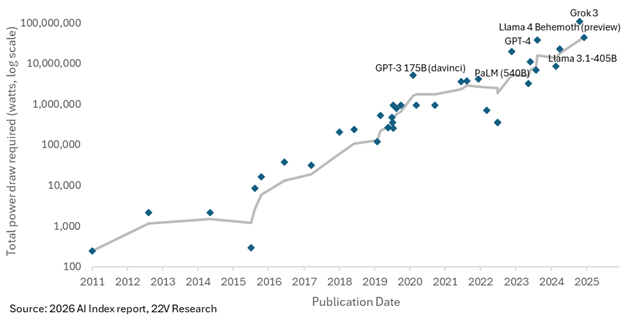
The table below from Stanford University Human-Centered AI researchers is one proxy of the increasing power demand. State and local government data center policies in the U.S. are not governed by a single unified framework. Instead, they are shaped by a layered mix of federal standards, state laws, and local governance practices. State utility regulators combine under the National Association of Regulatory Utility Commissions (NARUC) responsible for grid interconnection decisions (having disconnected power generation from all states, the Texas PUC is not a NARUC member but participates in many activities).
Two weeks back, NARUC announced an effort to help regulators understand and plan through the fast pace of large load demand associated with data centers. Governments are intensifying large load management learning and have dedicated a page on their site to the topic. This development highlights the understandable if not preferrable lag in public policymaking devoted to core AI issues. NARUC’s efforts also point to the fragmented nature of regulatory oversight (HERE). Continuing to underscore the power regulatory fragmentation theme, the Federal Energy Regulatory Commission last week proposed new rules for blanket permitting process for natural gas facilities – another source for powering data centers (HERE).
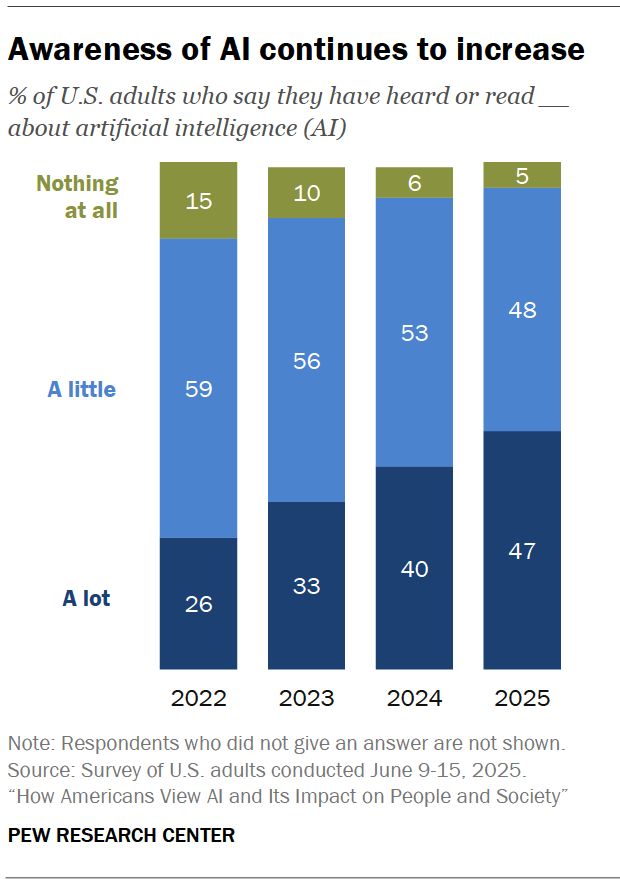
Over the past year, I’ve done old school collection of community impact stories almost entirely from mainstream media sources. The data center issues raising Americans’ heart rate include job implications (perceived pluses and minuses), utility rates, water use and environmental consequences, physical aesthetics, local political influence of operators. Not much community reaction begins as a political exercise, although prevailing politics of a locale naturally works into many debates. Bloomberg last week featured a conservative district around Granbury, TX were not unlike those in less conservative communities. The chart below reveals growing awareness of AI, a trend perhaps partly fed by some stories in my collection (HERE).
I will come back with a more complete thought on how or whether Pope Leo’s AI manifesto might influence politics and policy. His encyclical letter HERE is the 69th such papal communication since 1945, a period when governments and companies began investing capital in civilian or dual-use technologies. Of those, an ai search assistant tells me only 11 addressed “public policy” or “social justice” issues (16%) which qualifies as an unusual foray into policy. His focus on possible job destruction ramifications might resonate within Catholic and outside religious circles. That the Pope’s letter was released the same day he met with an Anthropic co-founder possible adds a bit to the inseparable capital/technology/societal mix never likely to dissipate from the evolving AI narrative.
State and local government data center policies in the U.S. are not governed by a single unified framework. Instead, they are shaped by a layered mix of federal standards, state laws, and local governance practices. Below is a structured overview of the key policy domains that typically apply. Persistent frictions define new technology policymaking. BoE Governor Bailey last Thursday dissected the many economic implications of general-purpose technology, perhaps broadening discussions of AI’s macro and applied policy opportunities and challenges. He agrees broad investment in AI education and skills will unambiguously help the “employment situation” (HERE).

