Back Economic Research

Moving Away from Dovishness as Inflation Doesn’t Follow the Forecast

Published on May 19, 2026

∙ Download the PDF Report

By

Peter Williams

Moving Away from Dovishness as Inflation Doesn’t Follow the Forecast

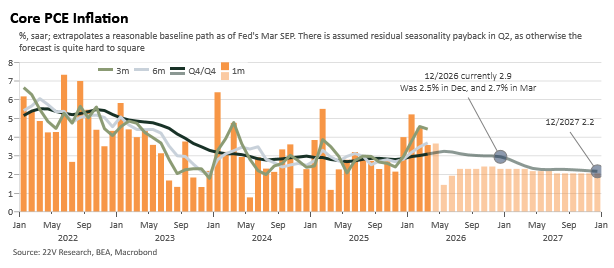
  • After the CPI and PPI data, nowcasts for core PCE point to a roughly 0.30% print in April.
  • Just since the March SEP, the data have mechanically pushed up the Fed’s 2026 forecast to at least 2.9% (from a surprisingly soft 2.7% in March and 2.5% in Dec). Unless the data turns in an unexpectedly optimistic direction, the next few months will push it up even further (3.1-3.2% is in play by June).
  • Given that the data seems pushing further against the old, already tentative, easing bias, June will likely see the Fed move away from it formally. This also presents an opportunity for Warsh to follow through on his long-held dislike of forward guidance by striking any of it from the statement.
  • Moving from no bias to a hawkish bias (if Warsh allows it), if not yet outright hawkish policy, would likely requite a series of prints over the summer hot enough (roughly a series of 0.3s) to bring the Fed’s 2026 forecast close to 3.5%. Fundamentally, hawkish policy would come from the Fed being forced to capitulate on their benign ‘26H2 and ’27 inflation forecasts.

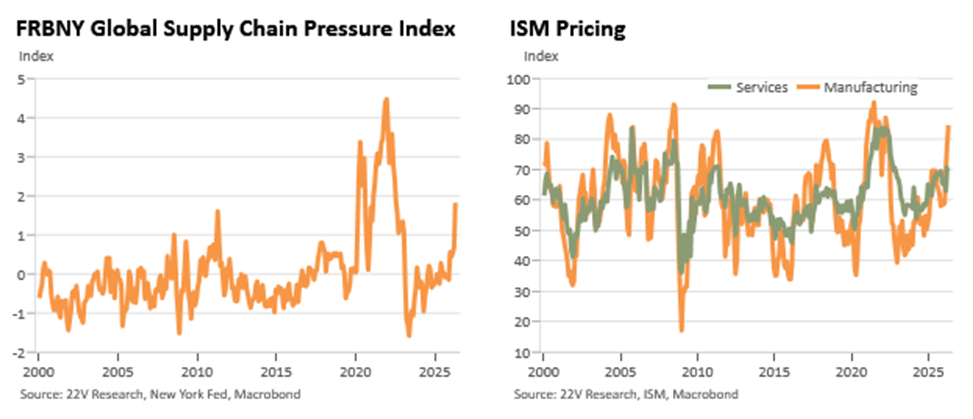
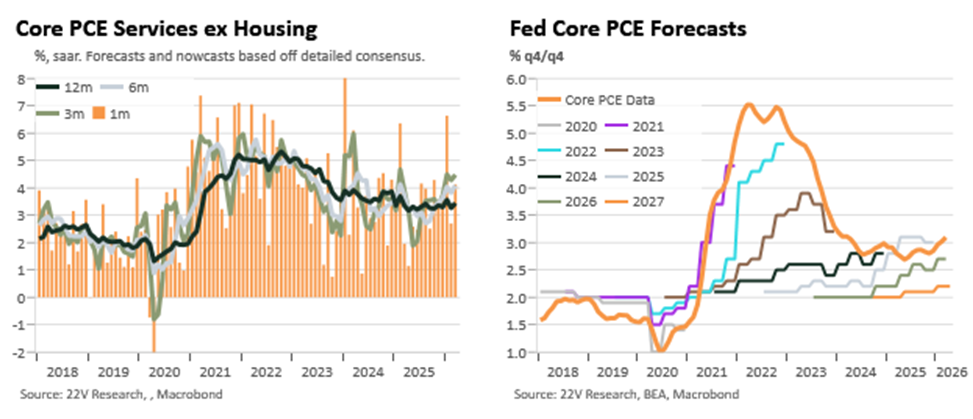
Fed officials have consistently been too optimistic about the medium-term trend in inflation. This goes beyond the recent policy driven sequence of supply shocks which have largely hit core goods inflation, as core services ex housing inflation is appreciably above pre-covid levels and may be reaccelerating. These inflationary shocks combined with more robust than expected growth and increasingly reassuring labor market outcomes, seems to be making them even more cautious.

Last week, Gov. Barr swung notably to the hawkish side, saying he remains “still quite attentive to concerns about what’s going to happen with the labor market, but to me the risk is much higher right now that inflation will not behave.” This echoes comments from the centrists Collins (“at this point, [I] am particularly concerned about inflation”) and Goolsbee (“if you look at the components that are not energy, like services, if that is an indication that the underlying economy is overheating, then the Fed’s got to be thinking about, how do we break the chain of escalating inflation?”).

Assuming we do not see very benign post-tariff pre-second round war-related inflationary effects n Q2, this process will take time. So far, the Fed’s shifts have been driven by a decreasing degree of concern about the labor market (becoming overheated still seems a very distant risk) and the inflation data in hand being less good, even making allowances for residual seasonality, tariffs, the war, and the inflationary impacts of the AI boom, than hoped for in December and March.

The more multicausal the explanation for overshooting inflation, the less comfort central bankers will feel in trying to look through that. This reflect messy analytic realities (it is harder to disentangle 3-4 overlapping shocks than 1) but also the basic point that many shocks may be much close to an underlying policy-offsetable medium-term economic force than something more easily looked through.

Given the recent data in hand the Fed’s March forecast for core PCE inflation in 2026 should move from 2.7% to at least 2.9% in June. Trying to keep some degree of forecast consistency across the meetings, in March the FOMC leaned heavily on notions of fading tariff pass-throughs and aggressive residual seasonality to pencil in such a small move higher from Dec’s 2.5%. The data since the March meeting make those look like fairly fraught assumptions. The 2.9% above is what happens with an unchanged monthly path from May-on; we will of course get a good read of the PCE data for May by the meeting. Given base effects and optimistic assumptions, an 0.25% in May likely moves the June forecast to at 3.1% without any shifts in the forecast months.

Assuming no forecast shifts beyond those forced by the data, given the stabilizing labor market, inflation data, and continued impacts from tariffs and the war, seems like an increasing strong assumption nearly halfway through the year. It is this process that really shows the increasingly less dovish FOMC’s underlying inflationary concerns far more than just following the data higher.
A graph with orange and green lines

Description automatically generated

DISCLOSURES AND DISCLAIMERS

Analyst Certification

The analyst, 22V Research Group, primarily responsible for the preparation of this research report attests to the following: (1) that the views and opinions rendered in this research report reflect his or her personal views about the subject companies or issuers; and (2) that no part of the research analyst’s compensation was, is, or will be directly related to the specific recommendations or views in this research report.

Analyst Certifications and Independence of Research.

Each of the 22V Research analysts whose names appear on the front page of this report hereby certify that all the views expressed in this Report accurately reflect our personal views about any and all of the subject securities or issuers and that no part of our compensation was, is, or will be, directly or indirectly, related to the specific recommendations or views of in this Report.

22V Research (the “Company”) is an independent research provider. The Company is not a member of the FINRA or the SIPC and is not a registered broker dealer or investment adviser. 22V Research has no other regulated or unregulated business activities which conflict with its provision of independent research.

22V Research, LLC is a professional services and independent publication organization. 22V Research, LLC is not a securities broker-dealer, not a member of the Financial Industry Regulatory Authority (FINRA), not a registered investment advisor (RIA) and not a member of SIPC.

Securities transactions, when offered, are offered by 22V Securities, LLC through LPS Capital, LLC. Certain employees of 22V Securities, LLC are dually registered as securities representatives of LPS Capital, LLC or Analyst Hub Securities, LLC. 22V Securities, LPS Capital and Analyst Hub Securities are members FINRA, SIPC.

https://brokercheck.finra.org/

Current Ratings Definition.

SECTOR OUTPERFORM: An “outperform” rating anticipates the company will outperform the S&P Regional Banking Index (peer group).

SECTOR PERFORM: A “market perform” rating anticipates the company will perform in line with the S&P Regional Banking Index (peer group).

SECTOR UNDERPERFORM: An “underperform” rating anticipates the company will underperform the S&P Regional Banking Index (peer group).

Limitation Of Research And Information.

This Report has been prepared for distribution to only qualified institutional or professional clients of 22V Research Group. The contents of this Report represent the views, opinions, and analyses of its authors. The information contained herein does not constitute financial, legal, tax or any other advice. All third-party data presented herein were obtained from publicly available sources which are believed to be reliable; however, the Company makes no warranty, express or implied, concerning the accuracy or completeness of such information. In no event shall the Company be responsible or liable for the correctness of, or update to, any such material or for any damage or lost opportunities resulting from use of this data. Nothing contained in this Report or any distribution by the Company should be construed as any offer to sell, or any solicitation of an offer to buy, any security or investment. Any research or other material received should not be construed as individualized investment advice. Investment decisions should be made as part of an overall portfolio strategy and you should consult with a professional financial advisor, legal and tax advisor prior to making any investment decision. 22V Research Group shall not be liable for any direct or indirect, incidental or consequential loss or damage (including loss of profits, revenue or goodwill) arising from any investment decisions based on information or research obtained from 22V Research Group.

Reproduction And Distribution Strictly Prohibited.

No user of this Report may reproduce, modify, copy, distribute, sell, resell, transmit, transfer, license, assign or publish the Report itself or any information contained therein. Notwithstanding the foregoing, clients with access to working models are permitted to alter or modify the information contained therein, provided that it is solely for such client’s own use. This Report is not intended to be available or distributed for any purpose that would be deemed unlawful or otherwise prohibited by any local, state, national or international laws or regulations or would otherwise subject the Company to registration or regulation of any kind within such jurisdiction.

Copyrights, Trademarks, Intellectual Property.

22V Research Group, and any logos or marks included in this Report are proprietary materials. The use of such terms and logos and marks without the express written consent of 22V Research Group is strictly prohibited. The copyright in the pages or in the screens of the Report, and in the information and material therein, is proprietary material owned by 22V Research Group unless otherwise indicated. The unauthorized use of any material on this Report may violate numerous statutes, regulations and laws, including, but not limited to, copyright, trademark, trade secret or patent laws.