The next significant AI connected order and backlog story will be liquid cooling and advanced thermal management for AI factories. This is an essential element to maximize AI token production and hyperscaler investment ROI. The acceleration of AI factory build will require 100% of computing power to be liquid cooled. The benefits are optimal operation to maximize AI token throughput and driver power use efficiency (PUE) lower, making more efficient use of the electricity. AI factories buildouts are accelerating heading into 2027 and expected to continue through 2030 at the very least. Thematically, we identify a select list of companies as primary beneficiaries of liquid cooling and advanced thermal management. (MOD, ETN, SU FP, ECL, MAIR, JCI, TT, CARR, CC and DOV).
The power density of compute racks is now surpassing the air-cooled density threshold of 41.3 Kilowatt (Kw) rack (Introl; 3/7/26). At this stage, the specificity and volume of air required to maintain optimal temperatures fails. Direct to chip liquid cooling systems are required to meet the growing power and thus thermal density of compute configurations. The Nvidia Vera Rubin 72 and 144 GPU racks will consume up to 155 Kw and 200 Kw of power respectively. Density factors are accelerating, with Nvidia Kyber racks speculated to breach 500 Kw of power and future 1 Megawatt (MW) racks speculated as not being far off. The shift to full liquid cooling racks occurred with the release of the Nvidia Vera Rubin configurations slated to ship later 2026. These are being configured, built and shipped with integrated liquid cooling systems (cooling trays, piping and connectors). As a standard for AI factories, it presents a clear and credible demand pull.
Orders and backlog are showing signs of acceleration. Carrier (CARR) reported on their Q1 call that global data center orders were up +500% y/y and noted they are starting to build meaningful orders for 2027. Trane (TT) noted lead times have moved from 6-9 months to 12-18 months as customers look for certainty of supply. Ecolab (ECL) noted the revenues for CoolIT (advanced liquid cooling systems in-progress acquisition) is seeing close to triple digit growth y/y.
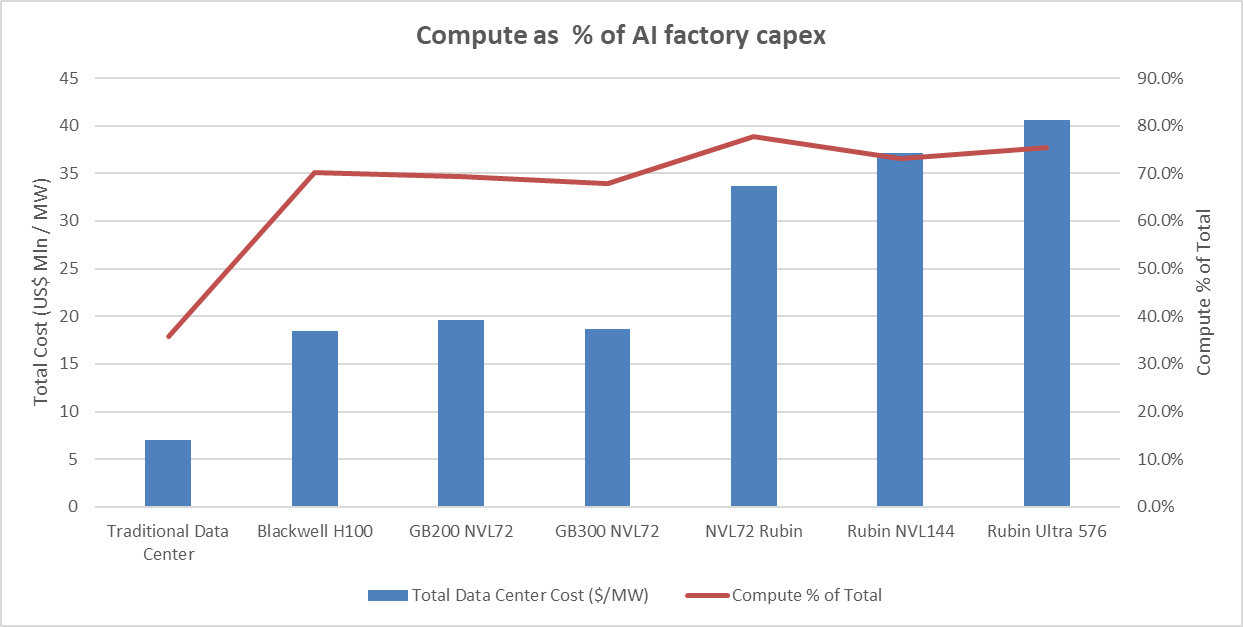
In order to meet rapidly accelerating demand, AI factories require leading edge thermal management to maximize AI token. Return on investment (ROI) is a primary focus for data centers that may reach north of $75bln for a 1 Gigawatt (GW) AI factory and where the compute now represents north of 60% of the total facility capex. Traditional operating metrics of 50-60% utilization will not suffice or provide the required returns required hence the need for leading edge liquid cooling and thermal management to optimize output.
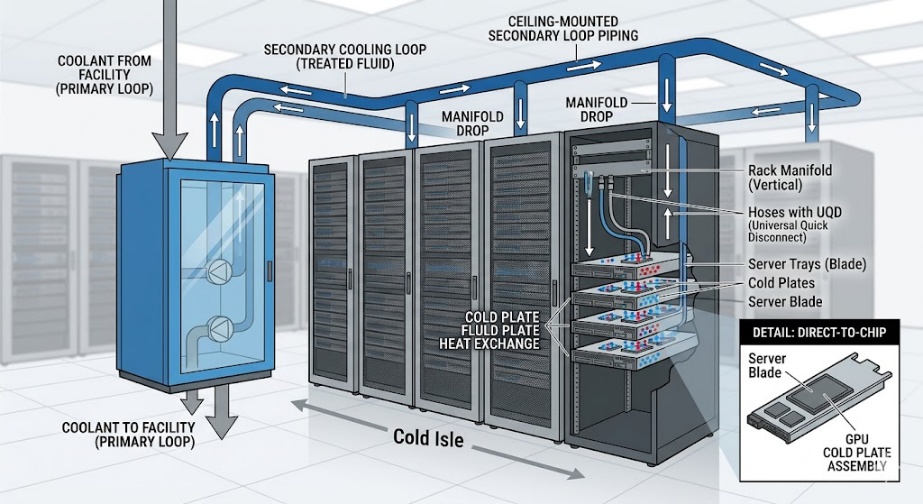
Liquid Cooling Ecosystem: As power densities escalate, hyperscale liquid cooling systems are transitioning toward centralized, floor-mounted Coolant Distribution Units (CDUs) to provide the increased thermal inertia required for AI clusters. These centralized CDUs serve as the primary gateway between the facility’s primary cooling loop and the Direct-to-Chip secondary loop, delivering fluid through row-level manifolds and quick-disconnect hoses. This configuration ensures a consistent flow of coolant to the cold plates mounted directly on the silicon, providing the industrial-scale infrastructure necessary to manage the extreme thermal loads of modern GPU architecture.
Total Addressable Market (TAM) for Liquid Cooling: The full liquid cooling package of CDU, cold plate, connections and related equipment can go between $1.0 – $1.5mln per MW of compute capacity. Utilizing a framework of 50GW of added compute between now and 2030 in the U.S. and factoring in N+1 redundancy, this leads to a liquid cooling TAM of $55bln to $82.5bln. The ballpark estimate for data center constructions is that 10-20% of the budget goes to thermal management. In the current market, AI factory construction cost estimates have moved from $10mln per MW to over $20mln per MW, leading to a ballpark total thermal management budget of $1mln to $4mln per MW and overall U.S. TAM of $50bln (very low end) to $200bln between now and 2030.
We set a concentrated group of companies as primary beneficiaries of the liquid cooling trend. These companies are also levered to other portions of either data center thermal management, or the overall AI infrastructure build out.
Beneficiaries:
MOD (Modine): Emerging as a pureplay data center thermal management provider. As they spin out Performance Technologies, close to 50% of their revenue will be tied to data center build outs. They have leading liquid cooling technology, chiller and free air cooling. Free air cooling is emerging as an effective way to reduce PUE and water usage.
ECL (Ecolab): The recent CoolIT acquisition gives it a front row seat in CDU to cold plates. Growing at triple digits this division will quickly combine with ECL’s ultra-pure water technologies to increase scale with AI factories and semiconductor fabs.
SU FP (Schneider Electric): The Motivair acquisition put them in a strong position with expanding liquid cooling technologies. In addition, Schneider is a primary participant along with ETN on global electrification trends.
ETN (Eaton): The Boyd acquisition in 2025 helps to create a full stack liquid cooling offering for hyperscalers. Additionally, ETN is a beneficiary of the move to 800V data center power connections and the overall trend of electrification.
MAIR (Madison Air Solutions): Recent IPO tied to more customized thermal systems with hyperscalers with liquid cooling offerings.
The “next” wave – two phase liquid cooling. As we push the boundary of 500kw – 1MW compute racks, two phase liquid cooling technology is advancing. Two-phase liquid cooling utilizes the latent heat of vaporization to absorb significantly more heat with lower flow rates than traditional single-phase systems. These three companies have or have made investments in leading edge technology and will be important to watch.
JCI (Johnson Controls): Accelcius investment (led recent investment round in January)
TT (Trane): Completed Liquidstack acquisition in March.
CARR (Carrier): Expanded their investment in ZutaCore in April.
Lastly, a couple notable suppliers into the liquid cooling stack:
CC (Chemours): Chemours is quite diversified however if two-phase liquid cooling advances, they are one of the primary suppliers
DOV (Dover): DOV’s SWEP division has a majority market share of Brazen Heat Plates (BHP’s) which are integral to the CDU.
The other side of the house:
HON (Honeywell) and LII (Lenox) do not appear as well positioned as peers due to lower leverage to hyperscale data centers and in some cases taking more of a wait and see approach with liquid cooling. In HON’s earnings call their CEO cited focuses on “Moving into Tier 2 data center providers” and made statements such as “if liquid cooling trend is true..”.
VRT (Vertiv) needs to take note. Larger players in thermal management are moving in on their position within the liquid cooling envelope.
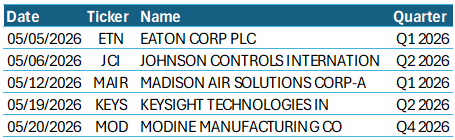
Upcoming Events / Earnings: