

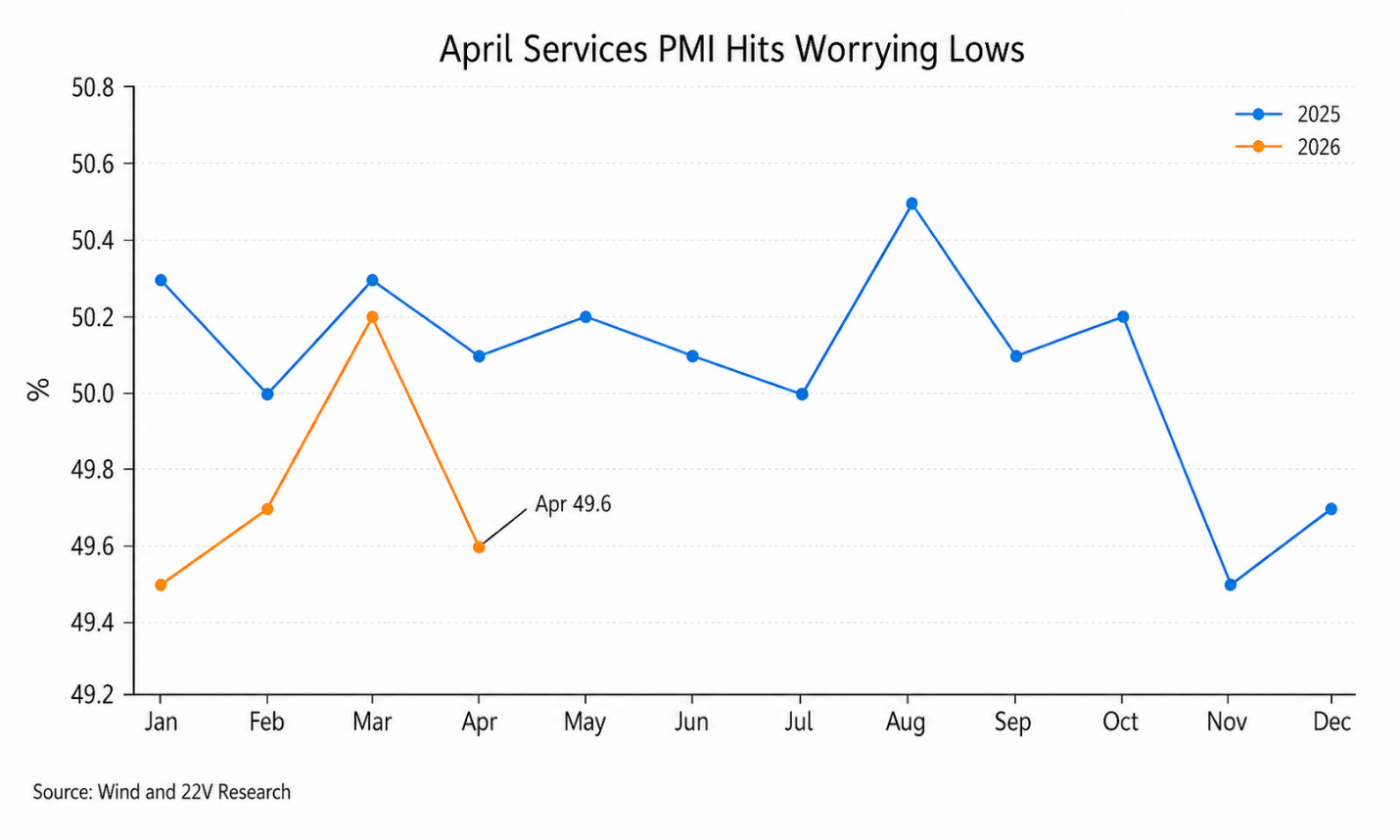
China’s official Manufacturing PMI came in at 50.3 (down slightly from 50.4 in March), only marginally in expansionary territory, while the services and construction PMIs fell to 49.6 (from 50.2) and 48.0 (from 49.3), respectively. The PMI data essentially confirm that fiscal policy is no longer providing meaningful stimulus, as reflected in the weak construction PMI. They also suggest that services firms are struggling to pass through higher input costs, while the oil shock is a slight net positive for manufacturing (for now). Taken together, the April PMIs point to weaker growth ahead.
The headline manufacturing PMI at 50.3 should be taken with a grain of salt. Exports remain resilient for now, with Chinese industry less directly exposed to oil and natural gas price hikes than many other economies, and with some industries (such as electric vehicles) benefiting from the crisis. However, that resilience may not be durable. Both PMI export orders and the export-heavy RatingDog PMI are above 50. But as oil prices are poised to stay high through Q3, the risk of slower global growth and trade is building until traffic through the Strait of Hormuz normalizes. Moreover, the weak construction PMI offers further evidence that fiscal policy is no longer stimulative, and that construction-related manufacturing demand will stay weak in the coming months. In fact, despite the recent PPI rebound, prices of construction materials such as rebar and cement remain soft.
The weak services PMI is worrying. The April services PMI reading of 49.6 is the weakest since November 2025 (not including distortions around the Lunar New Year), and the services new orders index, at 44.8, is the weakest since 2023. Weak demand has forced services firms to absorb cost increases. While services PMI input prices rose significantly in both March and April, to 52.2 and 51.2, respectively, PMI output prices were flat in March and declined in April, to 47.9.
A particular reason for our concern over services is the link back to employment (the sector is labor-intensive) and thus wages and consumption. The employment sub-indexes for services and for construction remained weak, consistent with our view that consumption activity in China will remain subdued (see our report from last week HERE).
Policy Implications:
Despite the overall softness in the April PMIs, we continue to expect Beijing to refrain from providing additional demand-side support for the economy for the time being. As laid out in our take on this week’s quarterly Politburo meeting on the economy (link HERE), we do not expect new stimulus before Q3.

