Back European Strategy/Geopolitics

Iran Update Day 15-16 – Donald Trump Continues To Signal No Negotiations and No Change in the War Strategy (Yet)

Published on March 15, 2026

Download the PDF Report

By

Jacob Funk Kirkegaard

Over the weekend, the military picture did not change much, despite Donald Trump’s strike on the non-oil parts of Kharq Island. Iranian drone retaliation against the Gulf region continued at a level clearly indicative of their ability to continue to project power into the Strait of Hormuz, effectively closing it for the vast majority of the usual traffic through the Strait and indicative of a continuing shortage of physical barrels of oil on the global markets, and hence an at least gradually rising global crude oil price with the risk of a rising number of downstream and geographically demarcated oil products markets exhibiting higher levels of volatility. In short, this is not a war that, despite ongoing and likely rising traditional military superiority over Iran proper, is currently going Donald Trump’s way.

The President faces a choice – either he rolls the dice and doubles down on coercing Iran by changing strategy and escalating the war with many new targets over Iran, triggering escalatory and possibly successful Iranian retaliation against the Gulf Region. Or he accepts that he will not reach all pre-war goals, and gives the green light for an explicit or below-the-radar negotiation process, so as to cut his otherwise likely rising political and economic losses from continuing a war that his strategy to date has not won him. Since the United States is not going to launch a full ground invasion of Iran and regime change from the air continues to look unlikely, eventually this conflict must find a diplomatic solution. As between Russia and Ukraine, until the party that started a war unable to subdue the target recognizes this, the fighting will not stop.

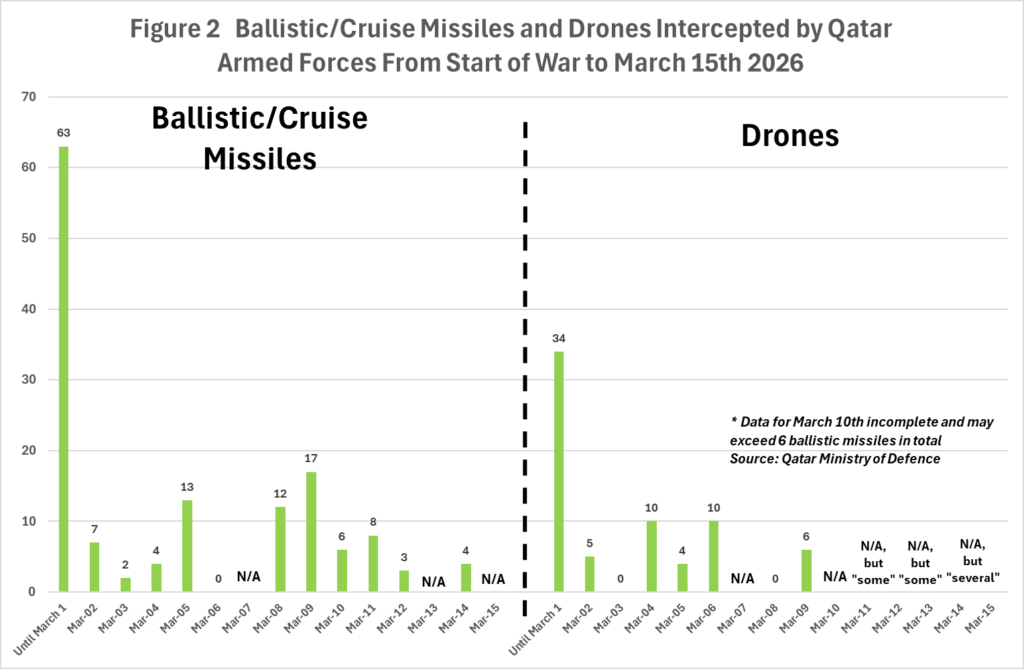
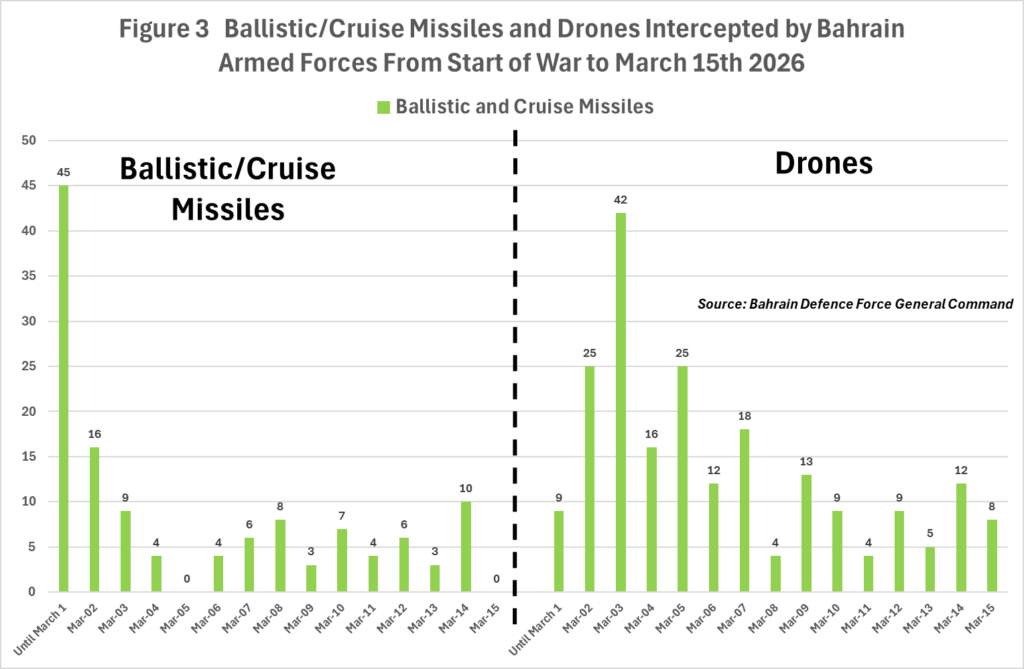
As noted, Iran clearly retains the capacity to retaliate against the Gulf region and as such continue to de facto close the Strait of Hormuz. Retaliation against the smaller Gulf states tracked in earlier notes show this quite clearly (Figure 1, 2 and 3). 
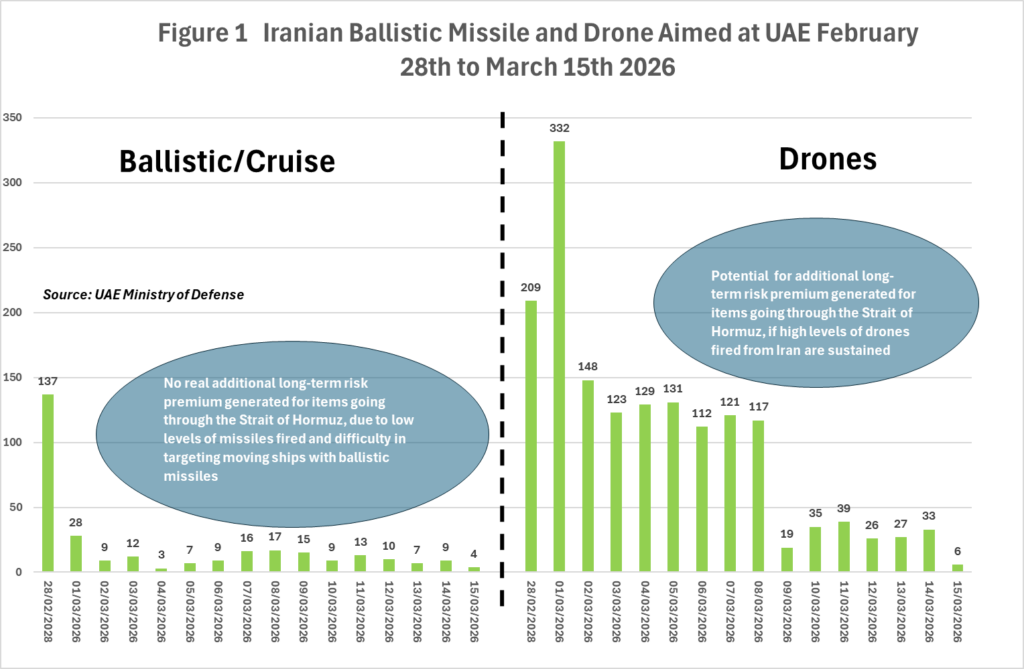
Some indication of a further decline in Iranian retaliation against these three smaller Gulf states on March 15th is visible, especially against UAE. However, press reports continue to imply that Iranian retaliation against Saudi Arabia especially via drone attacks has picked up in recent days, suggesting that there is a reorientation of Iranian strikes against the Gulf region from the smaller states towards Saudi Arabia.

The lack of daily consistently reported attack data from the Saudi authorities makes this trend difficult to validly capture. Press report from Saudi Arabia and the data in figures 1-3 however makes it clear that Iran retains to capacity to project material destructive power into the gulf region and by extension the Strait of Hormuz. This remains the crucially important point for this war.

Prospects for naval escorts of tankers through the Strait of Hormuz under these military circumstances does not look imminent, and the Trump Administration’s call for “the rest of the world” to join in such escorts will surely be interpreted by the Iranian leadership as a sign of U.S. military weakness in the Gulf region. Tehran will surely know that very few, if any, capable traditional U.S. allies (Japan’s Prime Minister Takaichi visiting Washington D.C. soon better have a good answer for President Trump!) will want to join Donald Trump in escorting tankers through the Strait while Donald Trump refuses any negotiation with Iran.

The high-profile air strike on Kharq Island this weekend, combined with the messaging surrounding the departure a U.S. Marine Corps Expeditionary Unit, has signaled a hypothetical U.S. interest in launching a ground assault on the island. Given the self-evident and grave difficulties of the U.S. armed forces of logistically supporting such an operation in a naval theater in the Persian Gulf in which the U.S. Navy appears hesitant at sailing war ships into, the probability however of such an operation remains very low.

If Donald Trump chooses to escalate this conflict, he will have to do so in the sphere where the coalition already enjoys a clear military advantage, namely in the air space over Iran. Such an escalation could still change the military and political calculus in Tehran, should it succeed over time in degrading Iran’s retaliatory capacity through both missiles and drones much further. Escalation would, however, almost invariably be associated with an intensifying regional conflict causing oil prices to rise further in the near-term.

Without unlikely short-term auxiliary policy initiated relief to global oil markets, the direction of oil prices hence looks likely to head upwards until the time when Donald Trump decides the war needs to wind down.

Jacob 

DISCLOSURES AND DISCLAIMERS

Analyst Certification

The analyst, 22V Research Group, primarily responsible for the preparation of this research report attests to the following: (1) that the views and opinions rendered in this research report reflect his or her personal views about the subject companies or issuers; and (2) that no part of the research analyst’s compensation was, is, or will be directly related to the specific recommendations or views in this research report.

Analyst Certifications and Independence of Research.

Each of the 22V Research analysts whose names appear on the front page of this report hereby certify that all the views expressed in this Report accurately reflect our personal views about any and all of the subject securities or issuers and that no part of our compensation was, is, or will be, directly or indirectly, related to the specific recommendations or views of in this Report.

22V Research (the “Company”) is an independent research provider. The Company is not a member of the FINRA or the SIPC and is not a registered broker dealer or investment adviser. 22V Research has no other regulated or unregulated business activities which conflict with its provision of independent research.

22V Research, LLC is a professional services and independent publication organization. 22V Research, LLC is not a securities broker-dealer, not a member of the Financial Industry Regulatory Authority (FINRA), not a registered investment advisor (RIA) and not a member of SIPC.

Securities transactions, when offered, are offered by 22V Securities, LLC through LPS Capital, LLC. Certain employees of 22V Securities, LLC are dually registered as securities representatives of LPS Capital, LLC or Analyst Hub Securities, LLC. 22V Securities, LPS Capital and Analyst Hub Securities are members FINRA, SIPC.

https://brokercheck.finra.org/

Current Ratings Definition.

SECTOR OUTPERFORM: An “outperform” rating anticipates the company will outperform the S&P Regional Banking Index (peer group).

SECTOR PERFORM: A “market perform” rating anticipates the company will perform in line with the S&P Regional Banking Index (peer group).

SECTOR UNDERPERFORM: An “underperform” rating anticipates the company will underperform the S&P Regional Banking Index (peer group).

Limitation Of Research And Information.

This Report has been prepared for distribution to only qualified institutional or professional clients of 22V Research Group. The contents of this Report represent the views, opinions, and analyses of its authors. The information contained herein does not constitute financial, legal, tax or any other advice. All third-party data presented herein were obtained from publicly available sources which are believed to be reliable; however, the Company makes no warranty, express or implied, concerning the accuracy or completeness of such information. In no event shall the Company be responsible or liable for the correctness of, or update to, any such material or for any damage or lost opportunities resulting from use of this data. Nothing contained in this Report or any distribution by the Company should be construed as any offer to sell, or any solicitation of an offer to buy, any security or investment. Any research or other material received should not be construed as individualized investment advice. Investment decisions should be made as part of an overall portfolio strategy and you should consult with a professional financial advisor, legal and tax advisor prior to making any investment decision. 22V Research Group shall not be liable for any direct or indirect, incidental or consequential loss or damage (including loss of profits, revenue or goodwill) arising from any investment decisions based on information or research obtained from 22V Research Group.

Reproduction And Distribution Strictly Prohibited.

No user of this Report may reproduce, modify, copy, distribute, sell, resell, transmit, transfer, license, assign or publish the Report itself or any information contained therein. Notwithstanding the foregoing, clients with access to working models are permitted to alter or modify the information contained therein, provided that it is solely for such client’s own use. This Report is not intended to be available or distributed for any purpose that would be deemed unlawful or otherwise prohibited by any local, state, national or international laws or regulations or would otherwise subject the Company to registration or regulation of any kind within such jurisdiction.

Copyrights, Trademarks, Intellectual Property.

22V Research Group, and any logos or marks included in this Report are proprietary materials. The use of such terms and logos and marks without the express written consent of 22V Research Group is strictly prohibited. The copyright in the pages or in the screens of the Report, and in the information and material therein, is proprietary material owned by 22V Research Group unless otherwise indicated. The unauthorized use of any material on this Report may violate numerous statutes, regulations and laws, including, but not limited to, copyright, trademark, trade secret or patent laws.