

Since the beginning of the Iran War, I have had a base case for the conflict roughly inspired by the 12-day June 2025 war and a duration of “about two weeks”. As we are now at Day 14 and the war is still raging, marking to market my forecast and analytical framework is appropriate.
I have somewhat simplified assumed that the coalition would quickly establish nearly full air superiority over Iran and following that would proceed with a wide-ranging bombing campaign against the traditional Iranian military (air defenses, navy, air force), missile launchers/missile storage facilities, drone launchers/drone storage facilities, Iran’s related military industrial sites, and regime HQ’s and leadership sites. Several known Iranian nuclear sites have also be bombed again, and in general the military campaign has unfolded as expected, including initially successful strikes at Iran’s top leadership.
I have assumed that roughly 500-700 daily sorties against Iranian targets by the coalition would gradually reduce the military and credible political goals of the bombing campaign to a level, where these no longer exceed the political and economic costs of continuing the campaign for the coalition leader in the United States. Overall, I continue to believe this is the right framework for analyzing this “war of choice”. As such, I also continue to believe that it is the militarily superior party in the coalition that gets to “decide when it ends”. Air campaigns are not like large-scale ground operations, but can be called off at short notice.
Important unexpected events have occurred during the conflict, centered on Iran’s decision to “horizontally expand the war” after being attacked by “retaliatory” (actually striking neighbors without any warning!) attacks against the Gulf region, another other neighbor in Azerbaijan, as well as against NATO bases in Cyprus and Turkey. This strategy by Iran has been so far very successful for Tehran through the now revealed capability of Iran to de facto close the Strait of Hormuz, as well as sow general economic chaos in at least the smaller Gulf Arab states.
Whether this strategy by Iran should have been the expected response or not is an interesting debate for analysts like myself, but matters little for the actual war planning and the decision to go to war by the Trump Administration. Given that the contingency of “Iran seeking to close the Strait of Hormuz in attacked by the United States” has been a core part of any war-gaming of a war against Iran for decades, the apparent and reported lack of explicit planning for this outcome by the Trump Administration is a deeply concerning fact that casts general doubts about the Administration’s war-time response function and capacity to adjust rationally and capably to events going forward. There is simply no excuse for not planning for this situation, which it though is certain that U.S. military staffers will have done, leaving the lack of practical preparations for a closure of the Strait of Hormuz as the evident responsibility of the Administration’s political echelon.
Facing the accumulating effects of a Strait de facto closed, the Administration has resorted to a number of policies to try to mitigate the upward pressure effects on oil prices. These include to date a major (if gradual) oil release from the SPR and other IEA member stocks, a general waiver for Russia to sell previously sanctioned oil (much to the chagrin of European leaders), and a continuing willingness to let Iran-linked (and still sanctioned!) tankers exit the Gulf and proceed to their destinations without being boarded by the US Navy. Saudi Arabia has also begun running their East-West pipeline to divert oil from the Gulf region, but it is now clear that these mitigating strategies cannot replace the around 20mn barrels/day – about a third of the traded oil market – no longer flowing through the Strait of Hormuz.
As it is further clear that U.S.-led naval escorts of tankers through the Strait of Hormuz is at best weeks away – Energy Secretary Wright said yesterday “by the end of the month” – the implication is straightforward that only a reopening of the Strait can alleviate accumulating pressures in the oil market. Given the lack of any near-term military option to address Iran’s coercive power over the Strait, such an opening can only come through a diplomatic solution, which can – as Iran is not going to surrender – only be initiated by President Trump. The question is when will he feel enough political and economic pressure to do so? Given that the continued closure of the Strait will invariably cause oil market, downstream and broader financial pressures to accumulate, Trump will eventually be compelled to do.
In line with my initial estimate of the war’s duration being “around two weeks”, I have evidently estimated that by now declining utility of further strikes and the pressure building on Trump would already have caused him to move to conclude the war. This has proven an erroneous assessment. Trump does not however likely have the luxury of simply prevaricating and not taking any decision. The war is already unpopular, even Trump’s ambitious Vice President is reported in the media to have been “a skeptical voice within the White House” in the run-up to the war, and the current level of bombing is not forcing the Iranian regime to capitulate as desired by Trump.
Trump will either have to end the war, or – as discussed in yesterday’s note – be compelled to escalate it to try to force Iran into submission. Possessing full air superiority, the coalition has a wide capacity to escalate targeting, but the Iranian regime has to date also exhibited significant durability, and it is hence not likely that an accelerated precision-guided repeat of Operation Rolling Thunder during the Vietnam War (the strategy of bombing North Vietnam into submission from 1965-68) will produce the near-term results that Trump wants. Escalation is possible, and gives Iran an important reason to accept a Trump ceasefire offer, but looks unlikely to provide a near-term military solution to the conflict.
As noted above, and discussed extensively in yesterday’s note, I consider it highly unlikely that Iran will want to prolong the war by refusing an offer for an essentially “unconditional ceasefire” from Donald Trump. This would politically put them in the new position of being responsible for the continuation of the war, while also continue to expose Iran to the consequences of ongoing escalatory bombing by the coalition.
This is unlikely to be the preferred strategy of a regime that will want to eventually rebuild its economy and military-industrial capacity, and has already established its durability and capacity to impose significant and ongoing economic pain on its main adversary in the United States. Yes, Iran would surely love if they could push the U.S. economy all the way into an economic recession, but they’ve already made their point and achieved most of what they need in a world with forward looking financial markets, and they are not likely to want to endure daily and likely intensifying bombings just for another couple of economic jabs at Trump.
Consequently, I consider it most likely that any “negotiating process” will be very brief, and essentially yield a relatively straightforward quid pro quo in the form of an end to the bombing by the coalition and a declaration by Iran that the Strait of Hormuz is now open. Neither side will have any interest in this process being prolonged, or tied up by adding various additional elements to the agreement.
This means that an eventual Trump “declaration of victory” will invariably be partial. Traditional military targets like the navy, air force and likely to a relatively high degree missile forces will have been destroyed, drone launch capability reduced, HQs and regime power centers flattened, and all of Iran’s known military-industrial capacity likely destroyed.
No regime change and no real material progress, however, on Iran’s nuclear program, whose end and removal of the stockpile of highly enriched uranium requires either a ground invasion, regime change or a future negotiated JPCOA-style solution. Only the latter may be possible in the longer-term. Going forward, such an outcome would – at best – leave Iran facing economic pressure, likely diplomatic isolation, and accordingly potential but unpredictable internal unrest.
Ayatollah Khomeini is said to have likened it to “drinking the poisoned chalice”, when he finally agreed to end the Iran-Iraq War in 1988. President Trump may not feel quite the same level of discomfort when he will have to settle for less than he had hoped for in his “war of choice” against Iran.
It has now taken more than my initially projected “around two weeks” duration, but I continue to find it unlikely that President Trump can politically sustain this conflict for more than a relatively limited number of days longer. This remains a conflict that is not likely to last weeks or months. Continuing the conflict will require that the scope of targeting inside Iran is expanded, which will likely see the targeting of Iranian’s retaliation against the Gulf region is expanded, with additional unpredictable consequences for oil markets possible. For now, those desiring peace will have to wait for President Trump’s political and economic “pain threshold” to be revealed by gradually rising pressure emanating from tighter physical oil markets. Or as President Trump put it today – “It will be over when I feel it in my bones“.
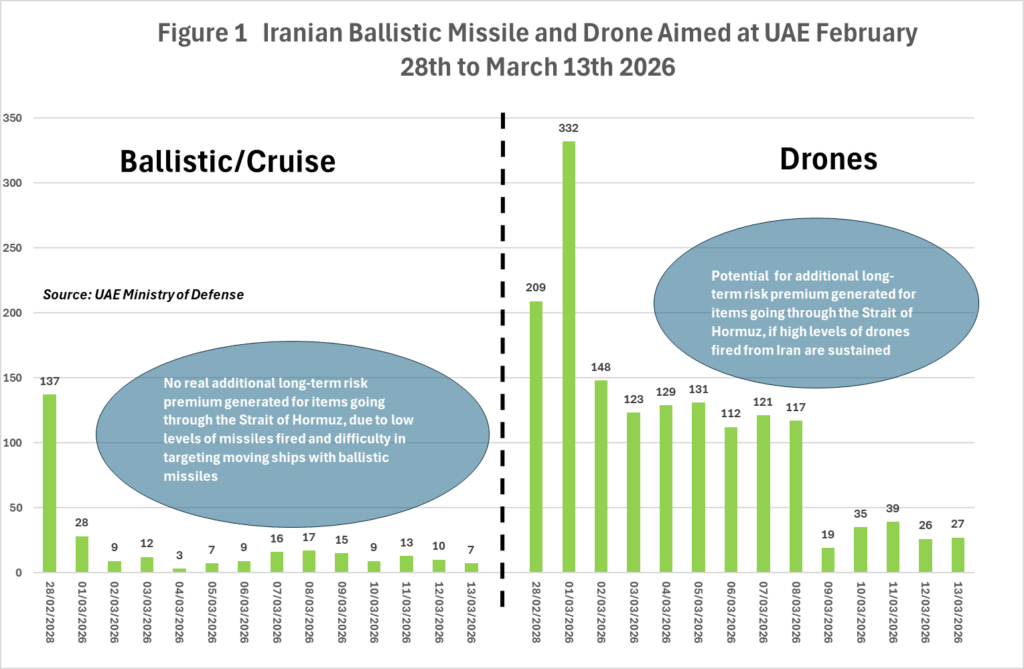
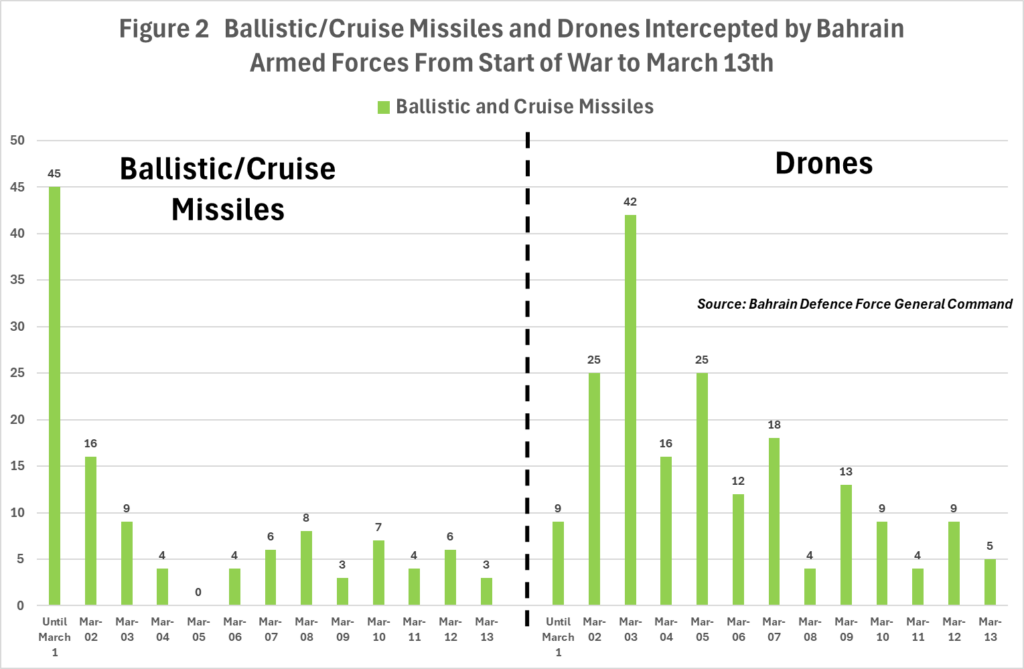
In terms of the reported scope of Iranian retaliation, irregular press reports suggests an uptick on drone attacks against Saudi Arabia in recent days, while the regularly reported official data from UAE and Bahrain (Qatari data for March 13th are not available at the time of writing) do not indicate any renewed increase in Iranian retaliatory attacks (Figure 1 and 2).
Jacob

