

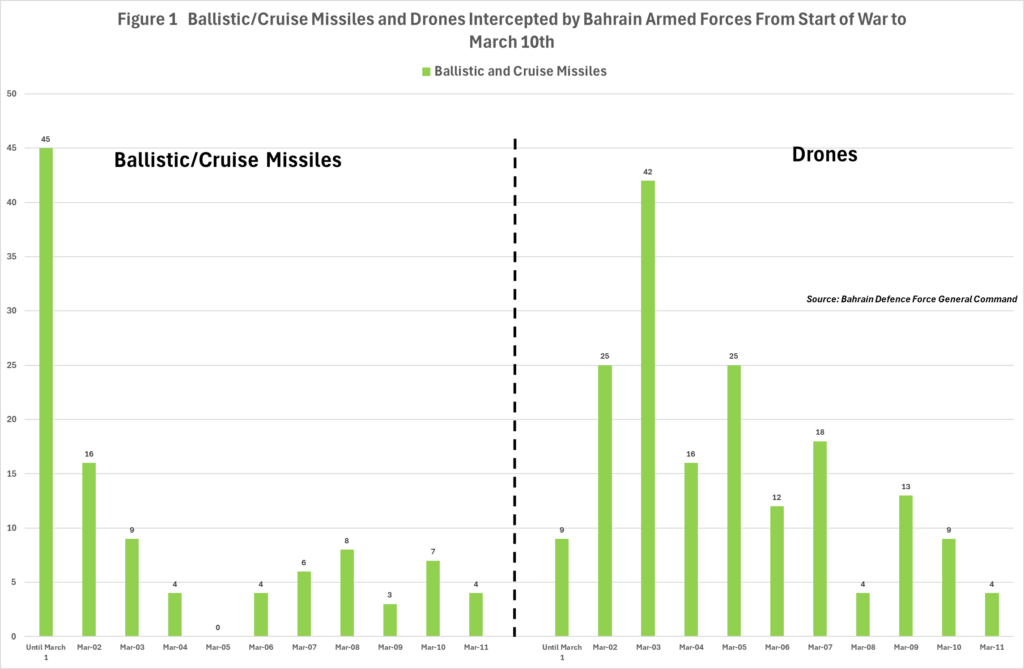
The coalition air strikes on Iran continued on Day 12, as did Iranian retaliation against both shipping in the Strait of Hormuz where several cargo ships were attacked, and Gulf region oil storage facilities in among other places Oman. Original source data for Iranian ballistic missile and drone attacks on the Gulf region have been slow to emerge from local governments today, with only Bahrain publishing new daily data (figure 1), though Emirati authorities have announced four separate Iranian missile/drone attacks today on March 11 and Qatar three. The total number of Iranian missiles and drones used against UAE and Qatar today remains unknown, though figure 1 for Bahrain does not indicate an increase in total number of ordonnance fired by Iran.
At today’s CENTCOM briefing, significant focus was again given to the degrading of Iran’s navy and later CENTCOM sent out a warning to Iranian civilians to avoid using Iran’s port facilities, clearly indicating that further strikes on Iranian maritime assets should be expected. Press reports based on leaked comments from “two sources familiar with the matter” today suggested that Iran have already laid about a dozen mines in the Strait of Hormuz, though there is no verified confirmation of this claim, which subsequently should for the time being be considered “just another rumor”.
It is clear that Iran has a clear interest in convincing the world that it has the capacity to mine the Strait of Hormuz at will so as to be able to intimidate the global shipping sector into not “taking any chances in the Gulf”, and it is equally clear that the U.S. has an urgent military need to address this latent Iranian capability. Hence the strikes against 16 Iranian mine layering ships yesterday and CENTCOM’s focus today.
Convincing the world that you “could do it if you want to” however is not in my opinion the same as actually doing something. And mining the Strait would – since mines unlike drones don’t know the difference between your ships and those of the others – dramatically reduce Iran’s own future capacity to ship crude oil to mostly China. Hence I continue to consider it a low probability event. This is underlined by the fact that Iran needs money and first of all continues to seemingly be able to ship its own oil out of the Gulf – TankerTrackers puts the quantity at 13.7mn barrels since the start of the war – and secondly since the oil overwhelmingly goes to China can likely assume that the US Navy will not board these tankers, as Trump wants a good summit with Xi in mid-April. Even a hardline regime like in Iran will need cash to rebuild, meaning that actually mining the Strait would not make any sense.
Let me also however here note that if I am wrong about this and Iran actually begins to mine the Strait with a large number of mines (a token number could possibly be a further signaling effect and could likely be avoided by Iran’s own tankers), I would regard this as an indication of the regime having entered into a more “messianic position”, willing to sacrifice its own future to maintain short-term escalation. This would force me to dramatically reevaluate the current outlook.
President Trump continues to weigh in regularly with comments about the prospects for the war, U.S. policy towards Iran and other related issues. This does not make for a consistent presentation of the Administration’s war plans or traditional war time message discipline. Today, he told Axios that “there’s “practically nothing left to target in Iran“, an argument that follows my own line of thought of a gradually declining utility of keeping the bombing campaign going, as the number of eligible and high value targets not yet struck naturally declines over time, especially given the intensity of the air campaign as CENTCOM today noted that 5,500 targets have been struck to date. Trump also said today, however, that “we are not finished yet with Iran“, leaving ample ambiguity about his actual plans.
As such, I continue to believe that the declared endpoint of the conflict remains relatively close, as Trump remains under political pressure from the still material rise in oil prices and the general political unpopularity of the war and the marginal military and political benefits of continuing to bomb will soon fall below their political costs. Trump in my opinion therefore remains likely to declare the end of the war within a relatively limited number of days, e.g. by the end of this week or early next week. That oil prices rose today, despite the announced (an admittedly rather uncoordinated and detail-scarce) IEA stockpile release also suggests that oil markets recognize the risk that lower oil prices reduce the pressure on Trump to end the war and hence risks prolonging it.
An important argument rages on what Iran would do in this situation, especially considering the often belligerent rhetoric coming from different quarters of the Iranian regime. I continue to believe that any Iranian regime – even the hardline one that looks likely to emerge after this war – will for simple reasons of self-preservation choose to quickly agree to any offer from Trump of what is likely to be a ceasefire (not a broader negotiated peace) – if Trump offers to end the bombing, Iran will quickly follow suit. It might reserve the right to launch the “last salvo” or something similarly symbolic, but it will not take long.
Recall what the implications of Iran refusing an offer from President Trump for a ceasefire would likely be in the current military situation? Donald Trump would most likely be compelled to significantly expand the scope of coalition targeting inside Iran to also include a far wider range of Iranian infrastructure and regime “police stations” to simply increase the pressure on the regime to compel it to accept a ceasefire. He would clearly have the military capacity to do so, as well as a far better political reason for it. Despite the current operation soon running out of “eligible targets”, more additional ones in principle exists in Iran, should the political circumstances change and call for further destruction to be rained down on a recalcitrant regime.
Ultimate willingness to agree to a ceasefire, rhetoric notwithstanding, follows from the basic military situation and the composition of the Iranian regime. The coalition literally drops thousands of tons of bombs at will daily on Iran, continuously degrading its military, military industrial capacity and other regime infrastructure. This is not “pleasant” or really comparable to the perceived gains of continuing to show your limited ability to shoot missile and drones at Israel, the Gulf region, and the Strait to keep oil prices elevated.
A regime that remains in power solely due to the willingness of its domestic security forces to kill Iranian civilians can moreover not afford to lose an unlimited number of such enforcers through coalition strikes on strongpoints and/or drones strikes on deployed security personnel. So while regime change remains a distant and unlikely outcome, Iranian leaders will need to be conscious of their ability to violently control Tehran and also Iran’s more distant provinces. It is not likely Tehran will choose to risk a regional uprising only put down with some difficulty, just to keep oil prices elevated a couple of weeks more.
Similarly in the longer-term, where again even a hardline regime bent on restoring Iran’s missile, drone and nuclear programs will need the bombing to stop as soon as possible to do so faster. While the ability to continue to inflict some economic and political pain on Donald Trump will be appealing to some in Tehran, those concerned about the regime’s longer-term recovery prospects will likely see the benefits of seeing the current uneven conflict brought to an end.
A quick end to the war now will leave Iran in possession of a newly revealed capacity to project drone force into the Strait of Hormuz, an arguably strategic gain against the U.S. (less so Israel) not increased by keeping the fight going. Tehran will most likely therefore choose to accept any offer for a ceasefire, despite knowing that a “Round 3” against Israel and possibly the U.S. remains a very high probability in the medium-term. To be prepared for such a confrontation, the Iranian however will need (like this time) to introduce new innovations in its response, something again facilitated by conserving its remaining economic and military resources by bringing an already militarily lost fight to an end.
Jacob

