

March 10th has seen the continuation of the intense air campaign against Iran, while Iran has retaliated with the lower intensity of missile and drone strikes seen first on March 9th. President Trump has weighed in repeatedly with public statements with considerable market impact generally suggesting that this is a “short-term conflict”, without however offering a specific timeline for ending the campaign. Overall, therefore the base case duration outlook ought to remain that President Trump will declare this conflict over around the end of this week, and that Iran will at that point in time accept joining into what will be a de facto ceasefire of unknown duration.
In a briefing today by Secretary Hegseth and the Chair of the Joint Chiefs of Staff General Caine, it was highlighted how the coalition continues to pursue three operational goals – degrading Iran’s capacity to produce and fire missiles and drones, destroying Iran’s navy and mine laying and mine storage capacities, and degrading Iran’s military industrial base and ability to reconstitute its military capacities. These identified goals differ from both those mentioned by Secretary Rubio yesterday (missiles, military industrial capacity and navy) and issued by the White House (Missiles, drones, navy, nuclear and proxies), once again highlighting the ongoing evaluation inside the Trump Administration of what constitutes an acceptable basis on which to declare the war over (won).
The particular mention for the first time by General Caine of Iran’s mine laying and mine storage capacities underlines the operational focus on Iran’s ability to threaten the Strait of Hormuz, though General Caine’s rather bland description of how the US Navy – almost a week after the President first mentioned this option – continues to consider a “range of options” to provide tanker escorts hardly implies that such operations are imminent. Secretary Hegseth made it clear that today March 10 would see the most intense strikes on Iran during the entire campaign, a claim hard to verify as most strikes take place far from the capital Tehran, but an air strategy nonetheless matching a military operating under a very finite timeline measures merely in days. It makes operational and strategic sense for both the US and especially Israel to ensure that as much damage is done to Iran’s military and military industrial capacity within the strike window of opportunity. That bombings now pick up suggests that the window is short.
Iranian retaliation against Israel and the Gulf region remained very low March 10th for a second day running, proxied here by available time series data derived from data published directly by the governments of UAE, Bahrain and Qatar (Figure 1,2 and 3).
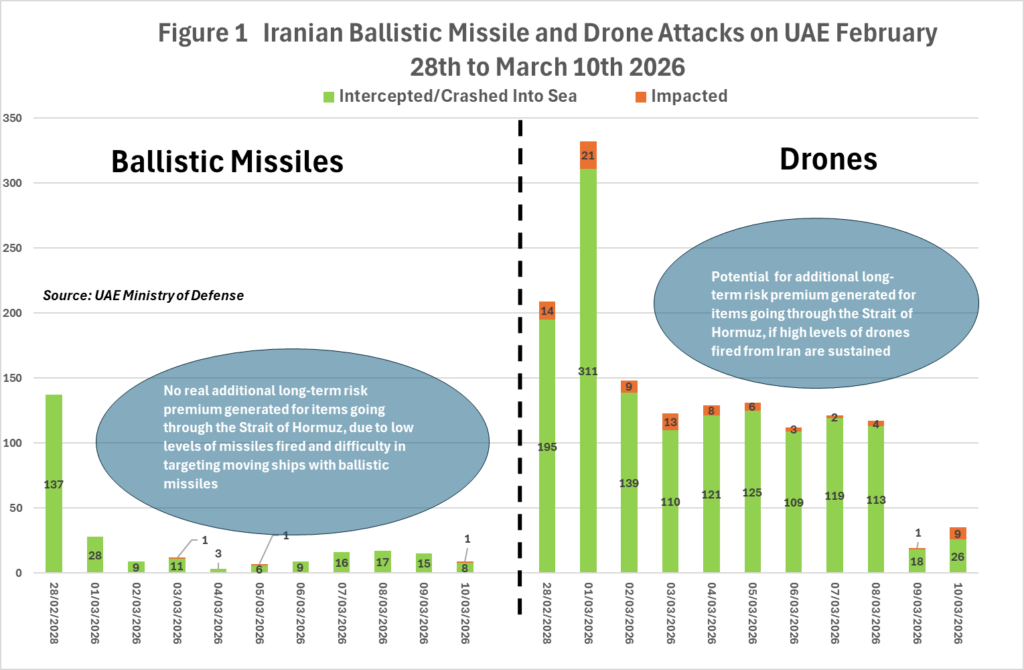
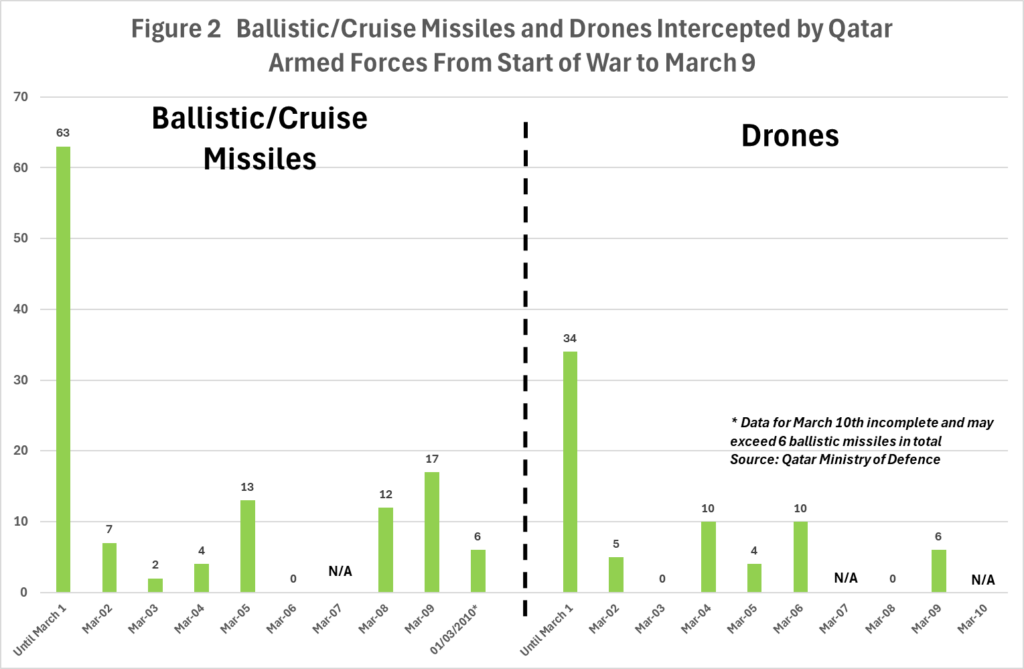
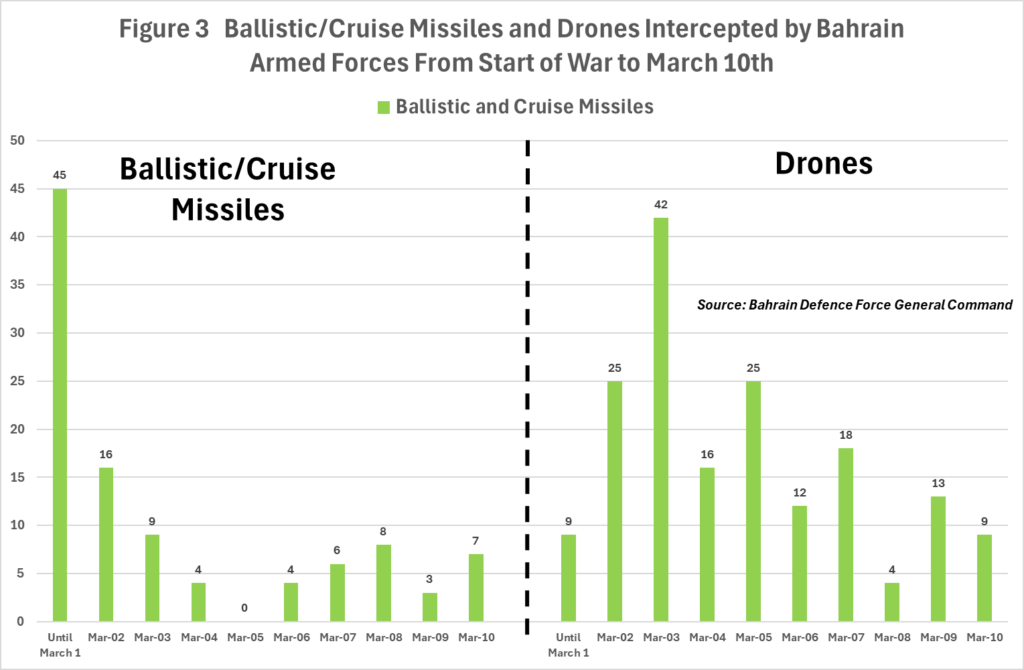
Today’s data gives more credence to the argument that Iran’s drone threat has been materially reduced, though not removed yet. However, given the high commercial incentives for tankers to physically traverse the Strait of Hormuz, it must in light of the objectively reduced drone threat be expected that more shipping owners will take the calculated risk going forward. This should see at least some pickup in what has otherwise been an almost closed for traffic straight since the start of the conflict (figure 4 from Lloyd’s).
Figure 4 Ships Sailing Through the Strait of Hormuz Since February 2nd to March 8th 2026.

An additional possible incentive to “take the risk” for commercial tankers lies in the fact that it, with the ongoing bombing from the coalition in Iran’s coastal areas, is increasingly likely that Iran’s radar coverage of the Strait is now significantly degraded, further reducing the chance of a tanker being discovered and shot at by Iranian forces. Lack of Iranian radar coverage plus a turning off of a tanker’s positional transmitters increases the chances of a successful “stealth passage”. A likely still somewhat limited, but rising through the power of precedent if there is no major attack on any tanker in transit, number of mainstream tankers should therefore be expected going forward, adding to the Iranian linked shadow fleet in taking crude oil out through the Strait.
Combined with Saudi Arabian efforts to increase flow through the East-West pipeline to the Red Sea, increased “stealth tanker passages” through the Strait might going forward provide a partial relief of the crude oil supply constraints imposed by Iran’s threats to the Strait. It does not look likely though that this can be more than a partial – probably relatively small part in fact – supply relief, when compared to pre-conflict crude flows through the Strait.
It must also be recalled that there likely is a “political link” between the severity of the crude oil supply constraints and its associate upward oil price impact, and the urgency with which President Trump feels he needs to bring the conflict to an end. Should “stealth passages” and alternative pipeline routes from the Gulf area provide a supply relief sufficient enough to lower crude oil prices in the coming days, it must be expected that Donald Trump will be tempted to let the conflict last a little longer, so as to achieve a further military degrading of Iran’s capabilities.
As such, there likely is a “short-term vs. long-term trade off” at play in which somewhat and “makeshift improved supplies” in the coming days might push the end of the conflict and a path towards a fuller normalization of crude supply from the Gulf into next week.
Jacob

