

The air campaign against Iran continued on Day 10, as did the Iranian retaliatory ballistic missile and drone strikes against Israel and the Gulf region. Limited impacts were registered in Israel, while the barrages against the Gulf region also diminished in intensity. At the same time, global oil (and LNG) prices spiked at initially over $100/barrel before falling back a bit later Monday, despite the G7 declining to release oil from their emergency storage. No public statements were made by the new Iranian Supreme Leader Mojtaba Khamenei, leaving it open as to whether he sustained serious injuries in the initial strike against his father’s command center.
The increased economic and political pressure from rising oil prices has emphasized the dangers of a prolonged conflict, and consequently – given the likely difficulty in solving the “Iranian retaliation problem” purely through military force – the need to find a diplomatic solution. This could amplify short-term disagreements between Israel and United States over the ultimate war aims, though a serious breach appears unlikely. There continues to be no obvious or publicly initiated diplomatic initiatives to end the conflict, so the base case must remain that current high levels of uncertainty about the security situation in the Strait of Hormuz continue in the coming days. Diplomacy though is beginning to stir under the surface.
The revealed capacity of Iran to strike at the Gulf region – and by inference the Strait of Hormuz – throughout this conflict relying mostly on drones is currently the main military threat originating from Iran and the source of the uncertainty about the security in the Strait of Hormuz. Today, data from the UAE suggests tentatively good news, as the reported number of daily drones strikes aimed at UAE territory for the first time in the conflict fell significantly by over 80 percent to just 19 (figure 1).
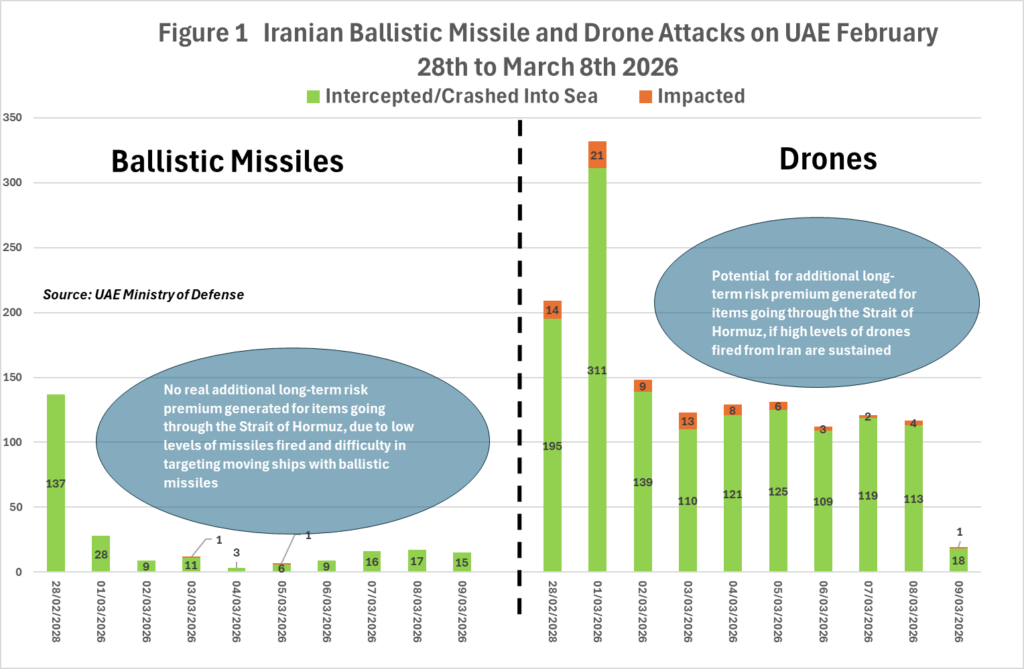
Reported ballistic missile strikes on UAE were broadly unchanged, meaning March 9th saw a material reduction in the overall scope of Iranian strikes. This is tentatively good news for the overall security situation in the Strait of Hormuz, and does as a “necessary but not sufficient condition” potentially mark the first step towards improvement. However, in order for the security situation in the Strait of Hormuz to genuinely improve, the number of Iranian drone launches aimed at the UAE would likely have to decline for several days in a row. This remains to be established, as the risk remains that it is merely a coincident that so few drones were fired at UAE today, and of course Iran could have taken a deliberate decision to not fire so many on this date. This latter option, however, would suggest a degree of centralized command and control among Iranian forces that has to date not been revealed by other events.
Following questions from clients, I have also dug into the available original data from other Gulf region countries to try to establish whether the decline in drone strikes at the UAE was made up for by more strikes on other countries. Sifting through the available press releases from relevant national authorities in the Gulf region, it is possible to recreate a daily dataset for both Bahrain and Qatar that – while not fully similar to UAE data – does provide this information to the best available degree of validity. Figure 2 and 3 makes it clear that the number of intercepted strikes in neither country spiked today. Note that no data is available for strikes that were not intercepted in Bahrain or Qatar, so we do not know the total number of launched weapons from Iran, but there has been no reported spike in Iranian missiles or drones hitting the two countries, so the trend is credible.
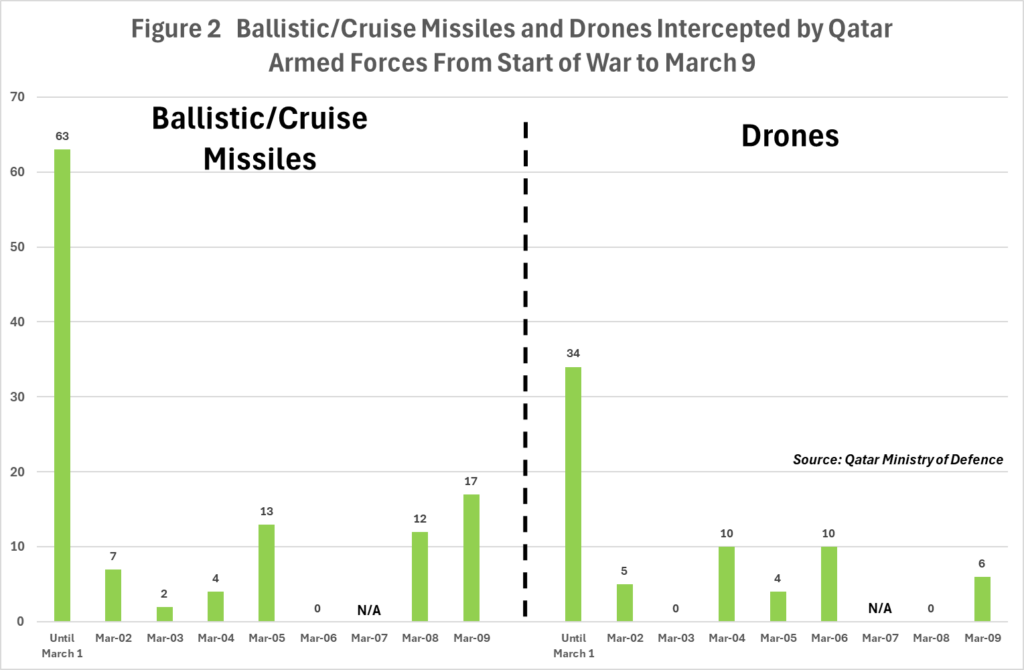
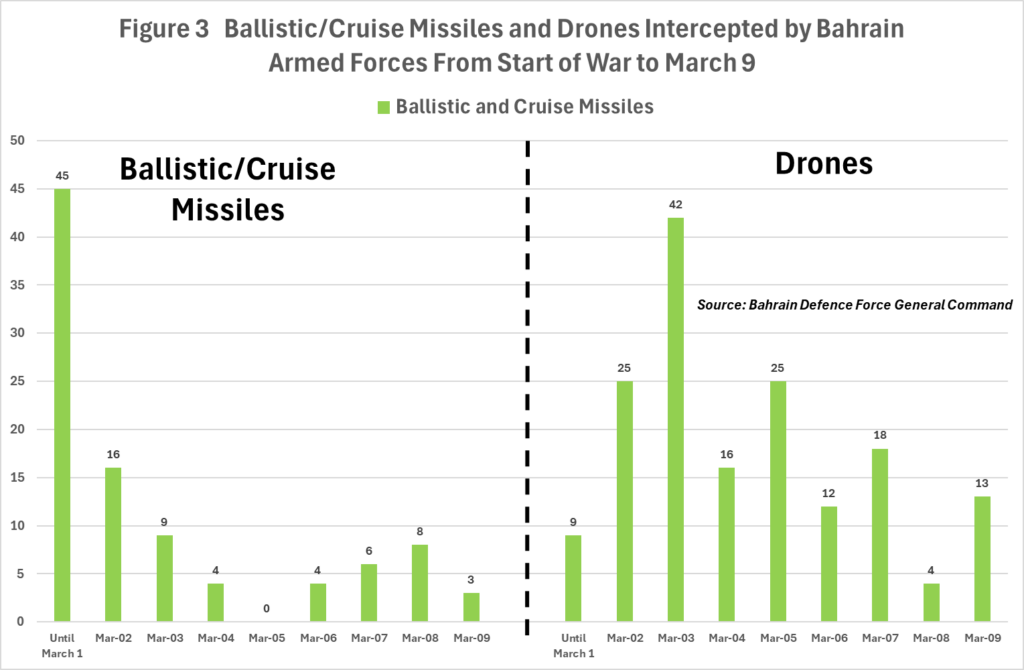
Figures 2 and 3 also make it clear that the total number of strikes aimed at either Bahrain or Qatar is significantly lower than the number for UAE. I found no comparable data from original national sources for either Saudi Arabia, Kuwait or Oman, but as there has been no reported dramatic increase in strikes on these countries, I believe it credible to conclude that no offsetting increase in strikes elsewhere have taken place. March 9th hence have for the first time since day 2 or 3 of the conflict seen a material reduction in the total scale of Iranian retaliation against the Gulf region.
This is good news, and could if sustained in the coming days lead to the commencement of US (and possible French following an announcement by President Macron) naval escorts of tankers through the Strait of Hormuz relatively shortly, if naval commanders deem the reduction in the overall threat level to be adequate to undertake such a task. Should the ability of Iran to retaliate against the Gulf prove lasting, it might also be a precursor for a diplomatic process to end the conflict, as the coalition’s military pressure begins to bear on Iran. Both represent possible near-term scenarios to reduce the uncertainty surrounding the Strait of Hormuz in the coming days. The scope of reported Iranian retaliation must hence be closely monitored going forward.
The reduction in reported Iranian retaliation against the Gulf region notwithstanding, with the dramatic increase in global fossil fuel prices, it nonetheless has become more likely that a diplomatic solution must be sought with increasing urgency in the coming days. This raises the question about what would be required for Donald Trump to “declare victory”, and whether this would be acceptable to Israel and the Gulf region? To start, Donald Trump must of course stop entertaining all notions of and public demands for “Iran’s unconditional surrender”. This will not happen, just as Trump does not seem to have had a say in the selection of the new Iranian Supreme Leader, and even if he doesn’t like the choice.
On the other hand, the listing by Secretary of State Marco Rubio today of the U.S. war aims as a greatly reduced threesome of 1) Destroy Iran’s ability to launch missiles; 2) Destroy Iran’s factories making these missiles; and 3) Destroy Iran’s navy is a far more achievable set of military goals, which arguably the coalition has made very great progress towards already. Ignoring Iran’s nuclear program, proxy forces and its drone program will likely not be acceptable to Israel or the Gulf region, but Rubio statements nonetheless suggests that a “process of reality check” is being conducted inside the Trump Administration with regards to what is acceptable to end the war. Implicitly the political process in Washington towards embracing diplomacy seems to have begun. The same political process of “getting to a diplomatic solution” appears to have started in Israel, as off-ramps and “alternatives endgames to regime change” are now being discussed in the recognition that the cost of fighting on to topple the regime will be too costly.
Given the selection of hardline cleric Mojtaba Khamenei as new supreme leader, it seems plausible that Iran will continue to pursue its nuclear, ballistic missile and drone programs. It will though want to have peace in order to do so free of unconstrained coalition bombing, and hence even a new hardline leader will likely see the benefits in accepting some sort of diplomatic solution in the near-term, perhaps in the hope that future confrontations will not involve the full weight of the U.S. military. Given this likely longer-term outlook, the whereabouts of Iran’s existing stockpile of highly enriched uranium becomes arguably even more important. IAEA chief Rafael Grossi noted today that his agency believed that at least half of the stockpile was stored near the Isfahan nuclear facility. If so, an additional very large U.S. strike on this facility seems highly likely soon, though it too might well herald the beginning of the end of the conflict, enabling Trump to declare – truthfully or not – that he “destroyed Iran’s nuclear stockpile”.
Winston Churchill once said about war that “Never, never, never believe any war will be smooth and easy, or that any one who embarks on that strange voyage can measure the tides and hurricanes he will encounter. The Statesman who yields to war fever must realize that once the signal is given, he is no longer the master of policy but the slave of unforeseeable and uncontrollable events.” These are certainty sentiments that appears to have affected Donald Trump in this conflict. It remains though the base case that the conflict will not be a drawn out one, and that the start of a diplomatic solution will become discernable as early as the end of this week.
Jacob

