

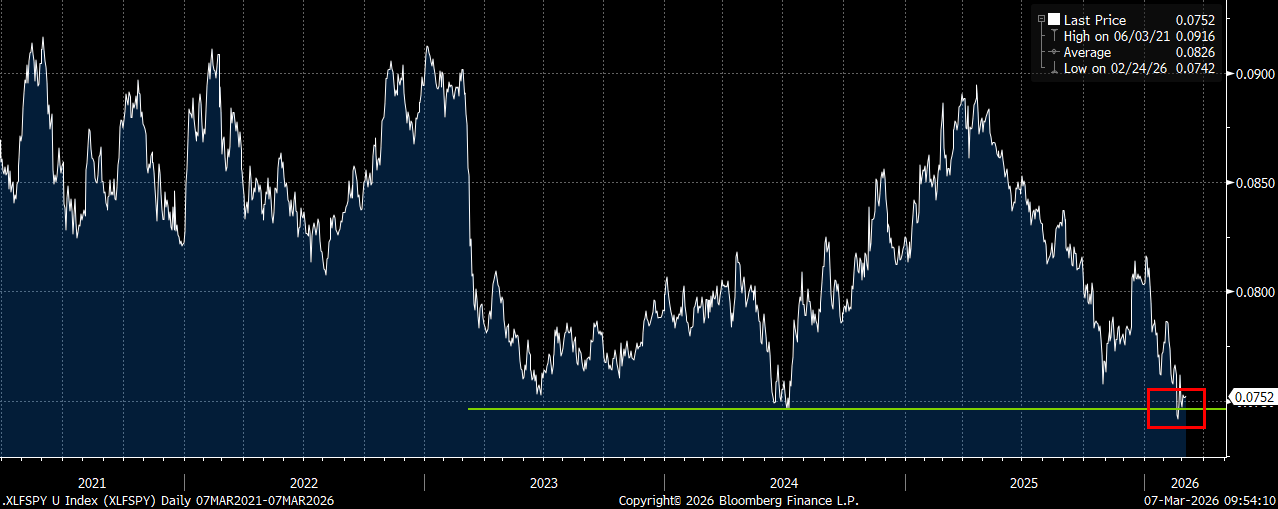
With the Academy Awards next week, I can’t help but think that the movie that is the favorite to win best picture, One Battle After Another, is a great way to describe the current state in the equity and credit markets. The equity battles started late last year with the Mag7 hyperscalers coming under pressure as the market started to be concerned that their enormous capital expenditures would not only impact on free cash flows, but it may also be extremely hard to ever see a meaningful return on their investments. The next battle the equity market had to contend with was the realization that advancements in AI could likely make many of the high-multiple software companies “replaceable” over time. The main software etf (IGV) declined by 35% from the October highs to the recent lows and had its worst relative showing vs tech (QQQ) ever. On the credit side, the First Brands default last fall put the entire private credit market under the microscope, and we have seen the industry come under sharp pressure since. The news flow continues to seemingly worsen by the day, with Blackrock saying on Friday they were limiting withdrawals in the private credit fund that caters to retail investors (BLK shares dropped by 7.7%). The private equity market has also been punished given their large exposure to the software sector. Financials (XLF) peaked relative to the market (SPY) in April and made a new 5-year low in late February, possibly signaling the private market concerns for all the financials?
XLF/SPY relative spread peaked back in April and made a new 5-year low in late Feb
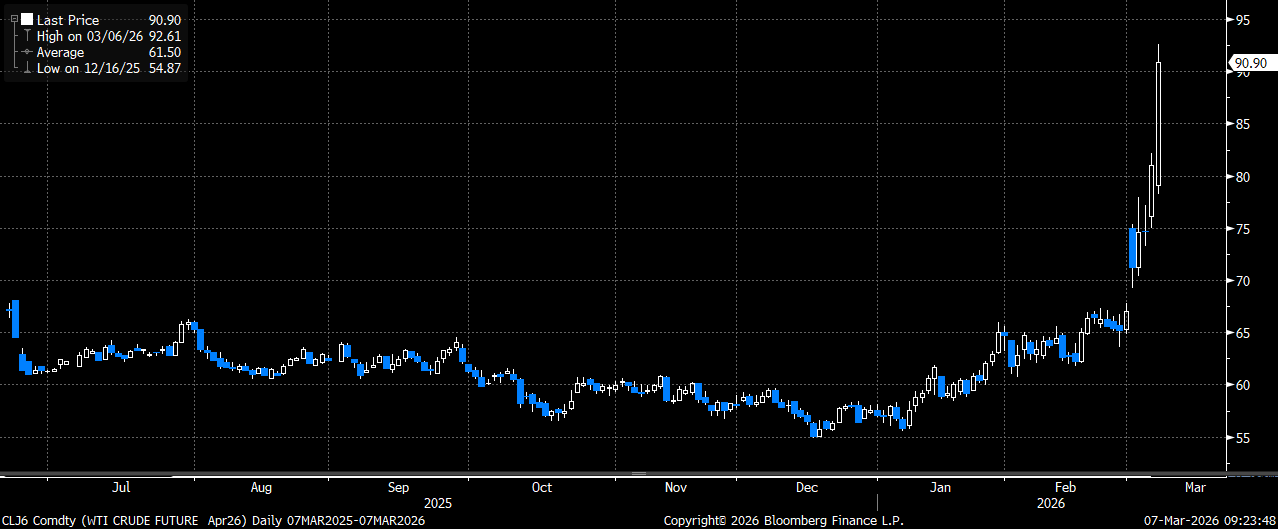
While all that was happening on the tech and private credit/equity markets, we started to get very “mixed” signals on the economic front. We saw a much hotter PPI print a week ago Friday, and then a really bad February payroll report that saw negative job growth along with higher average hourly earnings. All this negative data was from February and BEFORE the current situation in Iran started. Oil was up more than 12% on Friday and up a whopping 35% for the week (closing above $90). Stagflation concerns have arisen with job market weakness happening at the same time inflation appears to be perking up, and this move higher in oil will only make those concerns more justified. Even if there is “quick” resolution in the Middle East, all the issues regarding the hyperscalers, software companies and private credit/equity markets will still remain.
Oil was up 35% for the week and will only add to concerns about stagflation in the US
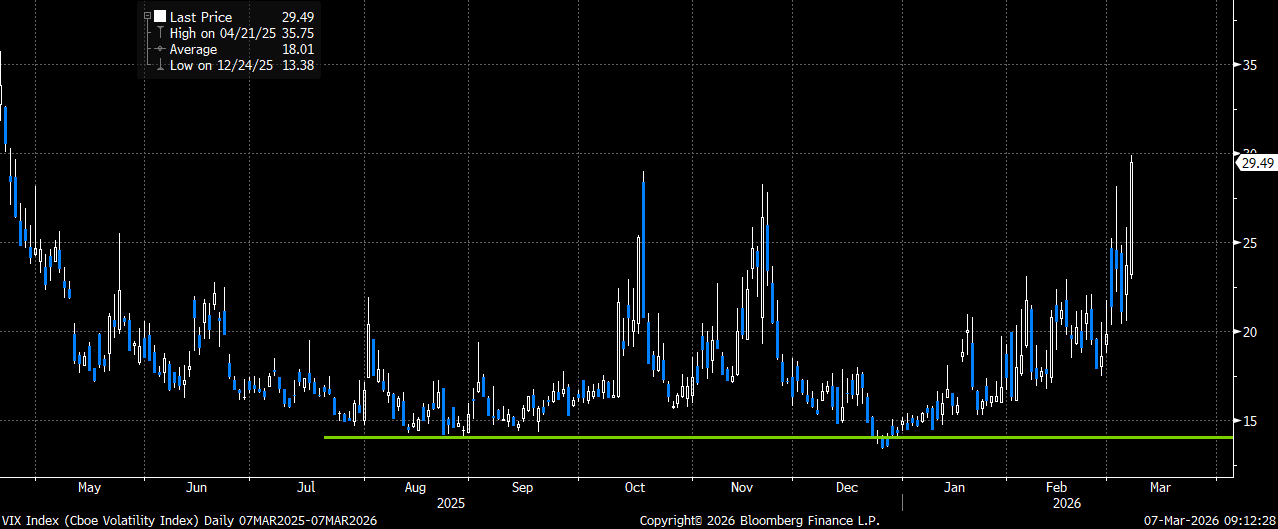
While volatility (VIX) has been signaling these concerns for a while, it really showed itself this past week with the VIX index spiking by nearly 50%. I have been advocating VIX macro hedges since early January and this past week really showed why the convexity in VIX calls is the “better” tail hedge in a market where complacency still exists. For reference, SPY was down only 2% on the week and tech (QQQ) was down ~ 1.25%. This is a theme that has played out for most of the year, where “damage” on the index level has been very much contained (for now) but vol continues to scream higher.
VIX index was up FIFTY percent this week and closed above the highs that were hit in October and November
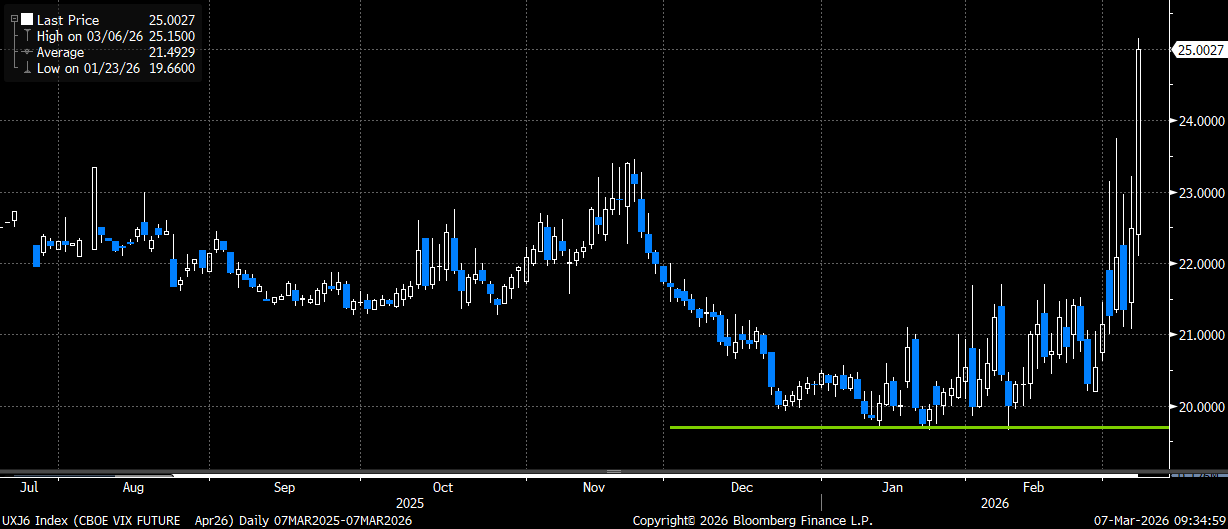
The issue now for investors is that it has gotten much more expensive to hedge exposure, yet downside risks clearly remain. On the VIX front, I continue to favor selling a downside put to own an upside call (or very wide call spread) out to April. I would use the April VIX futures support ~ $20 as part of any upside risk reversal (sell VIX April 20 put to buy the upside call or call spread). I believe that even on a relief rally that there should still be a quasi-floor to vol at lower levels and selling the put will help offset the cost of buying the now higher vol upside call or call spread.
VIX April futures with a large spike this week. I favor using the “floor” in vol at the 20 level as part of an upside risk-reversal trade
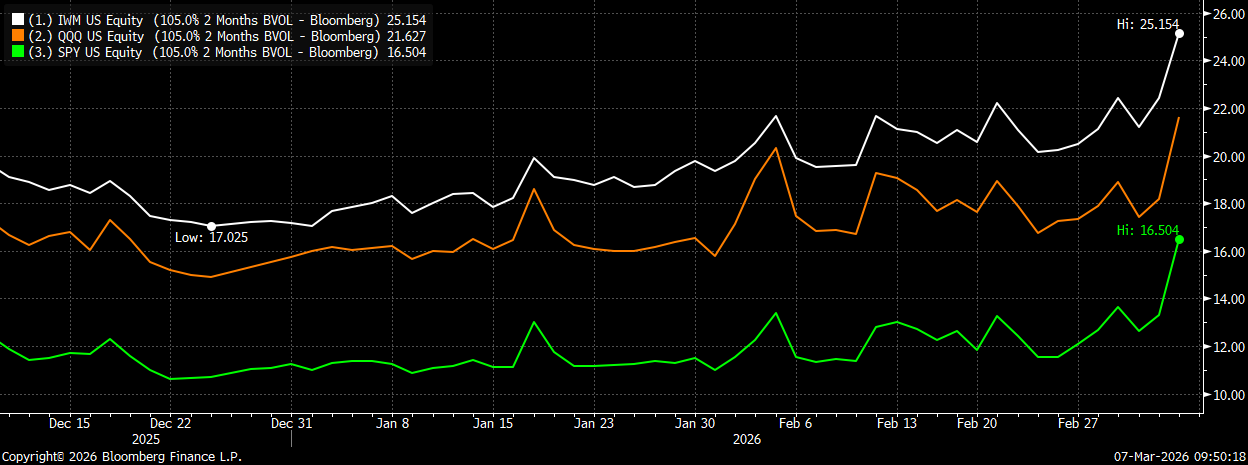
On the index front, I think it is an “easier” trade in that we just haven’t seen the typical weakness at the index level associated with a move like this in VIX. In other words, we are still close enough to the recent all-time highs that selling an upside call to help finance a downside put/put spread is an extremely viable and attractive way to hedge further downside risk. SPY is 4% below the highs, QQQ is less than 6% below the highs and small caps (IWM) are ~ 8% below the highs. When looking at 2-month (April) 5% upside call implied volatility we see a decided move higher in all three (see below). Therefore, selling that upside call on a higher vol, at levels that seem unlikely to be reached again in the short-term, remains my favorite way to hedge further weakness on the index front given the move higher in volatility. In addition, should we see a move back higher I would expect that upside call volatility decreases sharply (another reason why you want to sell the call as part of a collar hedge).
We have seen 2-month (April) 5% upside call volatility move up significantly over the last few weeks
The technical picture for all the main indices continues to worsen as well, which is yet another reason why collars continue to be my favorite way to hedge exposure on the index level through April expiration:
SPY with a close below the 100-day support and the Jan-Feb lows. You want to sell the upside April 700 calls here as part of a collar hedge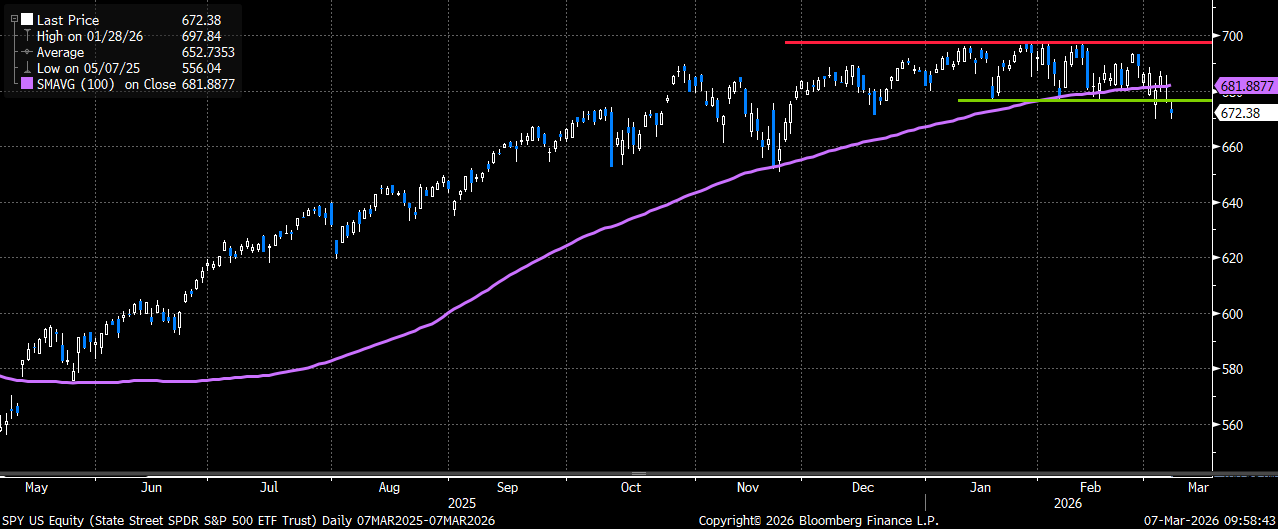
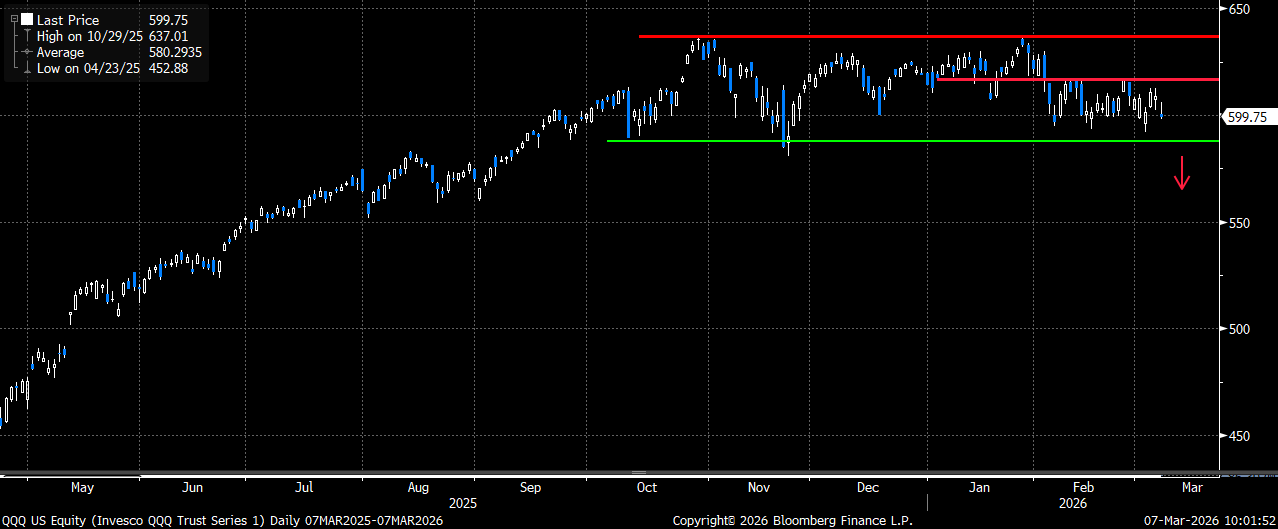
QQQ with clear resistance at the 635 level. You want to sell those calls as part of an April collar hedge in case of a break below next support
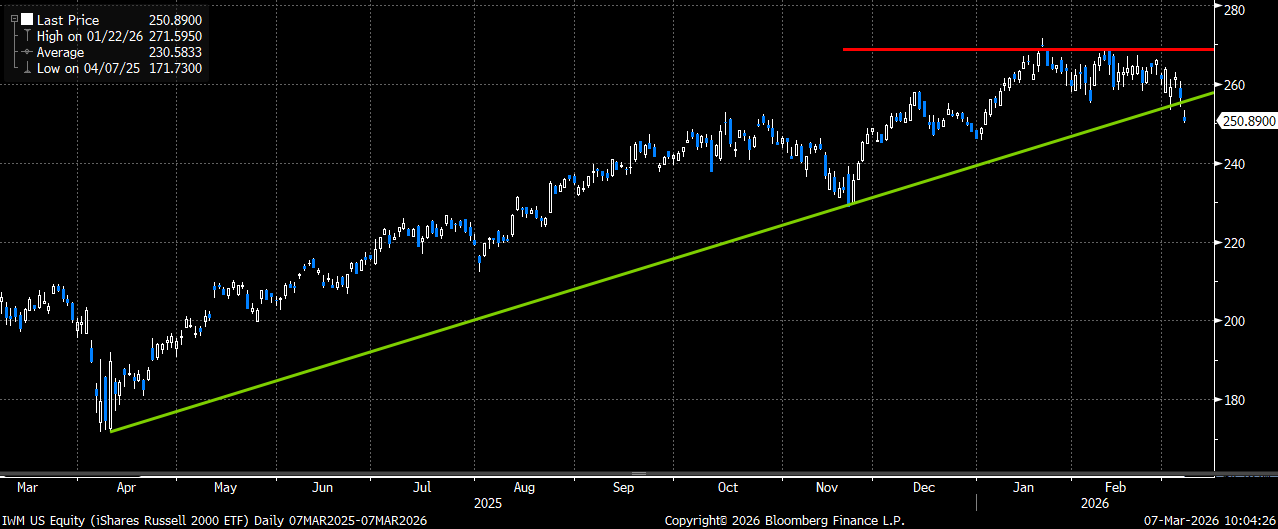
IWM with an ugly break below the April 2025 uptrend support. You want to sell the 270 calls as part of an April collar hedge
Please reach out to me or the 22V sales team to discuss specific April collar structures for any of these indices.

