

Day 7 of the air campaign against Iran looks to have unfolded much like day 6 – scaling up of U.S. and Israeli coalition bombing of Iranian deep strategic regime and industrial targets, naval assets and air defenses, while Iran continues to fire back against Israel (a limited number of ballistic missiles doing very limited if any damage) and the Gulf region, where both ballistic missile and especially drone attacks remain a material risk. This pattern to the war looks likely to persist in the coming days, too.
Figure 1 shows the updated number of ballistic missile attacks on the territory of UAE, as reported by the Ministry of Defense. Here it should be noted that many different numbers for missile and drone strikes circulate, some including all of the Gulf and some only a smaller group of countries, or as in this case only the UAE. Different sums and even directional trends can be derived from such different data sources. CENTCOM stated yesterday that ballistic missile and drone strikes from Iran are down 90 and 83 percent from day 1 (February 28th) respectively, but no underlying data or detailed methodology was provided. This statement seems substantively correct with regards to ballistic missile strikes, but materially incorrect with regards to drone strikes when measured against the data reported by the UAE Ministry of Defense.
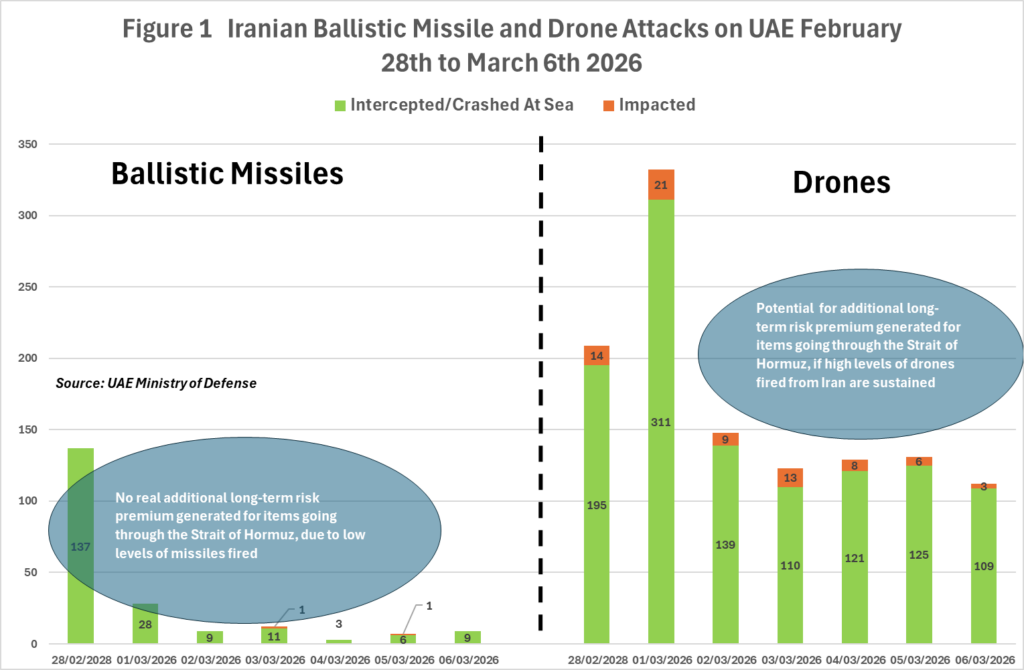
Ballistic missile strikes against UAE remained in the single digits on March 6th, and while drones strikes fell to the lowest number yet (just!) on March 6th, it is still the case that 112 drones were fired against UAE alone. Assuming (implausibly) that no drones were fired against any non-UAE target on March 6th, for CENTCOM’s 83 percent decline to be factual, about 650 drones would have had to have been fired on the first day of the war. This is certainly conceivable, given that more than 200 were reported fired against UAE alone on February 28th. Yet, reporting an 83 percent decline in drone attacks from Iran nonetheless seems “close to political spin”, once it is considered that 112 drones were still fired against the UAE on March 6th alone.
The reason for this is that 110+ daily drone attacks against just UAE implies a still significant Iranian drone attack capability, and consequently a still significant Iranian threat to shipping through the Strait of Hormuz. As long as that threat persists the coalition air forces have not addressed an increasingly urgent military task before it, namely to significantly degrade Iran’s drone threat and ability to project power into the Strait of Hormuz. As long as this military task remains incomplete and no explicit U.S. naval escorts seem imminent (despite being repeatedly mentioned by President Trump), it seems unlikely that oil tankers will attempt to navigate the Strait of Hormuz in any material numbers. At least it will be required that one high profile “brave and greedy” (or perhaps well politically connected to Iran so maybe an LNG tanker from Qatar?) commercial actor successfully sails through the Strait to possibly sway others. So far, no one has stepped up.
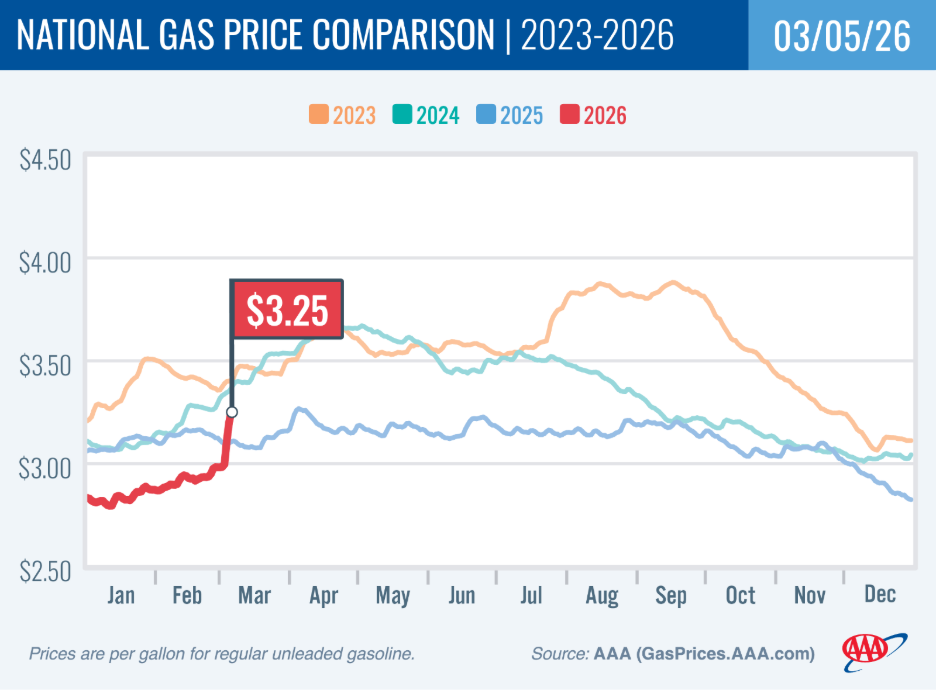
U.S. Energy Secretary Chris Wright said today that the U.S. military would “escort ships through the straits and get the energy moving again” as soon as it was “reasonable” to do so. This implies that also the U.S. Navy seeks to reduce the Iranian drone threat in the Strait of Hormuz before starting the provision of naval escorts for oil tankers. Precisely when this threat is deemed sufficiently low for the U.S. Navy to commence such escorts is unclear, but that the escorts have not yet started, despite Iran’s regular navy and air force having been decimated, oil prices rising above $85/barrel, and U.S. national gasoline prices rising materially to $3.25/gallon (Figure 2), suggests that the Trump Administration continues to have a healthy respect for Iran’s drone threat.
The base case at this point therefore should – surprisingly to me – be that U.S. naval escorts and with them a possible relief of the gathering oil market pressure still remain several days away, as we await more progress in the air campaign against Iranian drones.
Figure 2 U.S. National Gasoline Prices 2023 – Present
Despite the very near-term resilience of Iran’s drone threat one week into the conflict, it nonetheless – again in my opinion – is important not to start making assumptions – perhaps inspired by the long war in Ukraine that was supposed to be over in three days – about that this conflict is suddenly on track to become a protracted and month-long attritional war between Iran and the U.S.-Israeli coalition. This is not a war that is about to become a drawn-out test of wills, as this requires a resemblance of military parity and political cohesion on both sides. None of these parameters exist in this conflict.
First of all, this is not a balanced fight, but a war between an already largely militarily cribbled Iran and an increasingly dominant coalition that, due to the vast U.S. military superiority and ability to deploy large numbers of powerful military assets to the theater, will continue to pound Iran. Yes, Iran looks likely to continue to be able to fire drones at the Gulf in the coming days, but the cumulative effects on Iranian regime capacity and morale from being bombed daily by an array of heavy U.S. bombers will accumulate fast. The base case hence remains that this war do not last more than approximately another week.
Secondly, neither Iran nor the United States likely has the stomach for a protracted fight. Israel might, but will not be able to continue the fight on its own if President Trump pulls out soon, and Iran remain in a position to threaten the Strait of Hormuz and global oil markets. Iran is a large and mountainous country, but that geography merely mostly make a U.S. ground invasion impossible, and does not – given that the coalition today enjoy near total air superiority – provide Iran with important benefits other than improved ability to hide some of its military assets, including drone launchers.
Morale, or political will and cohesion in both Iran and the U.S. further points to a short war. The Iranian regime is, as discussed in earlier notes, unlikely to collapse and regime change hence remains highly unlikely. However, this is not equivalent to Iran being a strongly willed and unified country able to defy overwhelming military odds for months. Indeed, precisely the Iranian regime’s reliance on deadly violence to repress the majority of its own population means that Iran by definition is not a unified nation, and that the regime is inherently vulnerable to attrition among the murderous thugs that keeps it in power. Hence, for regime to remain safely entrenched, there are limits to how many of its domestic security forces it can afford to lose and how low their morale can go. Tehran hence looks unlikely to be able to sustain the kind of punishment Iran will continuously be subjected to in the coming days for long. And certainly not for months.
Meanwhile in the United States, the Trump Administration has in an election year started this war in a difficult domestic political situation, is now per figure 2 facing dramatically increased gasoline prices as a direct consequence of its decision to bomb Iran, and is moreover per today’s poor jobs report likely facing renewed concerns about the general health of the U.S. economy. Sudden questions about renewed recession risk are not what a president who just started a major war will be looking for.
Moreover, the Trump Administration is facing what increasingly looks like a deliberate effort for at least some of the Gulf Arab targets of Iranian attacks to drive up commodity and financial market concerns about the outlook for global energy markets. Qatari officials’ decision to first – perhaps prudent, perhaps intentionally aggravating market tensions – quickly shut down its LNG production and then in the Financial Times very publicly warn against “a stop to Gulf energy exports within days” is at a minimum dramatically different from Saudi Arabia trying to reroute significant oil exports from the Gulf to the Yanbu Terminal in the Red Sea and keeping quiet about the outlook for global energy markets.
All told, Donald Trump does not look to be in a domestic political and global commodity market situation that enables him to sustain a prolonged war in Iran. Consequently, it is sensible to simply ignore social media and interview commentary from Donald Trump directly related to the war. His recent comments about wanting to “have a say in the selection of the next Supreme leader in Iran” or demanding “Iran’s unconditional surrender” would both require open-ended war and a de facto regime change in Iran, something the current military campaign is extremely unlikely to engineer and certainty not under any circumstances in the near-term. Donald Trump does not have the domestic and political support to sustain a war, which if sustained beyond say a week could soon send oil prices north of $100/barrel. With the Supreme Leader Khamenei dead, and Iran’s military, and military-industrial sector increasingly degraded, Donald Trump has a path to declaring victory soon, and moreover in Cuba has already identified his Administration’s next foreign policy target. He is overwhelmingly likely to do so.
Lastly, it is worth noting that Iran’s president Masoud Pezeshkian earlier today sent out another social media post, declaring that “some countries have begun mediation efforts and that Iran is committed to a lasting peace“. This once again implies that Iran not that far off being ready to talk to third countries – perhaps Oman once again – about ending the current fighting. This is not a war that will go on for months, or even weeks.
Iranian President Pezeshkian’s tweet from March 6th:
Jacob

