

The last 24h of the U.S. and Israeli attack on Iran has revealed relatively few new and surprising developments. This indicates that the conflict has now found a (very) short-term equilibrium, as the coalition expands its bombing of Iranian targets and Tehran on its side seeks to continue to retaliate in a fashion designed to maximize political and economic impacts across global markets. Both sides will likely, based on the last day’s events, be able to claim that they are moving towards their strategic goals.
For the joint coalition, these goals include – once the aspirational rhetoric about regime change is discarded – degrading Iran’s military and military industrial capacity to the greatest extent possible, hereby pushing out into the future the timeframe in which an unreformed Iranian regime can reconstitute its nuclear, ballistic missile and drone programs. Extending this timeframe will enable the Gulf Arab states to rebuild and expand Ukrainian-style their air defenses against also very high numbers of cheap Iranian attack drones. Another goal for the coalition is to degrade Iran’s retaliatory capacity through ballistic missile and drone attacks. Here progress is uneven.
For Israel more specifically, these goals also include sowing the most comprehensive and lasting political chaos inside Iran, so as to weaken and delay the Iranian regime’s reconstitution. This includes fomenting regional uprisings (note that the rumors about a large Kurdish incursion remain completely unconfirmed!) and assassinating all plausible new political leaders in Iran. Israel can, given its formidable air defenses, generally pursue this goal without concern for the destabilizing effects that domestic political chaos in Iran might yield. Neither the Gulf region countries currently vulnerable to attacks from Iran, or a Trump Administration increasingly focused on restoring stability and lower oil prices will necessarily share these Israeli priorities.
On the Iranian side, the principal task is to “remain standing” and launch an adequate number of retaliatory attacks on the Gulf region and beyond to ensure that political and economic pressure from reduced oil and gas shipments from the Gulf region continues to build, hereby pressuring the Trump Administration. In this endeavor, Iran has seen both a noticeable setback in the number of ballistic missiles it has been able to unleash, and continuing military success in its ability to sustain a relatively high rate of firing of drones against the Gulf region. Figure 1 shows the development of ballistic missile and drone attacks on the territory of the UAE since the start of the war on February 28th.
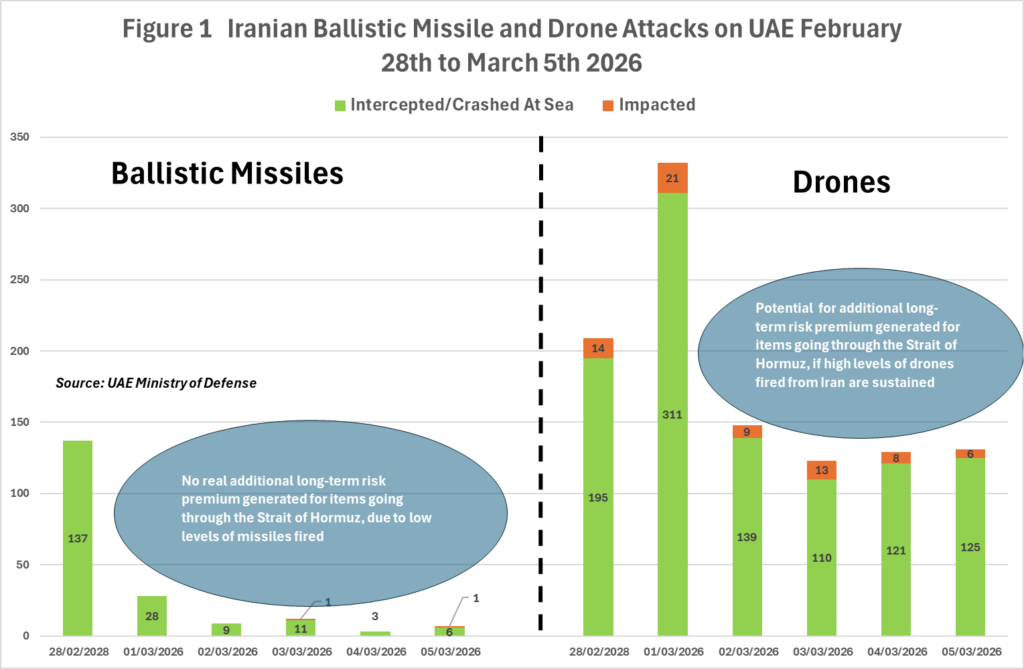
While figure 1 includes only daily provided data from the UAE Ministry of Defense and not the entire Gulf region, the UAE is the country that has seen the highest numbers of Iranian retaliatory attacks. Figure 1 clearly shows how the number of ballistic missile attacks has declined dramatically since day 1 of the war to now sustainably in the single digits and with virtually all missiles intercepted. At the same time, figure 1 however also illustrates how the number of drone launches against the UAE has only declined a bit since peaking on day 2 of the war and has remained at a high level of over 120/day for the last four days.
When thinking about the longer-term effects of Iranian missile and drone threats, the very significant decline ballistic missile threat suggests that this element of Iran’s projected power will not remain a material risk or push up risk premia until the point in time at which the ballistic missile program is possibly rebuilt after the war is over. In contrast, the still high level of drone attacks clearly suggests that the Iranian drone threat, were it to remain at the current level, would push up risk premia for items traveling through the Strait of Hormuz possibly permanently. Or at least until the drone threat is militarily reduced, or a new political arrangement struck between the Gulf Arab states and the Iranian regime.
Figure 1 illustrates that the still high drone threat from Iran remains the principal military task for the coalition in the coming days of attacks. It also suggests that the commencement of U.S. naval escorts of oil tankers through the Strait could today be associated with a still high level of drone attacks from Iran and hence a considerable risk to the tankers involved. Lastly it will remain difficult for the coalition and President Trump to end hostilities, as long as Iran’s drone threat has not been degraded to a materially higher degree. The current air campaign hence looks like carrying on for several more days.
Iran today also attacked Azerbaijan with drones, hereby further expanding the geographic scope of the conflict. This action, however, seems somewhat desperate as Azerbaijan both has potent and battle tested armed forces, and to date has remained neutral despite having a sizable Azeri minority in Northern Iran. The decision to strike Azerbaijan hence likely reflects a degree of desperation in Iran and a need to expand the conflict as much as possible to try to compel the coalition to end it.
In sum, the military situation continues to point to a number of days of continued fighting before there is any chance that the Iranian drone threat is sustainably reduced. This should be reflected in markets pricing in supply disruptions of still uncertain lengths.
Jacob

