

I As we await the outcome of ongoing negotiations between the Trump Administration and the Iranian regime in Geneva, intermediated by Oman, it looks increasing unlikely that a positive result can be achieved. The probability of military action against Iran in the coming days or week or so has hence increased further in recent days.
The Wall Street Journal today reported that the U.S. position in the negotiations on Iran’s nuclear program include demands for 1) zero Iranian nuclear enrichment; 2) dismantling of the Iranian nuclear sites at Fordow, Natanz and Isfahan; and 3) handover of all remaining enriched Iranian uranium to the United States. And in return the United States will offer only initially very limited economic sanctions relief and the prospects of lifting more material sanctions only after a prolonged period of verified Iranian compliance.
These are very tough negotiating positions, that it seems very difficult for the Trump Administration to materially compromise on – after all “zero enrichment” must to have any political meaning mean no Iranian enrichment beyond perhaps a token amount of nuclear material for medical use inside Iran. And these demands are certain to be rejected by Iran that has always maintained that it is a sovereign right for it to possess a substantive civilian nuclear program (Iran has always denied it has a nuclear weapons component to its enrichment program, despite burying its alleged civilian nuclear enrichment facilities ever deeper underground). As such, even if the Trump Administration has agreed to negotiate only the nuclear issue – not insisting on Iranian concessions on ballistic missiles and proxy group support would in itself represent a major concession to Tehran – the negotiations do not look likely to succeed.
Omani mediators as expected have declared that “significant progress in the negotiation” occurred during this week’s round of negotiations, and that “technical negotiations” will continue in Vienna next week. Even more predictably, Iranian representatives declared that “good progress on nuclear and sanctions relief issues” had been achieved, as Tehran will want to create an impression that an agreement is close, so as to make any decision to authorize military action politically harder for President Trump to take. Assuming, however, that the WSJ report on the Trump Administration’s key demands is correct, it is evident that the two sides remain far apart in these negotiations.
Other “facts on the ground” also point to relatively imminent military action, although of course all these actions could in theory be orchestrated as part of a political pressure campaign against Iran. U.S. military personnel levels at bases in the region are being reduced to “mission critical” only; the U.S. second aircraft carrier strike group will have reached the coast of Israel by tomorrow Friday; both President Trump in his SOTU speech and Secretary of State Rubio has publiclymade it clear that they believe Iran is seeking to reconstitute its nuclear weapons program crossing a clear red line from the Trump Administration; and the broader U.S. military build-up in the region continues unabated.
Other issues also directionally point to military action being relatively close, as Congressional Democrats insist on another (likely doomed though) War Powers vote in Congress next week which the Administration might want to front run, and then Indian Prime Minister Modi has now left Israel, removing the risk of a crucial foreign leader being caught up in a sudden U.S. (and possibly Israeli) military action against Iran. All told therefore it looks increasingly likely that a president that has ordered the transfer of a strike force of clearly near or by now at “war-time proportions” to the Middle East, and today looks highly unlikely to salvage a diplomatic solution, will give the order for a military action against Iran in the coming days or perhaps up to about another week.
As discussed in earlier notes, it remains quite plausible that Israel would participate directly in such a U.S. strike, and Israel would with certainty strike Iranian proxies in Lebanon and Yemen very severely, were Hezbollah or the Houthis to hit directly at Israel in retaliation for military action against Iran itself. It remains to be seen precisely what the scope of any U.S. military action against Iran will be, but as noted the military capacity for a very forceful strike now exists for President Trump.
At the same time, the prospects for successful “regime change” in Iran arising directly from even a powerful military strike remains very low, given the revealed willingness of large numbers of Iranian security forces to kill civilian protesters. This also extends to scenarios where the United States successfully targets Iran’s Supreme Leader Khamenei and other key regime leaders. Given the absence of any organized opposition inside Iran, the regime is likely to remain coherent, even if it might require a change in its top leadership.
As happened towards the end of Israel’s air war against Iran last summer, vastly superior U.S. air forces also fairly quickly – meaning at most a couple of weeks into an air campaign – is likely to run out of “worthwhile targets” to hit, meaning that any military action is highly unlikely to extend beyond this time horizon. It is also probable that the U.S. will start to run out of some types of especially smart ammunitions after a relatively brief bombing campaign. This too points to a short confrontation of no more than a couple of weeks at most.
Given the interest for the Iranian regime to use any armed confrontation with the United States to garner support among its own supporters inside Iran, a forceful retaliation against any U.S. strike must be expected. It is in other words not likely that Tehran will envisage any U.S. attack as modest or restrained, rendering any gradual escalation by the Trump Administration against Iran likely to fail. As discussed in earlier notes, it remains the strong base case that any Iranian retaliation will come against U.S. bases in the region and directly against Israel, and not target regional oil export facilities.
II Elections in small European countries are rarely important beyond their own borders. Yet, the Hungarian election on April 12th is likely to one of those contests that will have repercussions across the entire European continent, as long-time strongman, Trump-Putin-Xi ally and anti-EU and Ukraine prime minister Viktor Orban looks increasingly likely to lose power. Should Orban fall, it will greatly facilitate EU cohesion on all matters related to Ukraine, and perhaps most importantly illustrate that Orban’s increasingly virulent rightwing populism based on opposition to the EU is unlikely to be a successful political strategy. This, like what the effects of Brexit did with regards to dimming the calls by other far right parties for their country to depart the EU, will likely shape the political outlook of other European far right leaders, not least in France. The policies of Italian leader Giorgia Meloni may soon be the only viable path to power for far right leaders in Europe.
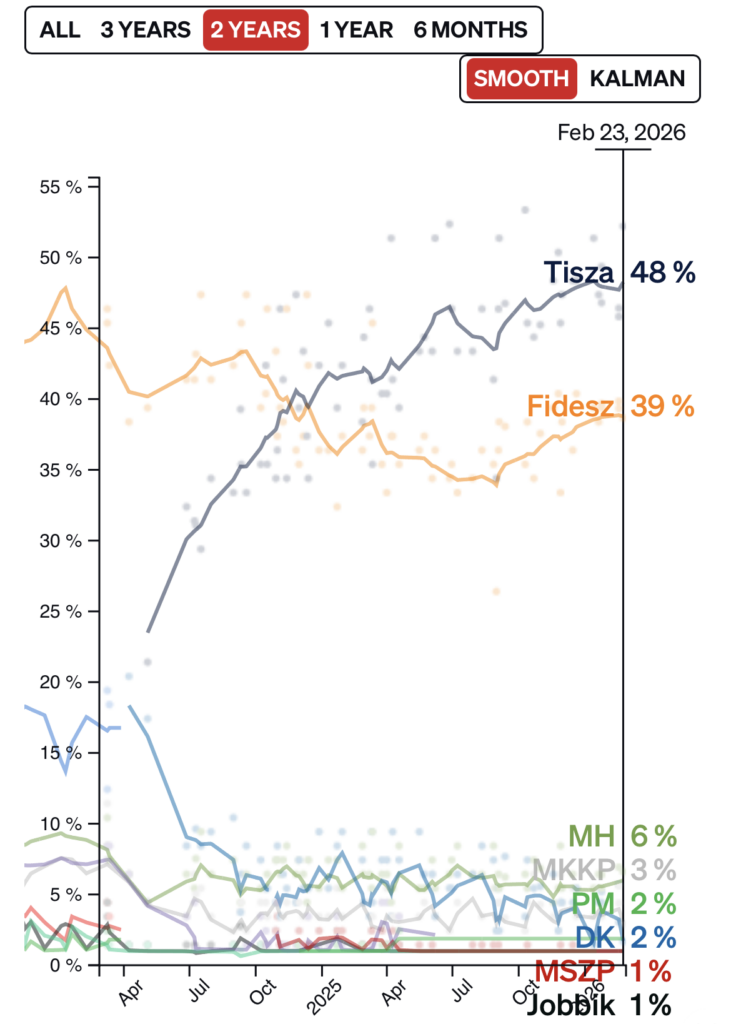
Politico’s “Poll of Polls” Indicator for Hungary’s April election now has the opposition Tisza Party almost 10 percentages points ahead, a lead that seems increasingly difficult for Viktor Orban to close over the remaining month and a half of campaigning (figure 1).
Figure 1 Poll of Polls for Hungarian National Election April 12th 2026
Source: Politico
The causes of Orban’s probable political demise are likely numerous, but surely dominated by the gradual deterioration of the Hungarian economy over the last years, as the EU has blocked sizable parts of planned budget transfers to Hungary over “rule of law concerns”. Hungarians, when measured at the average actual level of consumption, are today the poorest nation in the EU. This is a very difficult economic record for Viktor Orban to defend before the Hungarian electorate.
Hungary has in recent years repeatedly blocked or delayed EU policies on Russia sanctions, Ukraine’s EU accession process, economic and military support for Ukraine, and in recent days even the €90bn EU loan to Ukraine otherwise agreed by all EU leaders in December 2025. The latter blockade of the EU’s €90bn economic lifeline to Ukraine is rooted in Russian oil supplies to Hungary having stopped due to damage to the Druzhba pipeline to Hungary going through Ukraine, but is ultimately driven by Viktor Orban’s short-term electoral calculus that a hard line against Ukraine may help him among nationalist Hungarian voters. Should Orban lose power, this recurring distraction for EU policies towards both Russia and Ukraine will disappear, as the opposition Tisza party is highly unlikely to continue Hungary’s de facto blockade of any pro-Ukrainian EU policy. A change in government in Budapest is therefore likely to lead to a further tightening of EU sanctions on Russia, and a potentially dramatic acceleration in Ukraine’s EU accession process.
Viktor Orban’s increasingly populist anti-EU stance has, together with his longevity as Hungarian leader, made him arguably the leading figure on Europe’s far-right political scene, as Italy’s Giorgia Meloni has adopted more centrist policy positions. As noted above, a significant part of his loss of popularity can likely be attributed to Hungary’s loss of EU budget transfers, and are due to the EU’s legal sanctions against Orban’s government for breaching a variety of EU laws. Should Orban lose power, this will highlight the long-term effectiveness of such EU economic sanctions against member states that receive significant funds from the EU budget – a political impact likely not lost on other EU leaders when contemplating their policies towards the EU, and many are likely to moderate their positions accordingly.
This is particularly relevant in the case of France, where either Marine Le Pen or Jordan Bardella are currently favorites to win the next presidential election for the far-right RN party. This would usher in an unprecedented political situation in France, and would demand that the new president lays out an at least somewhat new political direction for the country. Here it will be important what type of far-right leader Le Pen or Bardella would want to be, and in making that choice it will likely matter what other far-right leaders are in power across the EU. If Viktor Orban is defeated in April, the arguably most populist of the EU current far fight leaders will be gone, and the only remaining with any real political stature will be Italy’s Giorgia Meloni. She is however far more moderate on a number of key policy issues than Viktor Orban, and should her “Meloni model” be the only one in office across the EU in 2027, it is likely to lead to a moderation in many of the positions a future French RN president will take.
Lastly, it is important to note that Orban’s Fidesz party has been in complete control of Hungary for well over a decade, and has put many of its political cronies in various positions of power throughout the Hungarian economy and society. As witnessed in Poland following Donald Tusk’s electoral victory in 2023, it can be difficult for a new centrist government to fully take control of a government bureaucracy, economy and society, after unseating a previously entrenched far-right government. At the same time, however, Hungary’s system is more centered on the prime minister, while the president has far fewer powers, and possible income prime minister, Tisza leader Peter Magyar, will therefore have better political possibilities to “clean house” once taking power.
It must also be recalled that the EU, when Donald Tusk won power, quickly agreed to release all the frozen budget transfers to Poland, giving the new Tusk government a considerable and quick fiscal transfer and corresponding political capacity to act. It should be the base case that a Prime Minister Peter Magyar would, with the right policy actions on issues penalized by the EU, be able to secure a similar early release of frozen EU budget funds for Budapest. This represents a potential significant near-term economic upside for the Hungarian government, and likely Hungarian assets more broadly, from an increasingly likely opposition Tisza victory in upcoming elections.
Jacob

