

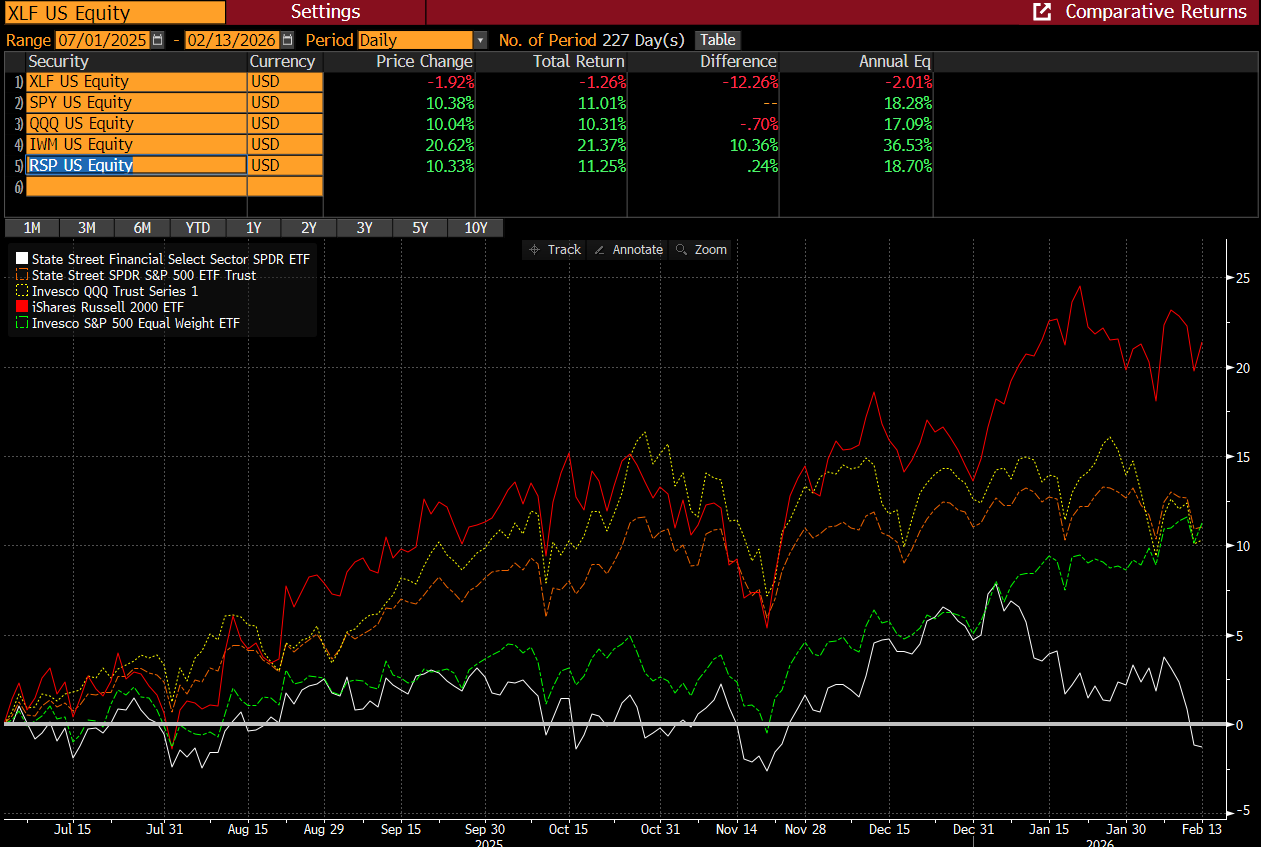
While there has been plenty of discussion about the weakness in the Mag7 trade of late, specifically the hyperscalers, it seems like nobody is talking about the large cap financials and how poorly they continue to trade. Consider that since the start of July the main financials (XLF) are now DOWN over 1%, and this is with all of the main indices up 10% or more over that time.
XLF is down 1% since the start of July, while all the main indices are up between 10% and 22%
Source: Bloomberg
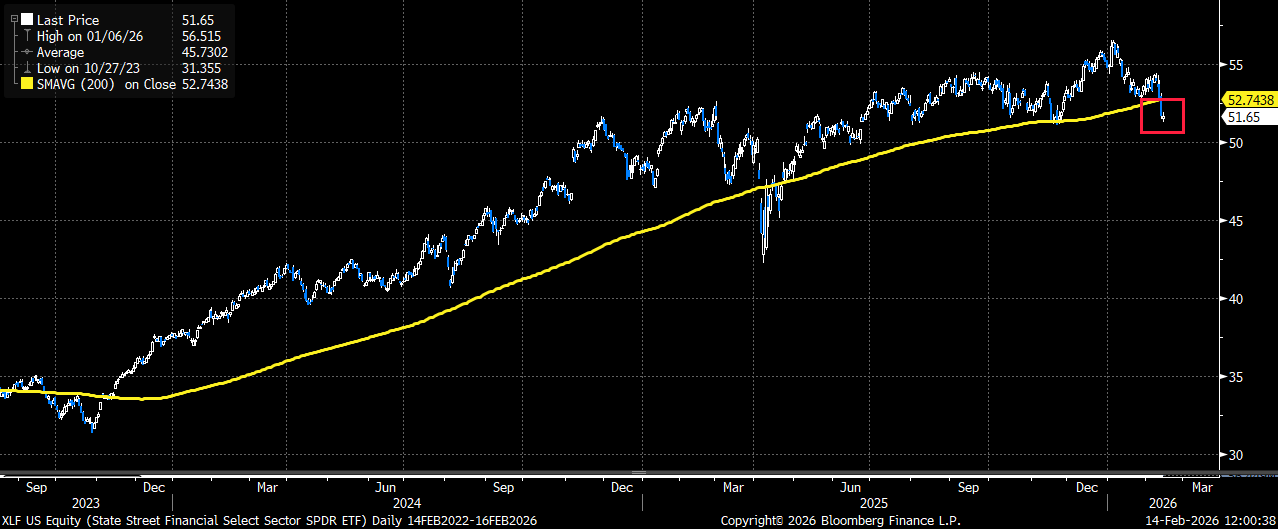
While XLF had been a laggard, it still was acting OK on a technical basis. That changed this past week when it dropped below its 200-day moving average on Thursday on very heavy volume. I believe this technical “break” is significant since XLF has been able to stay above the 200-day since November 2023 (except for the April 2025 tariff selloff that quickly reverted). The financials are potentially breaking down now in a market/tape that overall remains mostly healthy. Not only do the financials continue to be a major laggard, but now they are dropping on an absolute basis as well.
XLF with a technical break below the key 200-day moving average this past week
Source: Bloomberg
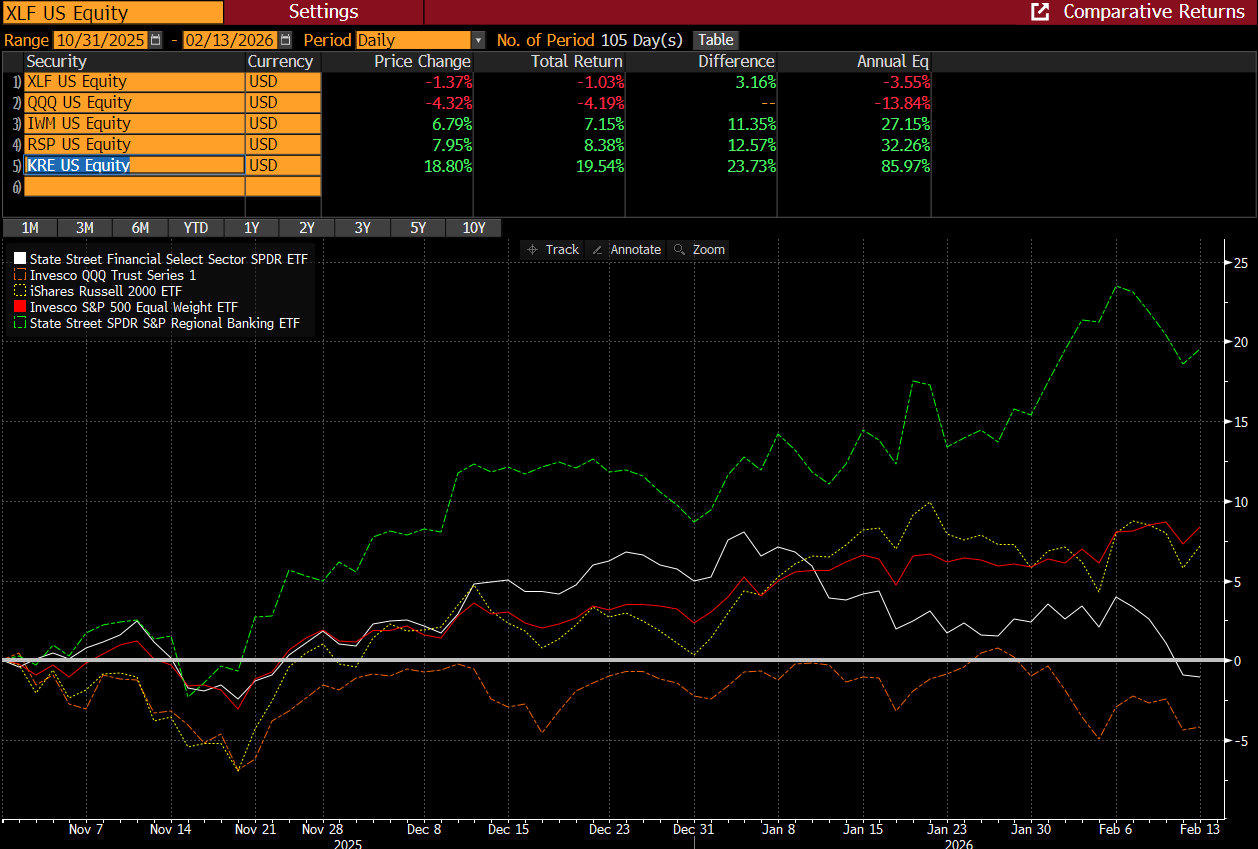
Perhaps the most concerning aspect of this weakness is that since tech (QQQ) peaked on both an absolute and relative basis at the end of October, XLF STILL can’t advance or outperform. Money continues to flow out of the crowded Mag7 names to several other areas of the market, yet XLF over that time is also down ~ 1%. The selling/weakness seems to be relegated to the largest financials as the regional bank etf (KRE) is up nearly 20% over that time as well.
Since tech (QQQ) peaked in late October, XLF is still down 1% while other areas of the “broadening-out” trade continue to do very well
Source: Bloomberg
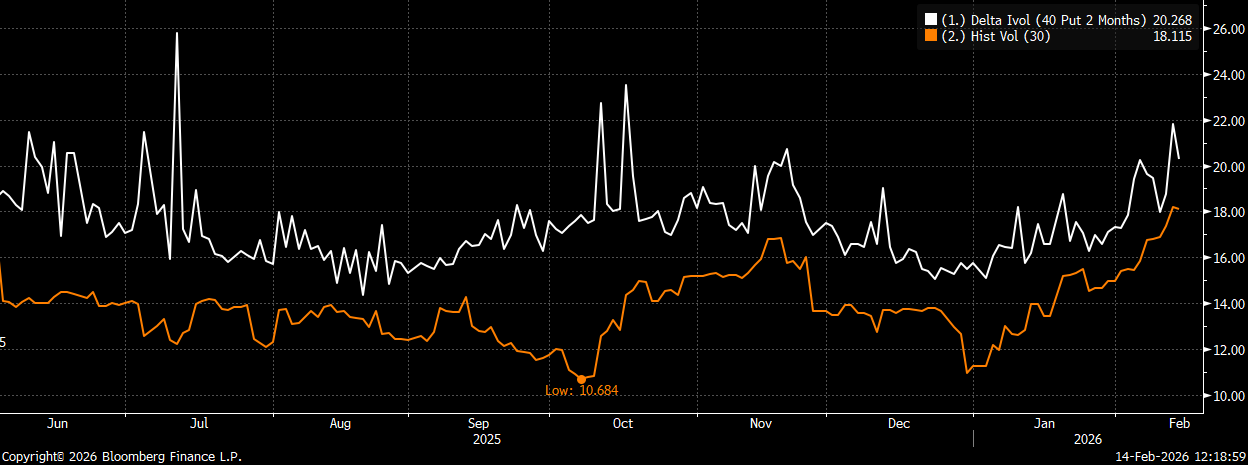
While I am not sure why the group trades so poorly (perhaps concerns about the private equity trade spilling over?), I do know that this weakness for now is something that shouldn’t be ignored (especially since the group has now been lagging the overall market for upwards of over seven months). Now that the group appears to have broken some technical support, perhaps the absolute weakness could start to intensify? While implied volatility in XLF 2-month (April) puts has moved up a bit off the lows, I believe it is somewhat justified given the move higher in market vol (VIX) as well as the move higher in XLF 30-day realized vol (which has climbed from a low ~ 11 to over 18 since the start of the year).
XLF 2-month (April) 40-delta put vol has moved higher, but so has the 30-day realized vol
Given this backdrop, I believe XLF hedges make a lot of sense. I want to focus on April structures since that not only allows time for trade to work, but April expiration will also cover the bulk of the earnings reports from several of the key names in the group. With implied vol elevated and put skew attractive here are two trades I suggest to either hedge exposure and/or for limited-risk downside bearish bets:
Trade #1 – XLF April ratio put spread
Buy XLF April 17th 51 puts 1x
Sell XLF April 17th 45 puts 1.5x
Costs ~ ($0.90 XLF 51.65 Fri closing ref)
Trade Details:
- Buying the April 1 by 1.5 ratio put spread that starts ~ 1% below spot
- Trade captures very attractive skew – buying 19 vol versus overselling 29 vol
- Trade is short delta (25d), positive gamma and theta neutral to start
- Trade makes money between 50.10 and 33.50 by April 17th expiry (-3% to -35%), with a max profit at 45 (-13%)
- Trade has a 5.7x to 1 max payoff and won’t cap upside exposure should group move back higher
Trade #2 – XLF April put spread
Buy XLF April 17th 50/45 put spread for ~ $0.75 (XLF 51.65 Fri closing ref)
Trade Details:
- Buying the lower-delta April put spread that starts 3% below spot
- Trade also captures attractive put skew – buying 20 vol versus selling 29 vol
- Trade makes money between 49.25 and 45.75 by April 17th expiry (-4.6% to -11.4%)
- Trade also has a 5.7x to 1 max payoff and won’t cap upside exposure should group move back higher
- Please reach out to me or the 22V sales team for updated pricing and execution capabilities

