

I EU and euro area Q4 GDP and December unemployment data came in continuing to point to resiliency in the European economy. Quarterly GDP rose by 0.3 percent from Q3 in both EU27 and EA21 (note Bulgaria is now included in the euro area), while growing 1.4 percent and 1.3 percent respectively over Q4 2024. These numbers were marginally above consensus and the ECB’s most recent economic forecast of 0.2 percent for Q4, and as such point to continued economic resiliency in the EU and euro area and do not suggest any change in the monetary policy outlook, where the strong base case remains that the ECB will not change rates in 2026.
One thing to keep in mind is the ongoing distortion of Irish GDP data from MNC tax optimization strategies, which particularly in Q1 2025 greatly inflated even euro area aggregate data. EU and euro area annual growth data for 2025 hence remains somewhat flattered by the “Irish factor”, and annual GDP growth (Q4 2024 to Q4 2025) for the EU and euro area, excluding Ireland, was a more modest 1.2 and 1.1 percent respectively.
Meanwhile, EU labor markets continue to show remarkable resilience at or near historically low levels of unemployment (figure 1).
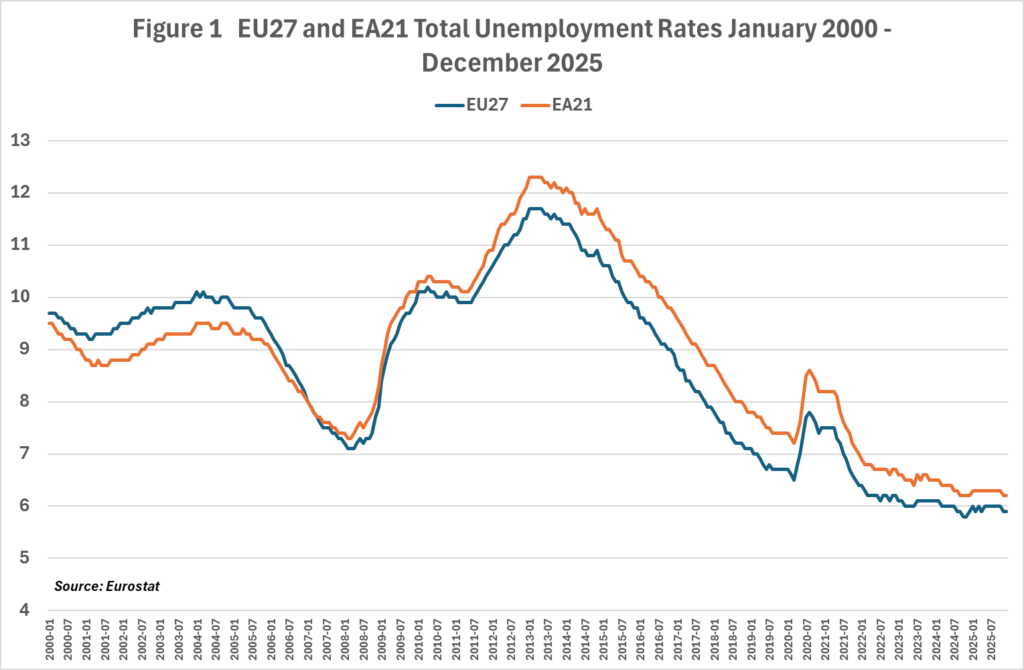
Euro area unemployment in December fell back to previous historical lows at 6.2 percent, while EU unemployment remains stable at 5.9 percent. The stability around these levels visible in figure 1 throughout 2025, despite trade tensions, volatile commodity prices and the ongoing war in Ukraine, underlines the resiliency of the EU and euro area labor markets, and makes it the strong base case for 2026 that levels remain at these low levels, providing a solid foundation (with real wage increases) for consumption spending and related investments.
II As discussed in recent notes, one of the important things to watch in the Middle East has been the degree of buildup of U.S. naval assets in the region, as this would provide President Trump with a new and higher degree of freedom in choosing a cause of action vs. Iran. We are now at a point where the build-up of U.S. military assets around Iran has reached a level that makes a very large attack, or even a more sustained U.S. campaign against Iran militarily and logistically plausible. Consequently, as backdoor diplomacy between Washington and Tehran appear to have reached a dead-end, the probability of an imminent U.S. military strike against Iran has clearly risen. As the decision is ultimately down to President Trump, whose process for reaching it is not immediately transparent, attaching a particular percentage to the probability of a strike is very difficult, but the build-up of forces in the region to date suggests that we have now passed the 50 percent level for a strike in the very near future. Global oil prices have correspondingly moved upwards.
This raises the question about the scope and strategic intent of any strike, as well as the possible Iranian retaliation. Press reports show that the Trump Administration have demanded that Iran ends its nuclear and ballistic missile programs, as well as stops supporting regional proxy forces around the Middle East, topics well beyond “helping Iranian protesters” and not directly related to or predicated on “regime change” in Iran. Given the lack of organized opposition inside Iran to the regime, there appears to be no obvious path from a military strike on Iran to regime change, meaning that at most military strikes may help create the conditions for possible political changes in Iran. By striking Iranian regime manpower centers, IRGC command centers, Basij military barracks and other support positions necessary to sustain the violent repression seen in recent weeks, it is plausible that elements of the regime might wither away and/or even defect to local “citizens entities”, undermining the regime’s ability to control all of Iran and setting the stage for dramatic political changes in the country. These are, however, scenarios associated with extreme uncertainty, so are hard to meaningfully quantify in terms of the odds of success of any “regime change”.
Demands to end its nuclear and missile programs – or else – have predictably not swayed Tehran towards a “negotiated solution”, as it would effectively rob the regime of both its ultimate insurance policy (the nuclear program), and its only remaining source of legitimacy among its diehard supporters (the ballistic missile program with which to attack Israel directly). Only very high levels of military pressure would make it possible for the Iranian regime to accept such “surrender terms”, and by making such demands explicitly to Tehran, the Trump Administration seems to have committed to a possibly very large military strike. This begs the question what Iran’s response to such an attack might be?
When a weak opponent chooses to retaliate, it must make sure that retaliation hurts its adversary (and the adversary’s allies) more than itself. This will make it less likely that Iran in the end chooses to strike against Gulf Arab oil export installations or indeed general Hormuz Strait oil transportation. Such an attack would immediately make its own oil export facilities a target of vastly superior U.S. air forces in the region, and the regime could hence risk severing its own sole remaining economic lifeline. For a regime already suffering acute economic crisis, this appears to be a highly risky, if not outright irrational retaliatory strategy. The risks to global oil trade from a U.S. military strike on Iran hence remains relatively low.
Far better for the regime’s domestic support would be retaliation against Israel proper through another round of ballistic missile strikes on the country. This would shore up support for the regime among its most devoted supporters (the very people who have been shooting demonstrators in the streets in recent weeks), while a certain Israeli retaliatory strike might not add much destruction to what a U.S. military strike has already wrought inside Iran. Similarly, U.S. bases in the region would be targets for retaliatory Iranian ballistic missile strikes, which again Tehran would conclude couldn’t add much destruction to what they would already be subject to. Iran is in other words likely to strike back at Israel and U.S. bases in the region.
In sum, a U.S. strike on Iran looks increasingly likely, it is probably going to be a large and/or sustained strike, and Iranian retaliation will rationally focus on Israel and U.S. bases in the region. Oil price movements consequently are likely to be more contained than what dramatic headlines might imply.
Jacob

